Home Blog Page 8

17 Witchcraft Symbols: Meanings, Context and a Simple Study Guide

Symbols of Witchcraft

A small shape can hold a surprisingly large question. A moon on a pendant might remind you of change, a star on an altar might express a spiritual commitment, and a spiral in your notebook might become a way of thinking about growth. Learning witchcraft symbols begins with noticing the shape and listening to the meaning around it.

You do not have to memorise every correspondence before you can explore. Start with one symbol, find out how a particular tradition or maker explains it, and leave room for your own thoughtful response. That gives your practice more depth than treating every attractive design as a promise of power.

A useful starting question: “What does this symbol mean here?” Keep three things separate: the shape you can see, the meaning given by its source, and the association it brings up for you.

How to read a symbol in context

A symbol on a modern journal cover is not automatically evidence of an ancient ritual. The same shape may be used by different communities, and a person wearing it may have a meaning you would never guess from appearance alone. Ask respectfully when that meaning matters.

Wicca also contains many paths. Circle Sanctuary’s introduction describes a diverse, decentralised religion with variation in symbols and practices. If you are finding your own starting point, our beginner witchcraft guide offers a gentle learning plan.

17 symbols you may encounter

1. Pentagram and pentacle

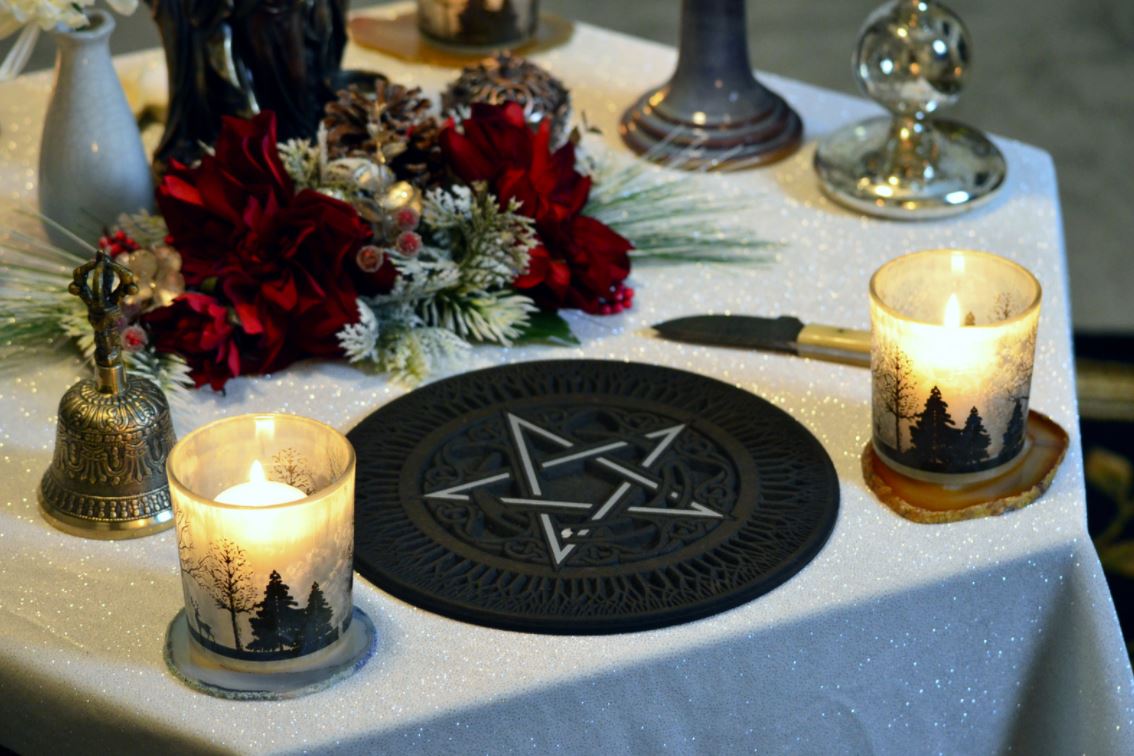
Look for a five-pointed star. In common modern Wiccan usage, the version enclosed by a circle is called a pentacle; terminology can also refer to an altar object. Elemental balance and spiritual belonging are familiar associations, but one diagram does not explain every use.

The US Department of Veterans Affairs includes Wicca (Pentacle) among its emblems of belief. That is a concrete example of religious identity. When studying a particular star, note its setting before assigning a meaning to its orientation.

2. Triple moon

Two crescents frame a central disc. Some modern Wiccans connect this design with the Goddess and the Maiden, Mother and Crone. You may find that life-stage language meaningful, or prefer to consider beginnings, fullness and release. A personal interpretation need not become a rule about anyone’s gender or life.

For a practical lunar starting point, explore our Moon phases and ritual guide.

3. Water

The elemental water sign in a commonly used triangle system points downwards. Water can become a prompt for noticing feelings, care or the need for a gentler response. Try writing, “What feeling needs a name today?” beside a paper sketch. You do not need to drink, mix or apply ritual water to use that question.

4. Earth

A downward triangle with a horizontal bar denotes earth in that same system. A useful personal association is steadiness: a meal, a comfortable place to sit, or one task you can finish. If you work with the symbol spiritually, connect the intention to something concrete you can care for.

5. Air

An upward triangle with a bar denotes air. Communication and thought are common modern associations. You might use a sketch before a difficult conversation, then write one sentence you want to say clearly and one question you are willing to hear answered.

6. Fire

An upward triangle without a bar denotes fire. Its energy can suggest initiative, warmth or change in a personal practice. Draw the shape and choose a small beginning: sending an application, tidying a work surface or making a kind invitation. A drawing can carry the intention without an open flame.

WaterDownward triangle
EarthDownward triangle with a bar
AirUpward triangle with a bar
FireUpward triangle

These four shapes are a reference to one system. Directions, colours and other correspondences can vary. The Covenant of the Goddess describes ritual tools as a shared symbolic framework and notes disagreements between some associations. Record the system you are learning rather than combining several charts without noticing.

7. Spirit or ether

Some systems add spirit to the four elements. There is no need to invent one universal glyph for it. Find out what your chosen source uses and why. In a personal notebook, “what connects these parts of my life?” can be a useful question, with the answer clearly labelled as your own reflection.

8. Crescent moon

A crescent is one curved lunar shape rather than the three-part moon design. It appears in many settings, so it should not identify a person’s religion for you. In a lunar practice, you can note the phase being observed and the intention you bring to it without claiming that it controls a relationship.

9. Goddess imagery

A figure, a lunar design or another image may represent a Goddess in a particular practice. Ask which deity or understanding of divinity is meant. The Covenant of the Goddess’s own overview offers one community’s nature-centred perspective; it is not a key to every image.

If a figure appeals to you, begin with a question such as, “What quality am I drawn to?” Learn its named context before adding it to an altar.

10. Horned God

A circle topped by curved horns is often labelled the Horned God in modern Wiccan guides. It may express a relationship with nature or a form of deity. Do not assume that every horned figure from every culture represents the same being. The specific image and the explanation of its practitioner matter.

11. Triskele or triskelion

This family of designs has three turning arms; a familiar version uses three spirals. Heritage Ireland identifies triple spirals at Newgrange, giving you a real place to begin a historical study. An old carved shape does not, by itself, prove the modern meaning assigned to it.

For a personal exercise, name three things you want to keep in balance. Label that grouping as your choice, rather than the original intention of an ancient maker.

12. Solar cross

A cross within a circle is often called a solar cross in modern symbol guides. A simple divided circle can invite a personal reflection on seasons or a cycle, but the geometry alone cannot establish its age or religious use. If you find one on an object, record the object and source before deciding what its quarters represent.

13. Hecate’s wheel

Modern guides use this name for a circular, maze-like design associated with Hecate. Be careful about turning a present-day label into an unsupported origin story. Ancient literary sources do address the goddess: Theoi provides translations of hymns and other texts. Those texts and a modern wheel design are different things to investigate.

If the image interests you, learn from a clearly identified devotional practice and note the source of its explanation. You do not need to copy an unfamiliar invocation to study the design.

14. Triquetra

A triquetra forms three interlacing arcs. Modern explanations give it different three-part meanings. Before calling one a Triple Goddess symbol, learn how that particular design is being used. You can also choose a personal grouping, such as care, honesty and patience, and write it beside your sketch.

15. Seven-pointed star

Count the points first: this is a seven-pointed star. You may see it described as a faery or elven star in modern guides. The label does not provide one fixed list of seven meanings. If your source assigns a set, record that set accurately; otherwise leave the association open rather than creating a universal rule.

16. Eye of Ra and Eye of Horus labels

Online charts can use Egyptian eye labels loosely. Identify the particular image and look for an object record. The Met’s wedjat eye amulet is described as the healed eye of Horus, associated in ancient Egyptian belief with regeneration and protection. That is a specific context, not evidence that a pendant guarantees safety.

Do not decide a deity or meaning from the direction an eye faces alone. A careful identification is more useful than repeating a confident caption.

17. Spiral

A line curling around a centre can suggest movement or returning to something with a different perspective. You might use a spiral in a journal to mark a lesson you are revisiting. That personal meaning is enough for the exercise; it does not need a claim that every spiral in nature or art encodes reincarnation.

Make a simple symbol study note

Choose one shape and give yourself a small, manageable practice. Sketch it on paper, write down where you found it, and separate the source’s explanation from your own response. Keep living trees, historic surfaces and other people’s belongings untouched.

If symbols appear during a psychic reading, ask about what the image helps you notice in your own choices. A thoughtful question leaves more room for insight than assuming the symbol proves what someone else feels. Our pre-reading guide can help you prepare that conversation.

Your symbol study note

Choose a starting point. Add an optional personal association, then copy the note into your journal and fill in a source you can check.


Choose a starting point to make a study note.

Questions about witchcraft symbols

1. What is the difference between a pentagram and a pentacle?

A pentagram is a five-pointed star. In much modern Wiccan writing, pentacle means that star inside a circle, although the word can also refer to an altar object and usage varies. Ask how a particular person or tradition uses the term.

2. Do all witches use the same symbols?

No. A symbol may belong to a named tradition, a modern personal practice or a different cultural setting. Learn the explanation given by its actual user rather than assuming that one chart applies to everyone.

3. Are the elemental directions fixed?

Directions and correspondences depend on the system being followed. Record the source of a particular arrangement. You can also study the elements through everyday observations without assigning directions or genders.

4. Does a triple moon mean the same thing as a crescent moon?

No. A triple moon combines two crescents and a central disc, while a crescent shows one curved lunar shape. Some practitioners give the triple design Goddess associations. A single crescent can have many religious, cultural or personal meanings.

5. Can a symbol guarantee protection?

A symbol can express a protective intention or remind you of a boundary. It does not establish that a situation is safe. Keep practical precautions and respect other people’s choices alongside your spiritual practice.

6. Is every three-part knot a Triple Goddess symbol?

No. A three-part shape does not identify its original meaning by itself. Find out who made the design, where it appears and how that source explains it before assigning a deity or an ancient history.

7. Do I need to buy or engrave something to begin?

No. A pencil sketch in a notebook is enough for a study practice. Leave living trees, historic objects and other people’s property untouched. You can add a personally meaningful object you already own if you wish.

8. How can I use a symbol during a psychic reading?

If a symbol catches your attention, bring a question about your own response: what does this image help me notice or express? Tell the reader any relevant tradition or personal association. The image alone does not establish another person’s feelings or intentions.

Understanding Beginning Witchcraft: A Clear First-Step Guide

Witchcraft

Beginning witchcraft can feel exciting and confusing at the same time. One guide tells you to buy tools, another tells you to follow the Moon, and a third presents a long list of spiritual labels. You do not have to settle every question before taking a thoughtful first step.

Start by noticing what draws you in. Perhaps it is the symbolism of a candle, a sense of connection outdoors, the language of tarot, or a wish to make everyday life feel more intentional. That interest can guide your learning without requiring you to promise a particular result or adopt someone else’s entire worldview.

A manageable beginning: Choose one question to study, keep a source notebook and try one simple, flame-free reflection. Give yourself permission to learn slowly and keep what you discover private if you wish.

What does witchcraft mean in this guide?

People use the word witchcraft in different religious, cultural and personal ways. Here, the focus is on beginning a personal practice of symbolic ritual, spiritual reflection and learning. This is not a claim that every tradition has the same beliefs or that a short introductory exercise grants access to every tradition’s rites.

Wicca is one modern Pagan religious path associated with witchcraft. It is not a label that every person interested in witchcraft uses. The Covenant of the Goddess’s Wicca FAQ describes its religious context and the variation among groups. Read such sources in their own context rather than treating one group’s practice as a rule for everyone.

For a broader look at identity and common stereotypes, see what it means to be a witch. The next steps here are about learning and beginning a practice.

Learn a few terms before collecting techniques

  • Intention: The purpose you bring to a practice. Writing it clearly helps you understand what you are choosing to do.
  • Ritual: A deliberate sequence of actions given meaning by a person or community. Its form depends on its context.
  • Correspondence: An association between a symbol or material and an idea, such as a colour representing an intention. Associations can vary between sources.
  • Divination: Practices for seeking or interpreting guidance through symbols, signs or tools. A reading is an interpretation, not access to another person’s private thoughts.
  • Book of Shadows: A name many practitioners use for a record of their study and practice. Follow your tradition’s use of the term, or simply call yours a journal.

You may also encounter the word energy. Ask what the writer means by it. In a personal journal, record the actual feeling or experience: alert, peaceful, distracted, emotionally moved, or something else. You do not have to assign yourself a vibration score or claim to measure a spiritual frequency.

Choose one starting point that interests you

Rather than choosing a permanent type of witch, choose an activity you want to understand. The following are starting points for study, not a personality test or a ranking of spiritual ability.

1. Symbol and intention

Explore why a particular word, image or everyday object feels meaningful. Learn where its associations come from.

2. Nature and season

Observe a tree, the changing daylight or your local surroundings. Keep notes without needing to gather plants or objects.

3. Divination and reflection

Learn one symbol or card in context. Compare an initial impression with the source’s explanation.

If you feel drawn to gods, spirits or a particular religious tradition, begin by learning from that community’s own explanations. Find out whether practices are openly shared, taught through a lineage or subject to specific expectations. You can be curious without claiming a tradition as your own immediately.

A first-week learning plan

This plan is flexible. Each part can take more than a day, and you can pause at any point. Its purpose is to move from collecting ideas to understanding what you actually want to practise.

  1. Write down your interest. Complete: I am curious about this because… Name one question you would like to answer. You might want to understand why a symbol keeps catching your attention, or how ritual fits with your beliefs.
  2. Read one source carefully. Note the author, title and tradition or perspective. Separate what the source teaches from what you personally believe. Write down an unfamiliar term instead of rushing to copy a whole ritual.
  3. Observe without forcing a message. Spend a little time with a symbol, an outdoor view or a quiet moment. Record what you noticed first, then any meaning you associate with it. Not every event needs a spiritual explanation.
  4. Try the simple reflection below. Use words and paper rather than adding unfamiliar ingredients. Connect your intention to one action within your control.
  5. Review and choose your next question. What felt useful? What was confusing? Would you like to repeat the practice, study another source or take a break? There is no requirement to make a purchase or choose a new identity.

Try a simple written intention

Choose a place where you can sit comfortably. Put a notebook or piece of paper in front of you. Settle your attention in whatever ordinary way feels comfortable; you do not need to create a special sensation.

Write an intention centred on your own choices. For example: I want to communicate with more honesty and care. Below it, write one small action: I will think through what I need to say before our next conversation. Read both sentences, then decide when you will return to the note.

You can regard that moment as sacred, reflective or simply intentional, according to your beliefs. The words mark your commitment. They do not require another person to reply, forgive or feel a certain way.

If you want to develop a more structured piece of spellwork later, use the spell-writing guide alongside what you have learned about your chosen tradition. If lunar timing interests you, the eight-phase Moon guide explains the cycle and offers a free way to check the current phase.

A free journal page you can copy

My question: What am I trying to understand?

My source: Who taught this idea, and in what context?

My intention: What am I choosing to practise?

What I did: What actually happened during the activity?

What I noticed: What did I see, feel or think?

My interpretation: What meaning am I considering, and what else could explain it?

My next step: What will I study, repeat, change or leave alone?

This page does not produce a psychic score or certify a result. It gives you a way to reflect clearly over time. A blank answer is useful too: it can show where you need more information.

Keep the practice within your means and comfort

You do not need to start with herbs, blades, smoke, a collection of crystals or an open flame. The budget witchcraft guide and free spending planner can help you consider supplies without treating shopping as proof of commitment.

Do not copy an unfamiliar recipe for burning, drinking or applying something to your body just because it is described as magical. Learn about the material and its intended use first. If a practice feels frightening, overwhelming or uncomfortable, you can stop; that feeling does not oblige you to keep going or pay someone to remove a supposed problem.

Learn from people without handing over your judgment

A book, class or group can offer context that scattered social posts lack. Ask practical questions before joining: What tradition is being taught? What are the costs? Can I observe before participating? How are consent and privacy handled? What happens if I decline an activity?

Be cautious about anyone who demands secrecy about mistreatment, pressures you into personal or sexual contact, or insists that only expensive work can prevent a disaster. Respectful learning leaves room for questions, boundaries and a decision to leave.

For your first week, one clear question and one manageable practice are enough. Let your next step come from what you have learned, rather than from pressure to prove that you belong.

Beginning witchcraft: common questions

1. Do I need to be born with psychic abilities to begin?

You can explore personal ritual, symbolism, journaling and spiritual study without claiming special powers. Curiosity and a willingness to learn are enough for these introductory activities; a feeling of connection is not a test you must pass.

2. Is witchcraft the same as Wicca?

Not always. Wicca is a particular modern Pagan religious path that includes witchcraft, while people also use witchcraft for other religious or nonreligious practices. Ask how a source or community uses each word rather than assuming everyone shares one definition.

3. Do I have to choose a type of witch immediately?

No. Labels can help you find topics to study, but you do not need to choose a permanent identity before beginning. Learn about one practice and its context before combining several traditions.

4. What do I need for a first practice?

For the simple reflection in this guide, use paper, a pen and a quiet place. No candle, herb, crystal, knife or special clothing is required. Formal traditions may have different requirements for their own rites.

5. Do I need to wait for a full moon?

Not for the introductory written practice here. Some traditions give lunar timing a spiritual role, but you can start learning, keeping notes and reflecting at a time that fits your life.

6. Must I tell everyone I am interested in witchcraft?

No. You can decide what to share, with whom and when. Consider your privacy and circumstances. You do not owe public disclosure, and keeping personal spiritual notes private is a reasonable choice.

7. Should I work alone or find a teacher?

Either can be a starting point. If you seek a teacher or group, ask about their tradition, expectations, costs, consent and privacy. You should be able to ask questions, decline an activity and leave without pressure.

8. What should I record in a Book of Shadows?

Record the source you studied, what you intended, what you actually did, what you noticed and what you want to understand next. Keep observations separate from interpretations so you can revisit them fairly.

9. What if I do not sense energy or see signs?

You do not need to force a sensation or treat ordinary events as messages. Note what you experienced without grading yourself. You can focus on study or a simple reflective practice, change your approach or take a break.

10. What if a spell does not bring the outcome I wanted?

Do not assume you failed or need to pay for a stronger ritual. Revisit your intention, the real-world circumstances and the actions within your control. Another person remains free to make their own choices.

How to Protect Yourself as an Empath: Practical Boundaries

Protect Yourself as an Empath

By Willette Moore

A crowded room, a difficult conversation or a stream of upsetting news can stay with you after the moment has passed. If you describe yourself as an empath, you may recognise the wish to stay open-hearted while having more room for your own feelings.

Protecting that room can be practical and personal. You might use a quiet spiritual image to mark a boundary, choose how long you can listen or plan a gentler transition after a busy day. Begin with what you can notice and choose, rather than trying to prove where every feeling came from.

You can care and still have a limit. Try: “I want to listen, and I have room for a short conversation now.” A limit does not erase affection. It makes what you can offer easier to understand.

Start with your experience, not a verdict about someone else

People use the word empath in different ways. Here, it describes feeling strongly affected by other people’s moods or the emotional atmosphere around you. Some readers connect that experience with intuition or spiritual sensitivity. You can explore that meaning while leaving room for uncertainty.

“I felt tense when the conversation became louder” describes an experience. “Their energy entered my body” is an interpretation of it. Keeping those two lines separate helps you decide what to do without treating your first impression as a confirmed fact about another person.

A headache, pain or feeling unwell is not proof that you have taken on someone else’s illness. Do not use an empath label to explain away physical symptoms that need attention. The same applies to a sudden uneasy feeling: it does not establish a prediction about what will happen next.

A simple before, during and after approach

1. Before

Name your capacity and one choice you want to keep available.

2. During

Notice what is happening and use a clear, manageable limit.

3. After

Let the event end and choose an ordinary act of care.

The aim is a plan you can use in an ordinary day. You do not need to become perfectly calm or identify every emotion before taking a small step.

Before: decide what you can comfortably offer

Think about the setting rather than giving yourself a permanent label. Is the difficult part the noise, the length of the visit, an uncertain expectation or a conversation you do not feel ready to have? A specific answer gives you more options than “I cannot handle people’s energy.”

  • At a social event: Decide how you will get home and whether a shorter visit would suit you.
  • Before helping a friend: Ask whether they want someone to listen or help with one practical task. Decide what you can actually offer.
  • At work: Clarify which task needs your attention first, and what can wait or be discussed with someone responsible.
  • Online: Choose when you will check a topic instead of leaving every notification open.

Leave a little space between demanding activities when you can. You might prefer a quiet journey home or a meal before another conversation. If plans change, you can revise the limit rather than treating the original promise as a test of how caring you are.

During: notice, check and choose

When you feel overloaded, begin with a plain observation: “The room is loud,” “I have been listening for a long time,” or “I am worried about what that message meant.” You do not have to decide that someone is draining you deliberately.

If it is comfortable, notice the support of your chair or the floor beneath your feet and let your breathing stay natural. Look at one ordinary object nearby. This can be a small pause in attention; it is not a requirement to create a special sensation or perform a breathing pattern perfectly.

Then choose a step that fits the situation. You might move to a quieter spot, ask to continue later, turn off a notification or ask what someone meant. If you cannot leave immediately, a smaller adjustment may still be available.

A caring limit with a friend:

“I hear how difficult this has been. I can listen for a little while, but I will need to stop after that. Would listening help, or is there one practical thing you want to ask me?”

You are offering something real without taking responsibility for the whole situation.

For the separate challenge of talking with a partner, the guide to sensitivity, clear requests and relationship boundaries offers more detailed examples. Use a question to understand someone, rather than assuming that a strong feeling tells you their private thoughts.

Give a spiritual image a practical meaning

If visualisation belongs in your spiritual life, you might imagine a soft outline around your personal space. Let it remind you of a choice: “I can listen without agreeing to everything,” or “I can decide when this conversation ends.” The image does not need to push anything back at another person.

Some people prefer a brief prayer, a meaningful object or a quiet request to their spiritual guides for wisdom. Choose something familiar and comfortable. There is nothing you need to buy, swallow, burn or apply to your skin for the practices in this article.

Treat the image as a personal reminder, not a guarantee that a person or place is safe. If a situation involves actual threats, coercion or mistreatment, practical support matters more than trying to make the visualisation stronger.

After: allow the conversation to finish

A person can remain important to you without having your attention all evening. Try writing two short lines: what happened, and what belongs to your next step. You might write, “My friend is upset about a change at work. I listened and offered to check in tomorrow.” That is different from spending the night trying to solve every possible outcome.

If the idea of cord cutting is meaningful to you, keep it symbolic. Picture placing the conversation in a notebook and closing it for now. No physical cord, scissors or flame is needed, and the image does not establish that you have altered someone else’s energy.

Choose an ordinary transition: change into comfortable clothes, prepare food, put your phone away or do something you enjoy. A gentle self-love ritual can be another way to pair kind words with one practical act of care, if that fits your beliefs.

Free boundary planner

Choose a setting. The planner gives you a before, during and after outline, with an optional action in your own words. It does not measure psychic sensitivity, diagnose a condition, judge another person or predict how you will feel. Your selection and text are not sent or saved by this planner.

Keep everyday care in the picture

The National Institute of Mental Health’s self-care guidance includes regular meals, sleep, relaxing activities, manageable priorities and connection with supportive people. Choose what fits your circumstances rather than turning self-care into another demanding project.

If distress keeps interfering with sleep, concentration or ordinary activities, consider speaking with a qualified health professional. You do not have to settle whether you are an empath before asking for support. Seek appropriate care for physical symptoms that concern you as well.

If you seek a psychic reading for spiritual reflection, you can ask about your own values and choices while keeping these everyday needs in view. The guide to preparing for a psychic reading helps you choose questions, privacy limits and a session budget. A frightening claim does not oblige you to pay immediately for additional work.

Being open-hearted does not require being endlessly available. A clear limit, a thoughtful pause and a small act of care can give your sensitivity a more comfortable place in daily life.

Questions about empath protection

1. How can I protect myself as an empath in a busy place?

Notice what feels difficult, choose a manageable amount of time and identify a quieter place or an exit if you need one. You can use a private spiritual image as a reminder, while still responding to the actual setting and your own needs.

2. Does a sudden change in mood prove I absorbed someone else’s emotions?

No. A change in mood gives you something to notice, but it does not establish where the feeling came from or what another person is thinking. Describe your experience first, then check what you can observe or ask.

3. Can a protection bubble guarantee that I am safe?

Treat a bubble or circle of light as a personal visualisation, if it is meaningful to you. It cannot establish that a person or situation is safe. Use ordinary boundaries and seek real help when you need it.

4. How do I care about a friend without taking over their problem?

Ask whether they want listening or practical help, and be honest about what you can offer. You can care about their experience without promising to fix it or making yourself available at every moment.

5. Is it unkind to say that I need a break?

A respectful limit can be kind and clear: I care about this, and I need to pause now. If you plan to return to the conversation, agree on a realistic time rather than promising availability you cannot offer.

6. Do I need crystals, salt, oils or a special purchase?

No purchase is needed for the practices here. A familiar object or an imagined symbol can remind you of your intention. You can also use a notebook and an ordinary practical boundary without any spiritual object.

7. What does cord cutting mean in this guide?

It means using a private symbolic image to mark the end of your attention to a conversation or concern for now. It does not require a physical cord, scissors, flame or a claim that you have changed another person’s energy.

8. What if I cannot leave an overwhelming situation immediately?

Look for a smaller choice that is available, such as reducing a distraction, asking for a brief pause or deciding which task comes first. Later, consider what support or adjustment would make a similar situation more manageable.

9. What should I do about physical symptoms or ongoing distress?

Do not assume that pain or feeling unwell is someone else’s illness passing into you. Seek appropriate health care for symptoms that concern you. If distress is persistent or interferes with everyday life, a qualified professional can help you consider support.

10. What does the free boundary planner tell me?

It suggests a before, during and after plan for the setting you choose, plus an optional action in your own words. It does not diagnose you, measure psychic sensitivity, score another person or promise protection. It does not send or save your entries.


How to Do Cheaper Witchcraft: A Practical Budget Guide

Witchcraft

A shelf full of crystals can be beautiful, but it is not an entry requirement for witchcraft. If you are drawn to spells, symbolism and intuitive practice, you can begin with what you already have and give each object a clear purpose. Your practice does not have to become another source of financial pressure.

The most useful question is not What does a witch need to own? It is What do I need for the particular practice I want to do? This guide helps you choose, substitute and plan without losing the sense of meaning that brought you to the craft.

Start here: Choose one intention, look through your existing supplies and try a simple practice before shopping. Keep food, rent and other essentials outside your ritual spending limit. A no-purchase practice is a valid place to begin.

1. Choose a practice before choosing supplies

Think of one thing you would like your practice to support: a calmer evening, a more deliberate morning, gratitude, or making space for a future relationship. Then describe a small ritual you could repeat. A written intention and a few quiet minutes may suit that purpose better than an elaborate spell kit.

For example, someone seeking more openness to love might write down the qualities they want to bring to a relationship, read the note during a weekly reflection and choose one respectful action for the week. The ritual marks their intention; the action could be accepting an invitation or practising a clearer boundary. There is no need to buy an object to represent another person’s feelings.

If you are still exploring the basics, the beginner’s witchcraft guide covers the wider subject. Here, keep the focus on making one affordable practice workable.

1. Use

Give an item you already own a clear symbolic role.

2. Adapt

Choose a simpler, flame-free or paper-based version.

3. Wait

Buy only when a real need remains after trying the practice.

2. Match the meaning, not the price tag

In a flexible personal practice, the meaning of an object can matter more to you than its appearance. A cup inherited from someone you love might feel more fitting than a new ornate chalice. Formal traditions can have specific teachings about their tools; learn those rather than assuming every ritual can be adapted in the same way.

Simple alternatives for a personal, non-heated practice
What you want to do Try what you already have What to keep in mind
Record spells and reflections A notebook, folder or private digital document Keep source notes, dates and your own observations together.
Create a place for intention A cleared shelf, tray or folded cloth Keep it stable, uncluttered and away from food preparation.
Represent light or warmth An existing battery candle or a drawing of a flame You do not need an open flame for a visual focus.
Represent a plant or season Your own drawing or photograph You can appreciate a plant without picking, burning or consuming it.
Set out a symbolic offering A clean cup or bowl used without heat Use an object suitable for its actual contents; clear it away afterwards.
Explore colour symbolism A coloured pencil mark or paper you own Write down what the colour means to you rather than buying every shade of candle.

A substitute should preserve the purpose without creating a new hazard. An ordinary food jar is useful for storing dry objects, but it should not be assumed safe for a flame or melted wax. A cooking pot is not an invitation to burn unknown mixtures. If a ritual depends on specialist equipment you do not have, choose a different ritual for now.

3. Build a small routine you actually enjoy

Repeating a manageable practice can help you discover what feels meaningful before you invest in more supplies. You do not have to follow every trend or decide on a permanent spiritual identity this week.

  1. Set your intention. Write one sentence about what you want to practise, such as making room for honest communication.
  2. Choose one object or symbol. Use a notebook, a drawing or another suitable belonging that reminds you of that intention.
  3. Make a little time. Try a few quiet minutes at a time you can reasonably repeat. A lunar occasion is optional if it is not part of your practice.
  4. Connect it to daily life. Choose a specific action: ask a thoughtful question, clear a neglected corner or put a boundary into words.
  5. Review without judging yourself. Note what you did, how you felt and whether you want to continue. A difficult week is not a reason to buy a stronger spell kit.

For help shaping the words and structure, see five steps for writing your own spell. Keep any relationship intention centred on your choices and mutual willingness.

4. Give your spending a clear boundary

Make two lists: needed for the practice I chose and interesting for later. Pause before ordering from the second list. You can enjoy beautiful tools without needing to own them immediately.

If your limit is zero, do not turn it into a challenge to find the cheapest purchase. Try a no-purchase version. If you do have room to spend, include delivery and tax when comparing the total. A large pack with a low price per item is not a saving if it costs more overall and most of it stays unused.

Free ritual-supply budget planner

Add up a small shopping list before you buy. Enter prices in one currency, with up to two decimal places. Use 0 for supplies you already own. Blank optional costs count as 0.

This is a spending calculation. It does not measure magical ability, predict results or convert currencies. The example is invented to show the maths; it is not a store price list. Nothing you enter is saved or sent by this planner.

Use each amount once: if an item price already includes tax or delivery, do not add that charge again.

Enter your spending limit and optional costs, then choose Show my budget.

To calculate on paper, add the three item costs, tax and delivery. Subtract that total from your spending limit. A negative answer means you need to remove or postpone purchases.


5. Save on learning without collecting everything

Look in your local library catalogue before buying a stack of books. You may find useful material on folklore, symbolism, gardening and the traditions you want to understand. Check availability and any borrowing conditions locally. Keep the author’s name and title in your notes so you can revisit ideas in context.

If someone offers to lend a deck or tool, agree how and when you will return it. A secondhand item can be meaningful too, but inspect its condition and intended use. Spiritual cleansing can be part of welcoming an object; it does not repair damage or establish that the material is safe for heat, food or skin.

You can also learn by comparing your own reflections over time. Record the practice, the action you took and what you noticed without turning every coincidence into a guaranteed answer. This leaves room for intuition while making your journal useful.

6. Keep inexpensive practice practical

Cheap should not mean improvised fire equipment or unidentified plants. For an easy starting point, keep this practice flame-free, leave unknown plants where they grow and avoid mixing ritual materials with things intended for eating or drinking.

If you do choose a real candle, the U.S. Fire Administration’s candle guidance recommends a stable holder, at least 12 inches of space from anything that can burn, and extinguishing it before leaving the room or going to bed. That distance is about 30 centimetres. Paper, dried herbs and altar cloths need to stay clear of a flame.

Read the love spell safety guide before adding more involved materials. When you finish, the spell-material disposal guide can help you think through what to keep, reuse or discard.

A simple practice for tonight: Write one intention on paper, choose one action within your control and put the note somewhere private. Return to it in a week. You can begin without a shopping trip.

Questions about affordable witchcraft

1. Can I practise witchcraft without buying supplies?

Yes. For a personal practice, you can begin with a spoken intention, quiet reflection and a notebook or scrap of paper you already own. A particular tradition may have its own requirements, so learn those before adapting a formal rite.

2. Does spending more make a spell stronger?

A higher price does not establish greater spiritual power. Choose items for their meaning, suitability and safe use rather than treating a costly purchase as proof that a ritual will work.

3. What should I buy first on a small budget?

First write down one practice you want to try and inventory your belongings. Buy only a genuinely missing item you can afford. A purchase is optional when a paper-based or spoken version serves your purpose.

4. Can a plain notebook be my Book of Shadows?

Yes. Use it to record intentions, sources, materials, costs and reflections. A simple notebook can be easier to maintain than an expensive journal you are afraid to mark.

5. Do I need a different candle for every intention?

Not for a flexible personal practice. You can represent an intention with words or a coloured drawing instead. If you follow a specific tradition, check its teachings rather than assuming every substitution is equivalent.

6. Can I use a flameless candle?

Yes, when light is serving as a visual focus in your personal ritual. It avoids the open flame. A flame-free choice is especially useful in a small or shared space.

7. Can a reused food jar become a candle holder?

Do not assume an ordinary jar can tolerate a candle or hot wax. Use a reused clean jar for dry, non-heated display or storage; choose a purpose-made holder if you use a real candle.

8. Are kitchen herbs automatically safe for ritual use?

No. A culinary ingredient is not automatically suitable for burning, skin application or pets. For a simple symbolic practice, draw the plant or leave a labelled ingredient sealed in its container.

9. Can I use a kitchen pot instead of a cauldron?

You can use a bowl as a non-heated symbolic vessel. Do not burn ritual mixtures in cookware or return contaminated equipment to food use. An expensive cauldron is unnecessary for a paper-based practice.

10. Is a secondhand ritual tool a bad choice?

A secondhand item can have personal meaning. Inspect its physical condition and suitability first. A spiritual cleansing ritual does not repair cracks, remove every contaminant or make an object heat-safe.

11. Is buying supplies in bulk always cheaper?

No. A lower price per item can still mean a larger total bill and unused supplies. Compare the amount you will actually use, storage, delivery and any tax before buying a larger pack.

12. How can I study without buying lots of books?

Check your library catalogue for relevant books and ask about borrowing options. Availability and fees vary. Keep source notes and borrow or preview a resource before deciding it deserves a place in your permanent collection.

13. What currency does the budget planner use?

It uses the currency you select: US dollars, Canadian dollars, British pounds or euros. Enter every amount in that same currency. Changing the label does not convert prices or use exchange rates.

14. What does money left in the planner mean?

It is your chosen spending limit minus the item costs, tax and delivery you entered. It is not money earned or a prediction of abundance. You can keep all of the unspent amount.

15. What if the planner says I am over my limit?

Remove or postpone an optional purchase, borrow a suitable item or choose a no-purchase practice. Recalculate before ordering. Do not increase your limit just because the shopping list is larger than expected.


Discover Your Soul Note: A Grounded Reflection Guide

Discover Your Soul Note Today

Some moments feel especially true to who you are: offering patient support, making something beautiful, speaking honestly or feeling quietly at home in your own company. The idea of a soul note can give you a gentle way to explore that feeling of recognition.

You do not have to uncover a secret code. Start with a quality you value and notice how it appears in your everyday choices. If you understand your soul as a connection to the Divine, you may hold that reflection as a spiritual practice. You can also use the language as a personal metaphor.

The starting question: When do I feel most aligned with the person I want to be? Look for an ordinary example before looking for a dramatic sign.

What does soul note mean?

There is no single shared definition across spiritual writing. Some writers use soul notes for personal messages or insights. Some sound practices use similar language for a tone a person finds resonant. Those uses are different, and neither needs to become a rule you must follow.

In this guide, your soul note is a working description of a quality you want to express. It might be kindness, courage, creativity or steadiness. A word like that is a starting point for reflection, not a fixed verdict about who you are.

For example, choosing courage does not mean you never feel afraid. It might mean you want to ask an honest question instead of pretending everything is fine. Choosing kindness need not mean agreeing to everything; a clear boundary can be kind to you and to the other person.

Notice, name and live your chosen quality

1. Notice

Recall a real moment when your actions felt meaningful.

2. Name

Choose a word for the quality you appreciated in that moment.

3. Live

Choose one small action that expresses the quality today.

Begin with a memory that feels comfortable to explore. Perhaps you listened without rushing someone, finished a creative project or made a decision that respected your limits. Write down what actually happened before deciding what it means.

Then name the quality. You can try a word and change it later. If several fit, choose the one you would most like to practise this week rather than trying to define your entire life.

Finally, turn it into an action within your control. A wish to express warmth could become a thoughtful message with no demand for a reply. A wish for steadiness could become taking time to consider a decision before answering.

Make room for intuition and questions

A phrase may arrive while you are quiet, reading, listening to music or talking with someone you trust. You can welcome that impression without assuming it must be obeyed. Ask whether it fits your values, the facts you know and the choices available to you.

Try keeping two separate notes: what I noticed and what I think it might mean. That leaves room for spiritual meaning and for changing your mind. The free journal template in the beginner guide offers a useful structure.

If you enjoy sound, you can listen to music you find comfortable while reflecting. You do not need to identify a special pitch, purchase a frequency recording or interpret a number as a medical finding.

Free soul-note reflection card

Choose a quality you want to practise and an area of life. The card will suggest one action and one question based on those choices. You choose the meaning; this is not a test of a hidden spiritual frequency. This tool does not save or send your selections.

Choose a quality and an area of life, then create your reflection card.

On paper, write your chosen quality, one action you can take and one question you want to reflect on afterwards.


Keep spiritual imagery separate from a physical cleanse

You do not need a detox, intestinal cleanse, restrictive diet or supplement to try this reflection. The National Center for Complementary and Integrative Health describes limited evidence for detox regimens and warns that some cleansing approaches can cause serious harm.

If language about light or renewal feels meaningful, you can use it as imagery. It does not establish that illness comes from spiritual impurity, that memories are leaving your cells as toxins, or that a physical body will stop ageing. For a health concern, speak with a qualified health professional.

You also do not have to relive painful experiences or forgive someone to participate. If reflection becomes upsetting, pause. Support from someone you trust, including a qualified therapist when appropriate, can be more helpful than pushing yourself through a spiritual exercise.

Bring the quality into a relationship without controlling the outcome

Your chosen word can guide how you show up with others. Courage might mean saying what you need. Kindness might mean listening without trying to fix everything. Steadiness might mean following through on an agreement you freely made.

These actions do not determine another person’s feelings. A warm message can still go unanswered, and a respectful conversation can reveal that you want different things. Your worth does not depend on receiving the response you hoped for.

If you would like to give your intention a more formal shape, the spell-writing guide can help you put it into words. Keep the purpose centred on your own choices and the other person’s freedom.

Return to the note without grading yourself

After trying one action, ask what happened. Did it feel natural, difficult or incomplete? What would you repeat or adjust? An uncomfortable moment does not mean you have lost your connection to yourself.

You may choose a different word next week, or keep the same one for a while. Let the idea remain something you can use with care: a reminder of the qualities you want to bring into everyday life.

Questions about discovering your soul note

1. What is a soul note?

The phrase has several spiritual and creative uses. In this guide, it means a quality or theme that helps you describe the way you want to live. It is a personal reflection, not a diagnosis or a test result.

2. Is my soul note a musical note or a frequency?

Some sound-based practices use similar language for a preferred tone. This guide does not calculate a pitch or frequency. You can enjoy music as part of reflection without treating a particular sound as proof of your identity or health.

3. Is a soul note the same as a soul urge number?

No. A soul urge number belongs to a numerology system with its own conventions. The reflection here does not use your name, birth date or a numerical calculation.

4. Do I need a detox or cleanse to find it?

No. This reflection needs no detox, fasting, intestinal cleansing or supplements. Cleansing regimens can carry health risks. If you have a health concern, discuss it with a qualified health professional rather than treating it as a spiritual blockage.

5. Does illness mean my vibration is low?

Illness does not establish spiritual impurity or a failure to think positively. A soul-note exercise cannot assess or treat a medical condition. You deserve care and respect whether or not you feel energetic, cheerful or spiritually connected.

6. What if I feel anger or sadness during reflection?

You do not have to turn every feeling into a positive message. Name what you notice, pause if you want to, and consider what support or practical response you need. Feeling difficult emotions does not make you less worthy.

7. Do I have to forgive someone to reconnect with myself?

No. This practice does not require forgiveness, renewed contact or reliving painful events. You can choose a boundary and seek support while deciding what, if anything, forgiveness means to you.

8. Will finding my soul note attract a particular person?

It cannot guarantee another person’s feelings or a relationship outcome. Use your chosen quality to guide your own actions, such as communicating clearly or respecting a boundary, while leaving the other person free to choose.


Can a Psychic Help You Find Love? Questions, Choices and Next Steps

The Psychic Way of Finding Love

By Willette Moore

When you want love, uncertainty can feel louder than everything else. You may wonder whether to try dating again, why a familiar pattern keeps returning or whether a connection has room to grow. If psychic readings are meaningful to you, a thoughtful conversation can give those questions a place to unfold.

The useful part begins with your own life: what you value, what you have noticed and what you can choose next. A reading may offer a symbol, an intuitive impression or a different way to frame a question. Let it start a reflection that you can bring back to the people and circumstances in front of you.

Bring a question you can live with after the session.

“What would a caring, mutual relationship look like in my everyday life?” gives you something to explore. You can take that question into dating, a conversation or your journal without waiting for a prediction to come true.

What a love reading can help you explore

Some readers use tarot or oracle cards; others describe intuitive impressions, spiritual guides or energy. You can ask how they work and decide whether that approach suits you. You do not need to share every belief to consider whether an idea helps you understand your own priorities.

For example, a card associated with balance might prompt you to notice that you always arrange the plans. The useful follow-up is concrete: would you like a partner who also initiates time together? What would you want to ask for? The image has given you a question, while the relationship itself provides the information you need.

  • Your hopes: Do you want companionship, commitment, more honest communication or time to recover after a breakup?
  • Your patterns: Are you overlooking inconsistency, agreeing too quickly or making more space for someone else’s wishes than your own?
  • Your choices: Is there an invitation you want to accept, a conversation you are ready to have or a boundary you want to keep?

Keep the focus gentle. A pattern is something to examine, not proof that you caused another person’s unkind behaviour or that your energy needs to be fixed before you deserve love.

Separate an impression from what you know

1. The impression

What idea or symbol did the reading offer?

2. The information

What have people actually said or done?

3. Your choice

What respectful next step is yours to take?

Imagine being told that someone you like is afraid of their feelings. You might find the idea comforting, but it does not establish why they have not replied. The information you have is that the message is unanswered. Your next choice could be to give it space and return to your own plans, rather than treating silence as hidden commitment.

The same care applies to descriptions of a future partner, a meeting place or a date. You can enjoy the imaginative possibility without organising your life around it or dismissing a promising person because they do not match a description. Compatibility grows clearer through mutual interest, consistent behaviour and time together.

Choose a question that fits your situation

If you are ready to date

Ask what qualities you want to offer and receive in a relationship. Give each quality an everyday meaning. “Kindness” could mean listening when you disagree; “reliability” could mean following through on a plan. Choose an enjoyable way to meet people rather than searching every encounter for a promised sign.

If the same disappointment keeps returning

Take one actual example into the conversation. Perhaps you keep saying that last-minute cancellations are fine when they leave you feeling unimportant. Explore a response you would feel comfortable using next time. You can learn from a pattern without accepting a sweeping verdict about your worth or destiny.

If you are unsure about an existing connection

Write down what feels good and what remains unclear. Ask what you want to communicate, rather than asking a reader to decide whether the other person is secretly “the one.” The boundary guidance from love is respect can help you think about expressing your needs and respecting another person’s limits.

If you are moving on

You may want a reading to help you name what you are leaving behind and what you want to care for now. You do not have to turn grief into a lesson immediately. A useful next step could be an ordinary plan with a friend or keeping a contact boundary, rather than trying to establish when an ex will return.

For more prompts, see questions to ask a psychic about love. Choose one that matters to you instead of trying to cover your whole future in one session.

Free love-reading question planner

Choose the situation closest to yours. The planner offers one question, a way to check it against everyday information and a next step. It does not predict love or calculate a score. Your selection is not sent or saved.

Choose a reader with room for your own decisions

Before booking, check the service, total price, session length and payment terms. Ask what happens when the time ends and how to stop. If a price is charged per minute, decide how much time and money you are comfortable spending before you begin. The guide to preparing for a psychic reading includes a session-budget tool and ways to choose privacy limits.

You can keep identifying details about a partner or someone you are dating private. A reader does not need access to your accounts, private messages or financial credentials to discuss a love question. If you invite your partner to a reading, agree on the topic together and leave each person free to decline.

Be careful when a claim creates an urgent demand for money: a curse must be removed today, a soulmate will disappear unless you buy more work, or only one reader can save the relationship. The Federal Trade Commission’s scam guidance describes pressure to act immediately and demands for particular payment methods as warning signs. Pause, check the terms and speak with someone you trust before paying.

If karma or spirit guides are part of your beliefs, you can reflect on those ideas without treating a claim about them as proof of why you are single. You are allowed to ask questions, disagree with an interpretation and leave a session without buying anything else.

Bring the reading back into your life

Afterwards, make three short notes: an idea worth considering, what you actually know and an action you can choose. You might decide to make your dating profile more honest, ask for a clearer plan or spend an evening doing something you enjoy.

Notice whether the reflection leaves you more able to make your own choices. If you find yourself seeking repeated answers about the same person, give yourself a pause before booking again. Love can matter deeply without every uncertain moment needing another reading.

You can welcome spiritual insight and still let a relationship reveal itself through mutual care. Keep your own voice in the conversation, and choose a next step that makes sense in the life you are living now.

Questions about psychic readings and finding love

1. Can a psychic find my future partner for me?

A reading can be a space to explore what you want and the choices available to you. A description, name or date offered in a reading does not establish who your future partner will be. Get to know people through actual communication and shared experience.

2. What is a useful question to ask about finding love?

Try a question about your own choices, such as: What kind of partnership do I want to build, and what would help me recognise mutual interest? You can discuss the symbols or impressions that arise without treating them as instructions you must follow.

3. Can a love reading tell me what someone secretly feels?

Do not treat a reading as confirmation of another person’s private feelings or consent. Notice what they actually say and do. When an appropriate conversation is possible, ask clearly and leave room for an answer you may not have hoped for.

4. What if I am told that past-life karma is keeping me single?

Karma may be part of a reader’s spiritual framework, but a claim about it is not a demonstrated explanation for your relationship history. Being single does not prove that you are spiritually at fault. You do not have to buy additional work to earn the possibility of love.

5. Can I bring my partner to a reading?

You can invite them if they freely want to take part. Agree on the topic and what stays private beforehand. A shared reading is not a substitute for listening to each other, and one person’s interpretation should not be used to overrule the other’s boundary.

6. How do I choose a reader for a love question?

Look for a clear description of the service, its full price, session length, privacy terms and how to end the session. Choose someone who leaves room for questions and your own decisions. You can decline urgent extras or stop a session that becomes frightening or pressuring.

7. Should I get another reading if the first one is confusing?

Give yourself time to consider what was said before spending again. Separate useful reflections from predictions or claims you cannot check. Repeated readings are not required to make a relationship happen, and different answers do not create an obligation to keep paying.

8. Does being single mean that I have failed to be positive enough?

No. Relationships depend on circumstances and more than one person’s choices. You can feel disappointed and still deserve affection and respect. A spiritual practice should leave room for your actual feelings rather than making every difficult day your fault.

9. What should I do after a reading?

Write down one idea you found useful, what you can actually observe and one action within your control. That might be attending an activity you enjoy, asking an appropriate question or keeping a boundary. You do not need to act on every interpretation.

10. What does the free love-reading planner do?

It suggests a reflective question, a reality check and a practical next step for the situation you choose. It does not read another person, predict a relationship, measure compatibility or recommend a paid service. Your selection is not sent or saved by the planner.


An Ancient Coptic Love Spell: Reading Yale’s Papyrus

Spells that Attract Women in Your Life

An ancient love spell can make the past feel surprisingly close. Someone wanted affection, words were written down, and a small object carried a large hope. If you are drawn to spiritual traditions, an old charm can be an invitation to look carefully at how people expressed longing.

The interesting question is more than “Would it work for me?” What has survived? What did the text promise? What can we learn without filling the gaps with a love story we do not actually know?

Start with the object, then ask your questions

This guide concerns one particular papyrus in Yale’s collection. Read it as a historical text. Its instructions and promises do not establish what happened to a real couple.

Meet the papyrus

Yale’s Coptic Magical Papyrus entry identifies an Egyptian papyrus in the Beinecke Rare Book Library as P.CtYBR inv. 1791, dating to the sixth–seventh centuries CE. It describes two spells: one concerning a singing voice and another concerning love.

1. An object identifier

1791 identifies the object. It is not a year.

2. An approximate period

Sixth–seventh centuries CE is an approximate dating range. CE means Common Era.

3. A written language

Coptic is this text’s language. Some individual readings remain uncertain.

4. Two different aims

Voice and love are different aims on the same object.

Separate a written promise from a known result

A recipe tells us what its writer wanted someone to do or expected to happen. It does not, by itself, tell us that anyone tried it, who they were or whether they obtained the result they wanted.

Imagine finding a folded wish in a second-hand book. You could read its words and describe the handwriting. You could not reconstruct the writer’s whole relationship from that page alone. The same distinction helps when reading an ancient charm, even though the object and its setting are different.

You can be interested in the spiritual meaning of a text while keeping those questions open. Curiosity does not require you to supply a success story.

What a close reading adds

In her discussion of this love charm, scholar Jennifer Cromwell explains its instructions, invocation and spaces for names. The placeholders do not identify a known petitioner or woman. She also discusses uncertainty around a word that should not simply be presented as the name of a Greek plant.

This is a useful reminder to slow down when a modern account supplies an ingredient list with complete confidence. A proposed reading of a difficult word and a verified identification are different things. A modern spelling that looks familiar is not enough to make something suitable to collect, burn or consume.

The charm also contains coercive wishes. Describing those wishes accurately does not require treating them as a model for your own relationships. You can ask how a text imagines desire while still caring about the choices of a real person today.

A wider Coptic context

In her introduction to Coptic love spells, scholar Roxanne Bélanger Sarrazin places such texts among a wider range of surviving magical materials. She discusses Coptic as the latest stage of ancient Egyptian and shows how Christian and earlier religious elements can appear together.

A familiar modern label may therefore leave out more than it explains. Instead of deciding that every old charm belongs in one simple category, ask about the particular object, its words and its setting. Be careful, too, about treating a second artifact mentioned in an article as if it were this papyrus.

Free artifact-reading card

Choose what you want to practise as you read. The card explains that choice, gives an example and suggests a question or action. It works on this page without sending or storing an entry. There is no score, prediction or paid step.

Try a small reading exercise

  1. Write what you can point to. Record an object detail or a statement in a named source. Keep its link with your private note so you can return to it.
  2. Label an interpretation. If you write “perhaps” or “may,” keep that uncertainty in the note rather than removing it later.
  3. Leave one question open. “Who used this?” is a worthwhile question even when the available source does not answer it.
  4. Choose your own response. You might feel curiosity, discomfort, recognition or more than one of these. Your response matters as a response; it does not reveal an unknown person’s biography.

For example, “The writer wanted a particular response” and “The other person wanted the same relationship” are not interchangeable statements. Keeping them separate makes a reading more thoughtful.

Bring the reflection back to your own choices

If the papyrus leaves you thinking about a current relationship, begin with something you can know: what has actually been said, whether contact is welcome and what you want to bring to a connection. An old template cannot answer those questions on another person’s behalf.

The love-spell ethics guide explores mutual choice and boundaries. If you would prefer a simple personal practice, the white-magic intention guide connects a private wish with an ordinary action. The relationship-values planner helps you turn a quality you care about into an everyday example.

There is room to appreciate a striking historical object without using its coercive language as a personal instruction. Let the papyrus deepen your questions about longing, belief and how people express hope. Let your own next step leave room for a freely shared answer.

Frequently asked questions

1. What is the Yale love-spell papyrus?

It is a papyrus in Yale’s Beinecke collection, identified as P.CtYBR inv. 1791. The museum describes a singing-voice spell and a love charm.

2. Is 1791 the year the spell was written?

No. It is part of the object’s inventory identifier. The approximate period in the museum record is not an exact writing date.

3. What does CE mean?

CE stands for Common Era, a way of labeling calendar years. The sixth and seventh centuries CE correspond to the years 501–700. That range describes the dating period, not a known birthday or event.

4. What language is the text written in?

The text is in Coptic. Scholar Roxanne Bélanger Sarrazin describes Coptic as the latest stage of the ancient Egyptian language. A modern translation involves interpretation; unfamiliar words are not automatically ingredient names.

5. Who was the woman the charm was meant for?

The surviving template does not identify a particular couple. Jennifer Cromwell explains the name placeholders in her discussion. They leave space for names rather than revealing a documented love story.

6. Does the papyrus prove that a love spell worked?

No. The survival of an instruction is evidence that the text existed, not that its promises happened. Keep the text’s intended effect separate from a documented outcome.

7. Can I follow the ancient recipe today?

This guide treats the text as a historical object, not a set of instructions to carry out. You can explore its language, setting and questions without collecting its materials or involving another person.

8. Was aspartos definitely a plant?

Cromwell discusses uncertainty in that reading and the possibility of a word related to bitumen. It should not be turned into a confident plant identification or a modern ingredient recommendation.

9. Is this an example of every kind of ancient love magic?

No. One object cannot represent everyone in a place, period or tradition. Other texts may have different aims and settings. Ask which particular source supports each claim before generalizing.

10. How can I use the free reading card?

Choose whether you want to record a fact, identify a claim, ask an open question or make a present-day reflection. The card gives a plain-English explanation and a small next step. It does not interpret your romantic future.

Using Techniques to Change Your Mindset

Change Your Mindset

There are different techniques that you can use to change your mind and to help you to embrace your psychic giftings. These things can help you to meditate better and help you to be stronger in all that you do.

Some psychics will see that they have these special abilities even when they are a child. They can talk with the spirit world and see things around them that others cannot see.

Alpha Mind

The alpha mind is measured in the EEG where the mind will go 14 to 7 different cycles each second. This is how your brainwaves move and how the alpha brain will come. Most people lose their alpha brain past age 7 and this is a time when the brainwaves will get faster, and the thinking skills will become stronger.

Once you learn how to slow your mind down and to stay calm, you can figure out how to train your brain. Psychics are able to manage their brain through their alpha waves. They can do this without realizing that they are increasing their giftings.

The brain waves of the alpha will open up the mind and will help you to be more creative. It will help you to find life full of coincidences and synchronicities.

One of the best ways that you can increase your giftings is to learn how to keep your mind in the alpha state. You can train your mind to help you to increase your giftings and this can be done with hypnoses and other techniques.

Being in a semi-hypnotic state can help you to get information that can help you to build your subconscious mind. You can see that you can reach your alpha state and you can use mind techniques to help you to move forward in your life and your gifts.

Formulating different alpha techniques can help you if you have clairvoyance as a gift. This can help you to function better and to live a happier life.

Meditation Tips

If you want to reach your alpha state of mind, there are different things that you can do in order to be stronger in your giftings.

Meditation with Red

Imagine that you see red coming all through your body and from your body. Imagine that the color absorbs every part of your being.

Breathe deeply and let the color embrace you while you talk about reaching our alpha mind.

Orange

Imagine that you are seeing the color orange running through you. Imagine it filling your whole body.

Yellow

As you breathe deeply, imagine the color yellow coming out of all parts of your body and filling your room.

Green

Let the green color come from the bottom of your feet to the top of your head. Imagine the color going all over your body.

Blue

Let the blue color embrace you and flow through your body as you absorb it. Imagine a blue mist around you.

Purple

Imagine that a purple mist is covering you all over your body and is coming as you breathe in and out.

Violet

Let the color violet come up from your feet and out of your belly. Imagine a mist around you covering you.

Relaxing

Make sure as you are imagining the colors that you relax and that you keep your eyes gently focused on what your mind is imagining.

Alpha Meditation

When you use the alpha state of mind tips you can reach a place that helps you to meditate and have all the power that you need to be strong.

Alpha State

You can know that you are in an alpha state when you find that you can meditate and be calm. You can also get an EEG machine and use the band to tell you where your brainwaves are.

Muse Brain Sensing

You can find a Muse Brain sensing headband if you look online. These can come with different sounds like ocean sounds that allow you to wonder into a state of mind that is beyond where you are.

Pay attention to your progress and make sure that you are finding the right products to help you reach where you want to be.

Letting Go of Unrequited Love: Gentle Rituals and Practical Steps

No Need for Love Spells

Letting go can feel like putting down a future you had already begun to imagine. Perhaps you hoped a friend would become a partner, or you kept waiting for an old relationship to return. Knowing that the affection is not shared does not make your own feelings disappear on command.

You do not have to become colder or stop believing in love. For someone who values spiritual practice, a gentle ritual can give the transition a shape: a page to write on, a small choice to mark and a moment to turn toward your own life again.

You can care and still step back

Letting go means releasing the effort to obtain a relationship that the other person is not choosing. It does not require you to erase every memory, feel grateful for rejection or stop being sad by a particular date.

Begin with the information you actually have

There is a difference between a clear no and a situation you have never discussed. If contact is welcome and the relationship is genuinely uncertain, a simple, respectful question may clarify matters. If they have already declined, are unavailable or have asked for no contact, you have information to respect.

Try not to explain a rejection as a hidden spiritual test you must overcome. Nor do you need to decide that the person is cruel because they do not share your feelings. You can wish them well while deciding not to keep pursuing the connection.

Real relationships can face distance, practical difficulties and complicated circumstances. The useful question is whether both people freely want to work through those circumstances. Your devotion alone cannot make that a shared decision.

Four ways to make room for yourself

1. Name what you are losing

It may be a person, a routine, a hoped-for future or the feeling of being chosen. Naming it can help you choose the kind of support you need.

2. Put one reminder away

Move a photograph, mute an update or close an old conversation. Choose a reversible change if you are not ready for a permanent decision.

3. Keep a boundary

Respect any request for space. Decide what you will do when you feel tempted to send another message or check for a sign.

4. Return to one part of your day

Make a meal, finish a small task or spend time with someone you trust. The action can be ordinary and still matter.

A simple paper ritual for release

Find paper, a pen and somewhere you can sit comfortably. If you like a symbolic light, use a battery candle. There is no need for oils, smoke, a flame or an object that belongs to the other person.

  1. Write what you hoped for. Use plain words. “I hoped we would become a couple” is enough.
  2. Write what you know now. Keep it to what has been communicated, without inventing a hidden explanation.
  3. Name what you are choosing to release. For example: “I am putting down the habit of waiting for a message that has not been promised.”
  4. Name what you are keeping. It could be your capacity to care, an interest you rediscovered or a wish for a mutually available relationship.
  5. Fold the page and close the practice. Put it in a private drawer or recycle it when you choose. Nothing needs to be burned, buried or left outdoors.
  6. Take one ordinary action. Drink some water, open a book, take a familiar walk or contact a friend. Let the next part of the day begin.

If a visualization suits you, picture placing the expectation of a relationship on a shelf and walking back into your own day. You are choosing where to place your attention, not claiming to cut a dangerous invisible attachment. Stop or change the image if it makes you uncomfortable.

Free worksheet: a clear next step for today

Copy these five prompts into your notebook. The result is a short personal plan, not a healing score, a romantic prediction or a promise about when you will stop missing someone.

  1. What I feel: Name one feeling without judging it.
  2. What I know: Write one fact about the contact or relationship.
  3. What I will respect: Name a boundary for your own behaviour.
  4. What would help today: Choose one manageable activity.
  5. Who I can turn to: Name someone safe to ask for company or support.

Example result: “I feel disappointed. They said they do not want to date. I will not send another romantic message. Tonight I will make dinner and ask a friend whether they have time to talk.”

If you want a guided version, the free specific-person reflection planner offers different next steps for mutual interest, uncertainty, rejection and a request for space. Choose the description closest to what the other person has actually communicated.

Handle reminders without rushing yourself

You do not have to discard every photograph or gift in one evening. Try putting difficult reminders out of everyday view. A box can wait in a cupboard while you decide what you want to keep. Keep belongings that are not yours safe and handle any necessary return as a practical matter.

Digital reminders deserve the same thought. You might mute a profile, stop rereading a conversation or move a folder away from the place you open every morning. Choose a boundary that reduces the habit of checking, rather than a dramatic gesture designed to make the other person respond.

If you work together, share a friendship group or have ongoing responsibilities, a total disappearance may not be practical. Keep necessary exchanges clear and limited to the matter at hand. You can decline private emotional conversations while remaining courteous.

Keep spiritual practice gentle and simple

Some people find comfort in a prayer, a familiar symbol or a quiet moment at an altar. Let that practice support the boundary you have chosen. You do not need to buy a stronger ritual because you had a difficult evening.

A candle should never be left burning unattended or treated as something that must burn completely down. The National Candle Association’s safety guidance explains these limits. The paper ritual above works as a complete practice without a flame.

If you already have spell materials to clear away, use the guide to respectful disposal. Do not burn or scatter unfamiliar substances, and do not leave wax, stones or other objects in a field or waterway.

When the feeling returns

A favourite song or an unexpected encounter may bring the longing back. That does not undo a boundary you have kept. You can say, “I miss them today, and I am still choosing not to pursue a relationship they have declined.” Both parts can be true.

Choose support that fits the moment. You might want company, a distraction or someone who can listen without turning the situation into a prediction. A trusted friend can help with those ordinary needs. If distress is making daily life difficult, professional support is also an option.

There is no obligation to start dating immediately. Make room for interests, friendships and plans because they belong in your life, not because they are a tactic to attract the person back. When you do want to meet someone new, allow that connection to develop on its own terms.

For a broader spiritual practice, the intention-to-action guide includes release and new-beginning prompts. You can begin with one small choice and let the rest of your story remain open.

Frequently asked questions

1. Does letting go mean my feelings were not real?

No. You can acknowledge genuine affection while accepting that a relationship is not available. Letting go concerns the choices you make now, not proving that you never cared.

2. Can a ritual make me forget someone?

A ritual cannot promise to erase a memory or feeling. You might use it to mark an intention, put a reminder away or choose how to respond when you miss the person.

3. Do I need a final conversation for closure?

Not always. If a person has declined contact, respect that boundary. You can write an unsent letter, speak with someone you trust or decide what you need to do without obtaining another answer.

4. What if we work together or share responsibilities?

Keep necessary contact focused on the practical matter. Decide what you need to discuss, which channel to use and what can wait. You can keep emotional distance without making routine cooperation hostile.

5. Do I have to throw away gifts and photographs?

No. You can put reminders in a box or move photographs out of everyday view while you decide. Do not destroy or discard someone else’s belongings. Arrange any necessary return without using it to pressure them into a relationship.

6. Is a cord-cutting ritual required?

No. Some people like the symbolism of releasing a connection, while others prefer ordinary writing or a quiet pause. Nothing requires a literal cord, blade, flame or belief that a dangerous bond exists.

7. Do I need to wait for the waning moon?

You may choose a moon phase that has meaning in your own practice. You can also begin on an ordinary day. A date does not determine how quickly your feelings will change.

8. Should I use forget-me oils or burn a candle completely?

Neither is needed for the paper practice here. Do not apply an unknown ritual oil to your skin or assume every candle should burn down completely. A written intention or battery candle can provide a symbol without those steps.

9. What if I still miss them after the ritual?

Missing them does not mean you failed or need a stronger spell. Notice the feeling, return to the boundary you chose and take one manageable action for your own day.

10. How soon should I start dating again?

There is no required deadline. Ask whether you want to meet someone new for their own sake and whether you can be honest about what you are ready for. Taking more time is an option.

11. Can a psychic tell me whether I should keep waiting?

A reading may give you questions to reflect on, but it cannot replace the other person’s freely expressed answer. Do not use a prediction to override a rejection or a request for no contact.

12. When is it useful to ask for more support?

You can ask a trusted person for support whenever you want company or perspective. If the distress is making everyday life difficult, consider speaking with a qualified mental-health professional rather than relying on a ritual alone.

Should I Use a Love Spell

Love Spell

Love spells are effective when you convert your sincere affection into magical power.  Love is a team sport that requires both parties’ freewill and hard work.  In order to produce a successful outcome, it is important that you ensure the following points below:

  • Have pure love for your significant other
  • Be grateful for their love
  • Be willing to spice up your relationship as need
  • Frequently show how much you care about them
  • Be thoughtful
  • Be respectful and supportive
  • Frequently help your partner with daily chores
  • Do you best in all facets of the relationship
  • Put effort into looking good for you both
  • Treasure your relationship and never forget how fragile it can be at times

You risk breaking a love spell if you act in any of the following ways:

  • Selfish and extremely stubborn
  • Act unfaithfully or jealous
  • Frequently blame them for your issues and missteps
  • Constantly criticize and/or humiliate them
  • Give up on working on your self-growth
  • Ghost them

When habitually act in toxic patterns, even the most powerful spell with come undone in under a month!  Your intended my still be attracted to you and respond favorably to your kind words or deeds, but this won’t be true love.  Even if you try to fix your wrongs, it will be too late and the relationship will continue to erode until one day you part for good.

Therefore, it is essential people only use love spells when they can accept full responsibility for their actions, their loved ones, and fight for a lasting love.  Sure, some greedy false psychic can claim they can help you fall in love with anyone without putting in hard work.  But this is similar to undertaking a spiritual kidnapping.  You may “have” this person in your life, but it is by force rather than true interest.  How long do you think this person would stay with you if giving back the power of freewill?  Inevitably if they don’t want to be a part of your life, they will find a way to leave it!  The Higher Powers in the spiritual realm are taking notice of your selfishness and will find a way to punish you accordingly, most likely resulting in you losing everything you hold dear and winding up alone and miserable.

It is important to always keep in mind that any black magic spell will fade much faster than any white magic ritual.  Moreover, white magic is considered safe, as supposed to black magic which can endanger both target and practitioner.  Also, those conducting black magic won’t warn their clients about the rituals’ risks for fear of losing money or power.  If you are ensuring your love spell involves white magic, it is helpful to renew your spell every few years and to use protective charms like amulets and talismans to ensure the health of the relationship for decades to come.  You can have love in your life with your true love as long as pure love resides in both your hearts, as this enduring love is the driving presence in any love spell.