

Home Blog

Love Spell Ethics: Consent, Boundaries, and Free Will

0
Two consenting adults, a woman with auburn curls and a dark-haired man in their thirties, sitting comfortably across a small round table, engaged in an equal respectful conversation

Love spell ethics starts with a simple limit: a meaningful ritual is not permission to control another person. You can use spiritual practice to explore hope, confidence and grief while leaving someone else free to choose a relationship—or decline one.

This guide treats love spells as spiritual or symbolic practices, not a proven way to change another person’s feelings. No ritual guarantees attraction, reconciliation or commitment. The practical question is whether your intention and your actions respect consent, privacy and real-world boundaries.

Consent is the starting point

Consent involves a freely given agreement, not silence, pressure or an assumption based on past affection. RAINN’s consent guidance explains the importance of clear communication and the freedom to change one’s mind. Its guidance concerns sexual consent; this article applies the broader ethical principle of respecting choice to spiritual practice.

You do not need permission to have a private feeling or write in your own journal. But private hope does not authorize using someone else’s belongings, sharing their personal information with a reader, or demanding a response. A person who once wanted a relationship can choose not to continue it.

Compare two intentions: “Help me communicate honestly if we both want contact” leaves room for choice. “Make this person obsessed and unable to leave” treats choice as an obstacle. Even without evidence that a spell can produce either result, the second intention can encourage unhealthy behavior in the person performing it.

Three areas of responsibility

Your choices

Confidence, honesty, patience, reflection and how you respond to disappointment are appropriate personal intentions.

Shared participation

A couple can choose a ritual together. Agree on its purpose, materials and limits. Either person can stop.

Another person’s decisions

Their attraction, privacy, relationships and decision to leave remain theirs. Do not try to bypass these limits.

Boundaries outweigh signs and predictions

A repeated number, vivid dream or hopeful reading can feel personally significant. It cannot tell you that someone has consented to contact. If a person has blocked you or requested space, do not use another number, a friend’s account or an unexpected visit to get around that boundary.

Love is respect distinguishes boundaries from relationship expectations and emphasizes communicating what makes each person feel respected. In practice, ask rather than assume—and accept an answer you do not prefer.

Keep two separate records if symbolism is important to you: what an experience means to you, and what the other person has actually communicated. The first belongs in reflection. The second governs whether you should approach them. When consent is unclear, do not escalate romantic or physical contact.

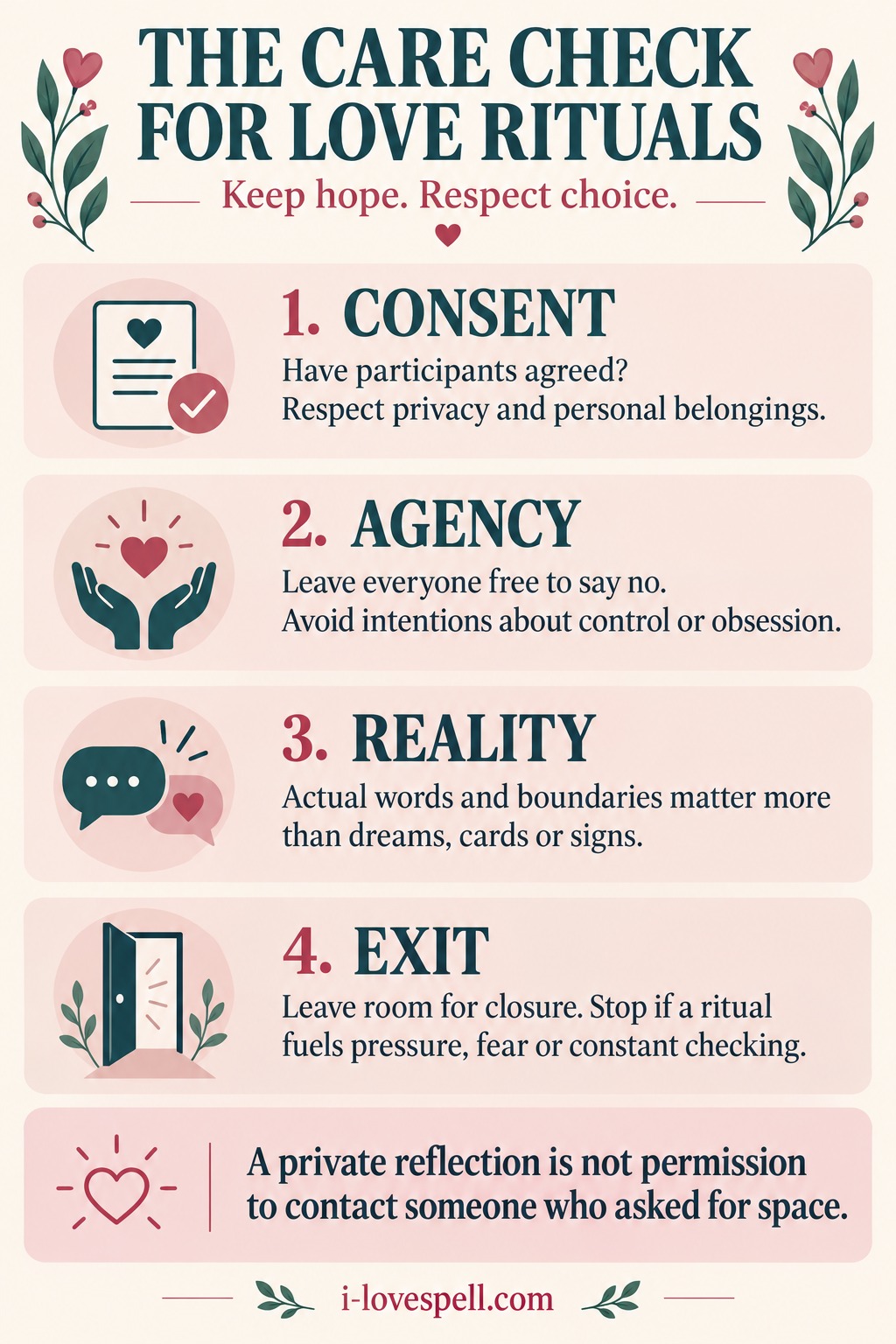
The CARE check for love spell ethics

Use this editorial checklist before a ritual. It is a reflection aid, not a scientific assessment.

  1. Consent: Has anyone actively participating agreed, and have you respected privacy?
  2. Agency: Does the intention leave every person free to say no?
  3. Reality: Are you taking actual words and behavior more seriously than imagined signs?
  4. Exit: Can you accept closure, stop the ritual and move on without punishment or pressure?

If any answer is no, revise the intention or pause. An expensive ritual does not deserve more chances merely because you have already paid for it.

Three ethical alternatives to controlling intentions

When you want an ex to return

Try: “May I understand what happened and communicate respectfully if we both welcome it. If reunion is not mutual, may I find closure.” Do not send a message if a no-contact boundary already exists. If contact is welcome, one clear conversation is more informative than repeatedly seeking predictions.

If you caused harm, reflection should lead to accountability. Our guide to apologizing in a relationship explains practical repair without treating forgiveness as something you are owed.

When you are interested in someone new

Try: “May I show up honestly and recognize mutual interest.” A respectful invitation can be appropriate when circumstances allow it. An evasive answer or refusal is not a challenge to intensify the ritual or pursue the person harder.

When a couple wants to reconnect

Each partner can write one quality they want to bring to the relationship and one boundary they want respected. Share only what both feel comfortable discussing. Choose one practical action, such as putting phones aside during dinner or checking before discussing private matters with others.

A shared ritual is optional. Someone can care about the relationship without sharing your spiritual beliefs.

Build a simple, non-coercive ritual

  1. Name the need: Are you seeking companionship, reassurance, an apology, confidence or closure?
  2. Make it your responsibility: Replace commands about another person with a choice you can make.
  3. Use your own materials: A notebook or neutral symbol is enough. Do not take hair, clothing, messages or photographs from private spaces.
  4. Leave room for refusal: Include “if mutual and healthy” in your intention.
  5. Choose a practical action: Journal, have an invited conversation, seek support or step back.
  6. Set a review point: Notice whether the practice helps you function and accept reality. Stop if it fuels constant checking.

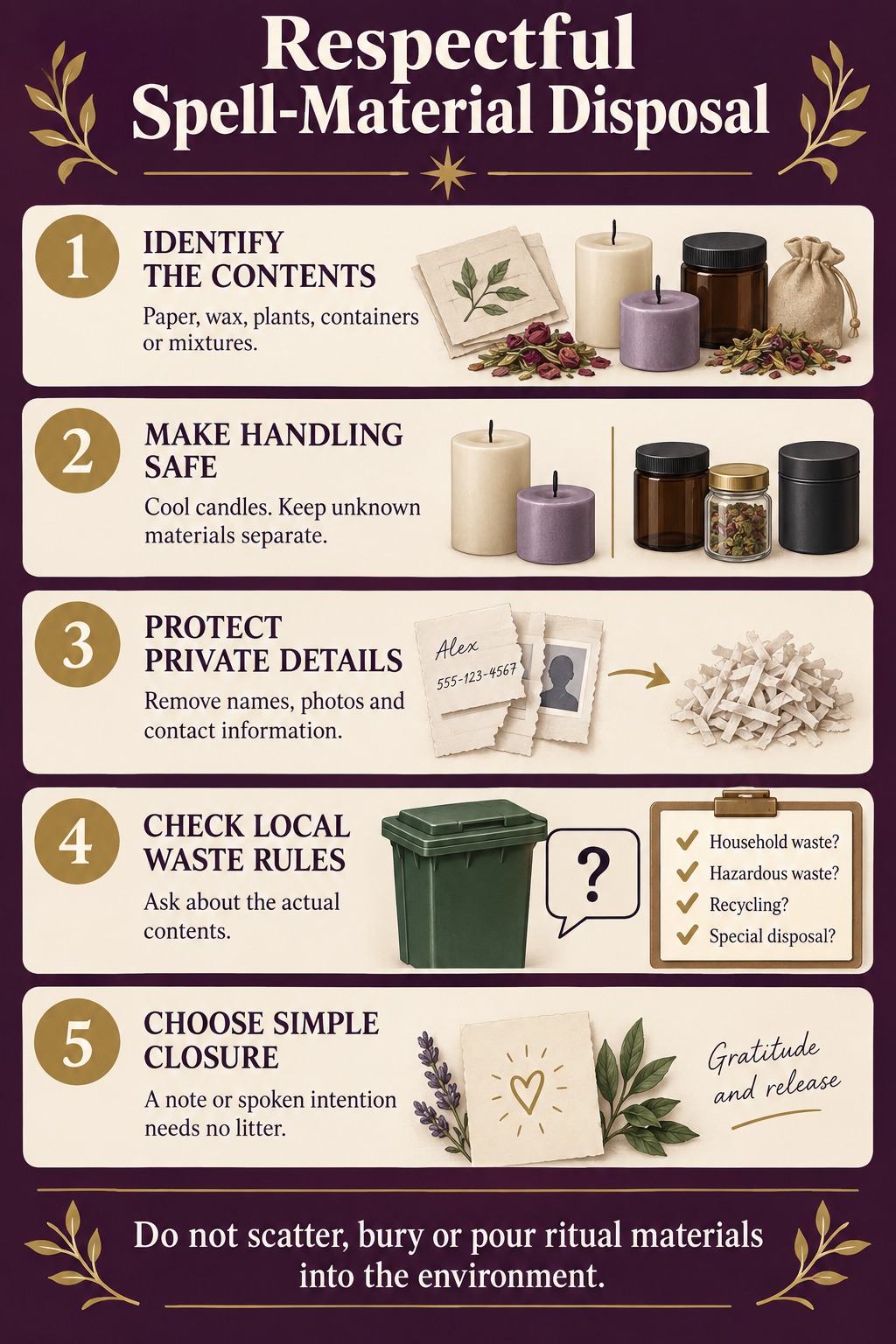
No special purchase is necessary. Avoid substances intended to affect someone without their knowledge, and never add herbs, oils or other ingredients to their food or drink. If you use candles or other materials, follow our separate love spell safety guide.

When to pause or seek support

Pause if the practice increases panic, anger, revenge fantasies, compulsive checking or spending you cannot comfortably afford. Be cautious of anyone claiming that rejection proves a curse or that another payment is needed to prevent harm.

Spiritual advice should not replace help with stalking, threats, coercion or abuse. Prioritize safety and contact a trusted support service when it is safe to do so. If there is immediate danger, use local emergency services. You are not responsible for maintaining a relationship because a reader calls it destined.

Key Takeaways

  • A private ritual can support reflection without granting authority over someone else.
  • Mutual choice matters more than a desired outcome, prediction or symbolic sign.
  • Ethical intentions lead to accountable behavior, not surveillance or repeated pressure.
  • Closure is a valid outcome; no relationship is owed to anyone.

Frequently Asked Questions

1. What makes a love spell ethical?

An ethical intention respects consent, privacy and another person's freedom to decline. It focuses on your behavior or genuinely shared participation rather than control.

2. Can a love spell guarantee that someone loves me?

No ritual can guarantee attraction or commitment. This guide treats spells as spiritual or symbolic practices, not a proven method of controlling feelings.

3. Is it wrong to hope an ex returns?

Private hope is not the same as coercion. Keep your actions respectful, accept a refusal and do not bypass a no-contact request.

4. Does a dream about someone mean I should contact them?

A dream can have personal meaning without conveying the other person's wishes. Base contact on their actual boundaries and whether communication is welcome.

5. Can I use someone's belongings in a ritual?

Ask permission before using their belongings or private information. Your own journal or a neutral symbol avoids that privacy problem.

6. Do both partners have to believe in a shared ritual?

No one should be pressured to participate or adopt a belief. If you choose a shared practice, agree on its purpose and allow either person to stop.

7. What if a psychic says we are destined to be together?

A prediction does not create consent or an obligation to stay. Judge the relationship by mutual interest, behavior, safety and freely made decisions.

8. Is silence consent to romantic contact?

Do not interpret silence as agreement or an invitation to escalate. Respect clear refusals and give someone room not to respond.

9. How can I replace an obsession spell intention?

Focus on your own confidence, clarity and ability to accept an answer. Invite mutual connection without asking for dependence or obedience.

10. Can self-love rituals fit this approach?

Yes. Journaling about values, practicing self-respect and choosing a healthy next step stay within your own responsibilities. Supernatural effects are not established.

11. What does the CARE check mean?

It stands for Consent, Agency, Reality and Exit. It is this article's reflection checklist, not a validated test or guarantee of a healthy relationship.

12. Should I pay for a ritual to remove a relationship curse?

Do not treat a frightening claim as proof that you must pay. Pause, avoid urgent purchases and discuss the situation with someone independent whom you trust.

13. Can I perform a ritual after someone blocks me?

A private reflection focused on acceptance does not require contacting them. Do not use the ritual as justification to get around the block.

14. Do ethical rituals require candles or crystals?

No. A written intention and a practical action are enough. If you use physical materials, consider fire, ingestion and other ordinary safety risks.

15. When should I stop a love ritual?

Stop if it encourages boundary violations, compulsive checking, fear or unaffordable spending. Seek appropriate support when distress or relationship safety needs attention.

How to Apologize in a Relationship: 14 Powerful Ways to Heal Emotional Hurt

0
Couple having a calm, sincere apology conversation on an outdoor patio

A meaningful apology does more than say “sorry.” It names what happened, acknowledges the impact, takes responsibility and makes repair visible through changed behavior. It cannot erase harm or guarantee forgiveness, but it can restore dignity and create a credible path forward.

Safety and accountability matter: An apology is not a reason to stay in an abusive or coercive relationship. No one owes forgiveness, renewed contact, sex, secrecy or reconciliation. If there are threats, stalking, physical harm, sexual coercion or controlling behavior, prioritize confidential support and safety planning rather than a joint repair exercise.

Quick Guide

  • Name the behavior: be specific about what you did or failed to do.
  • Acknowledge impact: do not argue someone out of their hurt.
  • Own your part: remove “but,” blame-shifting and scorekeeping.
  • Offer repair: ask what would help and propose a realistic action.
  • Prevent repetition: explain what will change, then follow through.

The Acknowledge–Repair–Prevent Model

14 Powerful Ways to Apologize and Heal Emotional Hurt

  1. Choose a time when both people can engage

    Do not force a conversation in public, during work, late at night or while either person is too activated to listen. Ask: “I want to apologize properly. Is now okay, or would another time feel better?” A delay should include a real return time, not indefinite avoidance.

  2. Name exactly what you are apologizing for

    “Sorry for everything” can make the hurt person do the work of defining the problem. Be specific: “I shared something private after you asked me not to,” or “I raised my voice and called you a name.” Specificity signals that you understand the breach.

  3. Acknowledge the emotional impact

    Intent and impact are different. You can say, “I did not intend to embarrass you, and I understand that my comment did.” Do not tell the other person what they should feel or how quickly the feeling should pass.

  4. Take responsibility without a “but”

    “I’m sorry, but you made me angry” shifts responsibility. A cleaner version is: “I was angry, and I chose to speak disrespectfully. That was my responsibility.” Context may explain behavior, but it does not transfer ownership.

  5. Listen before explaining

    Ask what part hurt most, then summarize what you heard. Explanation should not become a courtroom defense. If facts are genuinely disputed, acknowledge what is clear while agreeing to revisit the difference calmly.

  6. Validate without pretending to agree on every detail

    Validation recognizes an experience: “I see why that felt dismissive.” It does not require identical memories or automatic agreement about the solution. This distinction helps people feel heard without forcing false consensus.

  7. Express regret in plain language

    Use direct words: “I am sorry I hurt you.” Avoid “I’m sorry you feel that way,” which places the problem inside the injured person. Regret is strongest when it follows clear responsibility rather than replacing it.

  8. Offer concrete repair

    Ask what would help, while recognizing the other person may not know yet. Repair might involve replacing an item, correcting a false statement, rescheduling protected time, repaying money or changing access to private information. Do not promise what you cannot deliver.

  9. Explain how you will reduce the chance of repetition

    Trust returns through a new pattern. Name the safeguard: setting a reminder, leaving the room before yelling, beginning therapy, changing a financial process or no longer discussing private matters with friends. If spiritual practice is meaningful to you, this guide to whether love spells can strengthen relationships keeps ritual secondary to communication, consent and real behavior.

  10. Do not demand forgiveness

    “I apologized, so you have to move on” turns the apology into pressure. The hurt person controls whether and when to forgive, trust or continue the relationship. Acceptance of an apology and restoration of access are separate decisions.

  11. Expect questions and mixed feelings

    A person can appreciate an apology and remain angry. They may need details or space. Answer honestly without insisting that every question be resolved in one sitting. If repeated questioning becomes harmful to either person, a qualified couples clinician may help when joint work is safe.

  12. Match words with consistent behavior

    One polished conversation cannot outweigh repeated harm. Keep the promise when no one is praising you. If you slip, name it promptly and return to the prevention plan rather than treating imperfection as proof that change is impossible.

  13. Recognize when the relationship may not be repairable

    Some breaches change what the injured person is willing to continue. Reconciliation depends on safety, accountability and mutual choice—not love alone. A spiritual wish to reunite cannot decide for another person; the same grounded principle applies when considering whether a love spell can bring an ex back.

  14. Learn from the pattern, not only the incident

    Ask what made the harm more likely: defensiveness, substance use, avoidance, resentment, unclear agreements, entitlement or poor coping. Addressing the pattern turns apology from a social script into prevention. When behavior remains controlling or abusive, the priority is safety—not shared blame.

A Sincere Apology Script

“I’m sorry I [specific behavior]. I understand that it [specific impact]. I was responsible for that choice. You did not deserve it. I want to repair what I can by [specific action]. To reduce the chance of this happening again, I will [specific prevention step]. I understand that you may need time, and I will respect your decision about what happens next.”

Use the structure, not as a formula to obtain forgiveness, but as a checklist for accountability. Leave out any sentence that is not true, and do not make a promise you are unwilling or unable to keep.

What Research Suggests About Effective Apologies

Research is often conducted through scenarios, trust games or workplace settings, so it cannot map perfectly onto every romantic relationship. Still, it offers useful clues. Ohio State researchers tested six apology elements and found that acknowledging responsibility and offering repair were especially important. Experimental research has also found that apologies can improve perceived trustworthiness, though negative emotion and the nature of the violation affect results (trust-repair study).

What Is Not an Apology?

  • “I’m sorry you were offended.”
  • “I already said sorry—what else do you want?”
  • “We both made mistakes,” when you have not named yours.
  • A gift that replaces a conversation or restitution.
  • A spiritual ritual used to avoid accountability.
  • Promises of change with no new behavior or safeguard.

Key Takeaways

  • A strong apology names behavior, impact and responsibility.
  • Intent does not cancel impact, though context can still be discussed.
  • Repair and prevention make an apology more credible.
  • Forgiveness, trust and reconciliation are separate choices.
  • Changed behavior matters more than an eloquent script.
  • Abuse calls for safety-focused support, not ordinary couples repair.

Frequently Asked Questions

What makes an apology sincere?

A sincere apology is specific, accepts responsibility, acknowledges impact, expresses regret and is supported by repair and changed behavior.

Should I apologize if I did not mean to hurt my partner?

You can acknowledge the unintended impact while explaining your intent later. Lack of harmful intent does not make the other person’s experience unreal.

What should I avoid saying in an apology?

Avoid “but,” blame-shifting, minimizing, demanding forgiveness and statements such as “I’m sorry you feel that way.”

Can I explain my side?

Yes, but listen and take responsibility first. An explanation should add context, not erase the impact or transfer blame.

What if my partner will not accept my apology?

Respect the decision and space requested. An apology does not entitle you to forgiveness, contact, trust or reconciliation.

How do I rebuild trust after apologizing?

Follow through on repair, use specific safeguards, answer reasonable questions honestly and demonstrate the changed pattern consistently over time.

Should both partners apologize after every conflict?

Only for behavior each person genuinely owns. Mutual conflict does not mean responsibility is always equal, and abuse should not be reframed as shared blame.

Is a written apology okay?

It can help organize thoughts or respect requested space, but the form should fit the harm and the recipient’s needs. Written words still require behavioral follow-through.

Does forgiveness mean staying together?

No. Someone may forgive and still end the relationship, maintain boundaries or decide that trust cannot be restored.

When should couples seek professional help?

Consider a qualified couples therapist when conflict cycles repeat or a major breach is hard to repair, provided joint work is safe. Abuse requires confidential, safety-focused guidance.

15 Signs You’re in a Karmic Relationship: What It Means

0
Signs You’re in a Karmic Relationship

A “karmic relationship” is a spiritual idea used to describe an intense connection that seems to bring unresolved patterns, lessons, or emotional growth to the surface. It is not a clinical diagnosis, and there is no scientific test that can prove a relationship is karmic.

That distinction matters because intensity can feel meaningful without making a relationship healthy. No spiritual label creates an obligation to stay with someone who repeatedly violates your boundaries, pressures you, frightens you, or treats you badly.

Quick Guide

  • A karmic relationship is a spiritual interpretation, not a proven psychological category.
  • Intensity is not the same as compatibility.
  • Repeated conflict deserves attention even when the connection feels “fated.”
  • Healthy relationships require consent, respect, communication, and room for individual boundaries.
  • Abuse, coercion, stalking, threats, or violence are safety issues—not spiritual lessons you must endure.

What a Karmic Relationship Means

In spiritual traditions and modern relationship language, “karmic” often describes a bond that feels unusually familiar, magnetic, or emotionally charged. People may believe the connection brings unfinished lessons from the past or exposes patterns that need to change.

A grounded way to use the idea is as a reflection tool: What keeps repeating? What are you learning about your needs? Are your boundaries becoming stronger or weaker? Are both people taking responsibility for change?

A Common Karmic-Relationship Cycle

Fast Pull

Strong familiarity, attraction, or a sense of destiny.

High Intensity

Rapid attachment and emotional highs and lows.

Repeating Pattern

The same arguments, fears, or boundary problems return.

Choice Point

Both people change the pattern—or one person decides to step away.

15 Signs You May Be Describing the Relationship as Karmic

1. The Connection Feels Instantly Familiar

You may feel as if you have known the person for years even when you have only just met. That feeling can be powerful, but familiarity is not evidence that someone is automatically trustworthy. Trust still needs time and consistent behavior.

2. The Attraction Feels Extremely Intense

You think about the person constantly or reorganize your life around the connection early on. Intensity can be exciting, but it can also make ordinary incompatibilities easier to overlook.

3. Part of You Feels That Something Is Off

You feel drawn to the person while also noticing comments, reactions, or behaviors that make you uncomfortable. Do not dismiss specific warning signs simply because the relationship feels spiritually important.

4. The Relationship Moves Very Fast

Deep disclosure, major promises, exclusivity, or life changes happen quickly. A fast pace is not automatically unhealthy, but it can make it harder to evaluate compatibility and keep your usual boundaries.

5. Your Emotional State Starts Depending on the Relationship

Your mood rises and falls almost entirely with the other person’s attention, approval, or availability. That is a sign to rebuild routines, friendships, and sources of stability outside the relationship.

6. The Emotional Highs and Lows Are Extreme

Powerful reconciliations may follow equally powerful conflicts. The relief after tension can make the connection feel even stronger. Stability, not just intensity, is an important measure of relationship health.

7. The Same Problems Keep Returning

You discuss the issue, apologize, and promise change, but the same conflict comes back. Repetition is more informative than a single dramatic apology. Look for sustained behavioral change.

8. Communication Becomes Confusing

Simple conversations turn into defensiveness, silence, accusations, or misunderstandings. Healthy repair requires both people to listen, clarify, and take responsibility—not one person doing all the emotional work.

9. Your Boundaries Become Less Clear

You start saying yes when you mean no, giving up privacy, tolerating disrespect, or feeling guilty for having normal needs. A spiritual bond should never require surrendering consent or autonomy.

10. The Relationship Feels Unbalanced

One person makes most of the decisions, controls access to money or friends, or expects the other person to carry nearly all the emotional labor. Imbalance deserves practical attention regardless of the spiritual label.

11. You Feel Emotionally Unsteady

You spend a lot of time waiting, worrying, checking, analyzing, or trying to predict the other person’s mood. If the relationship repeatedly makes you feel unsafe or unable to function normally, consider outside support.

12. The Connection Leaves You Drained More Than Fulfilled

All relationships have difficult periods, but chronic exhaustion, dread, or loss of self can be a sign the cost is too high.

13. You Do Not Recognize Your Usual Reactions

You may become more jealous, reactive, fearful, or withdrawn than usual. Strong relationships can expose old patterns, but that does not mean those patterns have to control what happens next.

14. Walking Away Feels Almost Impossible

You may believe leaving means failing a spiritual lesson or abandoning “the one.” That belief can keep people stuck. You are allowed to end a relationship that is unhealthy, incompatible, or simply no longer right for you.

15. You Begin to See the Pattern Clearly

The turning point often comes when the focus changes from “How do I keep this connection?” to “What is this pattern costing me, and what do I want to do differently?” Growth may mean repairing the relationship together—or leaving it.

Karmic Relationship vs. Soulmate vs. Twin Flame

These terms come from spiritual belief systems rather than science, and people define them differently. “Karmic” is often used for lesson-focused, repetitive, intense bonds. “Soulmate” usually describes a deeply supportive or meaningful connection. “Twin flame” is often used for a highly reflective, transformative bond.

None of these labels can tell you whether a relationship is safe or compatible. Judge the relationship by behavior: respect, honesty, consent, accountability, emotional safety, and whether both people can maintain healthy independence.

What You Can Learn Without Romanticizing Harm

  • Which boundaries need to become clearer.
  • What conflict patterns you keep repeating.
  • What behavior you will no longer excuse.
  • How you communicate under stress.
  • What you actually need from a partner.
  • Whether both people are willing to make measurable changes.

If you use spiritual practices around love, consent still matters. Our article on the risks of manifesting a specific person explains why another person’s autonomy should stay central. You can also read Should I Use a Love Spell? for a belief-based discussion that emphasizes free will, and How to Overcome Your Neediness for self-focused relationship reflection.

When the Priority Is Safety, Not Spiritual Meaning

If there is coercive control, threats, stalking, sexual pressure, physical violence, isolation, financial control, or fear of what your partner may do, treat it as a safety issue. Consider contacting trusted people, a local domestic-violence service, law enforcement where appropriate, or another qualified professional who can help you assess options safely.

You do not need to stay in danger to complete a karmic lesson. No healthy spiritual practice requires accepting abuse.

Key Takeaways

  • “Karmic relationship” is a spiritual concept, not a scientific or clinical diagnosis.
  • Intensity, chemistry, and a sense of fate do not guarantee compatibility.
  • Repeated patterns are useful information only when they lead to clearer choices and boundaries.
  • Consent, autonomy, respect, and safety matter more than any spiritual label.
  • You are allowed to leave a relationship even if it feels spiritually significant.

Frequently Asked Questions

1. What is a karmic relationship?

It is a spiritual term for an intense relationship believed to involve lessons, unresolved patterns, or personal growth.

2. Are karmic relationships scientifically proven?

No. “Karmic relationship” is a spiritual and interpretive concept, not a scientifically established relationship category.

3. Do karmic relationships always feel intense?

They are often described that way, but intensity alone does not prove a relationship is karmic.

4. Can a karmic relationship be healthy?

Any relationship can improve when both people communicate, respect boundaries, and make consistent changes. The label itself does not determine health.

5. Do karmic relationships have to end?

No spiritual rule can determine that. The practical question is whether the relationship is safe, respectful, compatible, and able to change.

6. Is a karmic relationship the same as a toxic relationship?

No. “Karmic” is a spiritual label, while “toxic” is an informal description of harmful patterns. Neither should replace careful evaluation of actual behavior.

7. What is the difference between karmic and soulmate relationships?

In popular spiritual language, karmic bonds are often described as lesson-focused and repetitive, while soulmate bonds are usually described as supportive and deeply compatible.

8. What is the difference between karmic and twin-flame relationships?

Twin-flame beliefs often emphasize mirroring and transformation, while karmic beliefs emphasize unresolved lessons. Definitions vary widely.

9. Is moving fast a sign of a karmic relationship?

It is commonly mentioned in spiritual descriptions, but moving fast can happen for many reasons and should not be treated as proof.

10. Why is it hard to leave an intense relationship?

Attachment, hope, fear, habit, intermittent closeness, shared responsibilities, and beliefs about destiny can all make leaving difficult.

11. Can I set boundaries in a karmic relationship?

Yes. Healthy boundaries are appropriate in every relationship, regardless of spiritual beliefs.

12. Does karma mean I deserve relationship pain?

No. A spiritual belief about karma should never be used to justify mistreatment or imply that someone deserves harm.

13. Should I stay because the relationship is teaching me something?

No lesson requires you to remain in an unsafe or unhealthy situation. Learning can also happen after you leave.

14. When should I seek outside help?

Seek support when you feel unsafe, controlled, threatened, isolated, unable to function, or unsure how to leave safely.

15. How can I break a repeating relationship pattern?

Identify the specific cycle, strengthen boundaries, slow major decisions, seek trusted support, and focus on changes you can actually observe rather than promises alone.

Types of Love Spells: Purposes, Meanings and Differences

0
Man comparing symbolic materials in an artisan studio

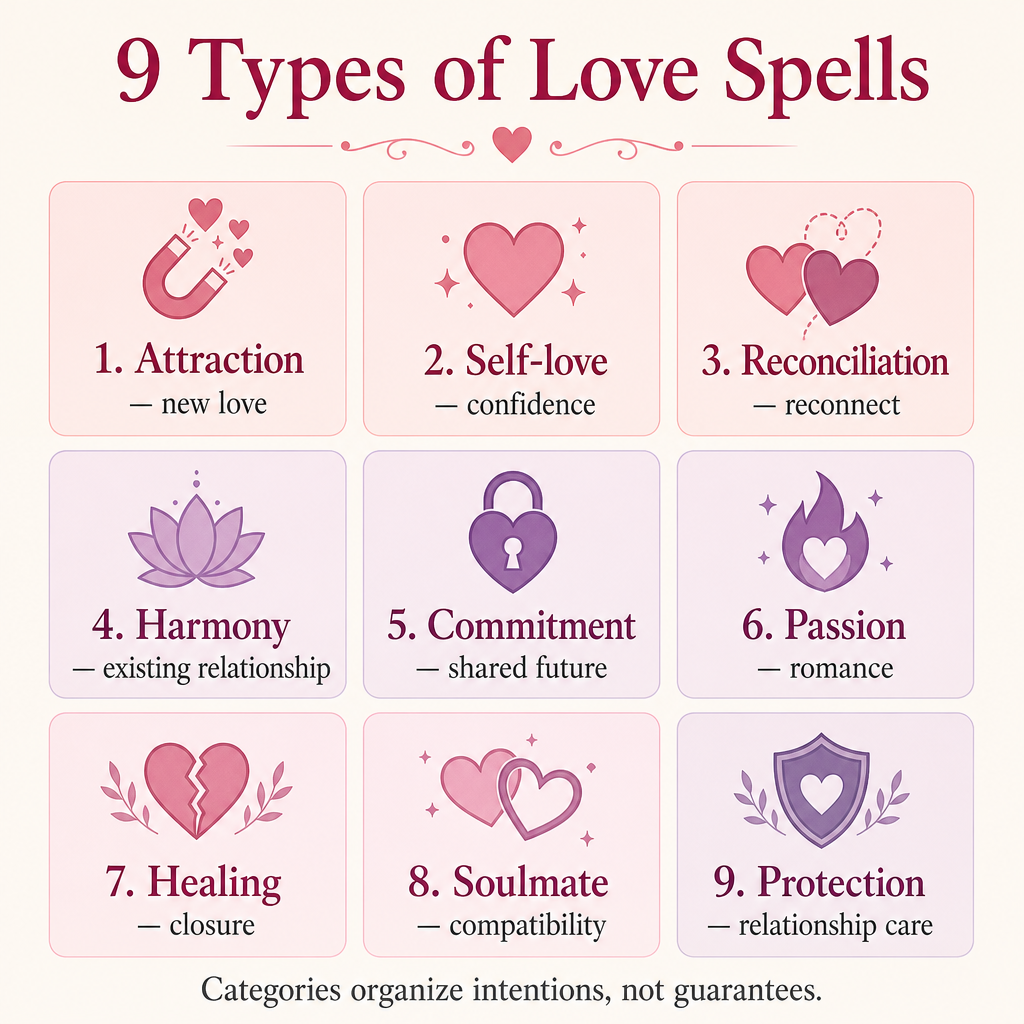
The phrase “love spell” covers many different spiritual practices. The uploaded draft lists attraction, self-love, reconciliation, commitment, romance, healing, soulmate, and relationship-protection rituals. Those categories are useful when they are treated as spiritual purposes rather than as promises of specific outcomes.

This guide is a reference page: it explains what each type is meant to symbolize, how the categories differ, and what real-life relationship goal sits underneath each one. Different traditions may use different names, and there is no universal scientific classification of love spells.

Think of spell types as intention categories. They can help organize a spiritual practice, but they do not override consent, compatibility, or real-world relationship behavior.

Love Spell Types at a Glance

Type Spiritual purpose Grounded relationship focus
Attraction Openness to new love Meeting compatible people
Self-love Confidence and healing Self-respect and boundaries
Reconciliation Healing a past connection Mutual willingness to reconnect
Harmony Peace in an existing bond Communication and teamwork
Commitment Celebrating stability Shared goals and reliability
Passion Renewing romance Affection and quality time
Healing Release after hurt Closure and emotional recovery
Soulmate Openness to deep compatibility Values, maturity, and patience
Protection Symbolic care for a relationship Boundaries, trust, and problem-solving

1. Attraction Love Spells

Attraction rituals are usually associated with welcoming new romantic opportunities. A grounded version focuses less on “making” a particular person respond and more on clarifying the kind of relationship you want to recognize when it appears.

Useful reflection questions include: What values matter most? What kind of communication feels safe? What patterns do you want to avoid repeating?

2. Self-Love Spells

Self-love rituals focus on confidence, self-respect, emotional healing, and becoming more comfortable with your own needs. They are often described as a foundation for other love-focused practices because healthier boundaries and self-awareness can improve relationship choices.

Self-love does not mean becoming perfectly healed before dating. It means treating your own well-being as part of the relationship equation.

3. Reconciliation Love Spells

Reconciliation rituals are intended to symbolize forgiveness, healing, and the possibility of renewed communication after a breakup or conflict. They are most grounded when both people are still willing to talk and when reconnecting would actually be healthy.

If the relationship involved repeated disrespect, coercion, or a clear request for no contact, a reconciliation ritual should not be used to reinterpret that boundary.

For a full reconciliation guide, see Can Love Spells Bring an Ex Back?.

4. Relationship Harmony Spells

Harmony rituals are for an existing relationship. They usually symbolize patience, listening, forgiveness, and renewed appreciation. The practical counterpart is simple: discuss the actual source of tension, listen without interrupting, and make changes both people can observe.

For couples, Can Love Spells Strengthen Relationships Naturally? explores this category in more depth.

5. Commitment Love Spells

Commitment rituals are usually connected with loyalty, stability, long-term partnership, anniversaries, engagements, or other milestones. They are best understood as ceremonies that celebrate commitment that already exists, not as ways to create commitment against someone’s wishes.

6. Romance and Passion Spells

Passion rituals focus on affection, romance, excitement, and emotional closeness. Long relationships naturally change over time, so some couples use symbolic rituals as a prompt to make time for each other again.

The practical actions behind this category include planning time together, expressing appreciation, discussing intimacy honestly, and noticing whether both people feel respected.

7. Healing Love Spells

Healing rituals are centered on heartbreak, resentment, disappointment, grief, or the end of a relationship. Their purpose is not to erase what happened but to create a structured moment for release and reflection.

A healing ritual may be more appropriate than an attraction or reconciliation ritual when you are still overwhelmed by the previous relationship.

8. Soulmate Love Spells

Soulmate rituals are usually framed around openness to a deep, compatible relationship. It is safer to treat “soulmate” as a spiritual idea about connection and shared growth rather than a guarantee that one predetermined person must appear.

If you are deciding between soulmate, attraction, or another category, What Is the Most Powerful Love Spell? explains why matching the ritual to the goal is more useful than chasing the strongest label.

9. Relationship Protection Spells

Protection rituals symbolize caring for the peace and stability of an existing relationship. They may focus on boundaries, trust, loyalty, or reducing outside stress. They should not be used to blame every conflict on “negative energy” when the issue is communication, dishonesty, jealousy, or incompatible goals.

10. Gratitude and Renewal Rituals

Some practices do not fit neatly into one traditional category. Gratitude rituals, anniversary intentions, renewal ceremonies, or shared reflection may support harmony, commitment, or self-love depending on the goal.

This is a useful reminder that categories are flexible. The intention gives the ritual its meaning.

Nine types of love spells infographic

How to Choose Among the Different Types

  1. Name the real-life problem or goal.
  2. Decide whether the focus is you, a new relationship, a past relationship, or an existing partnership.
  3. Ask whether another person’s consent or boundary is involved.
  4. Choose the simplest category that matches the goal.
  5. Add a practical action that supports the same intention.

For vocabulary used across these categories, see the Love Spell Glossary.

Tools Do Not Define the Category

Candles, herbs, crystals, prayer, journaling, moon symbolism, and meditation can appear in many types of rituals. The same pink candle could be used in a self-love practice, a gratitude ritual, or an attraction ceremony depending on the intention.

The tools are better understood as symbols or prompts rather than proof that one ritual is stronger than another.

Timing Does Not Change the Basic Purpose

Some traditions connect new beginnings with the new moon, growth with the waxing moon, celebration with the full moon, and release with the waning moon. These associations can give a ritual rhythm, but they do not guarantee a relationship result.

If timing is your main question, see How Long Do Love Spells Take?.

Safety and Boundaries Apply to Every Type

No category should be used as a reason to ignore consent, fire safety, emotional well-being, or financial pressure from a practitioner. A ritual should not require fear, secrecy from someone whose consent matters, or repeated spending to “fix” an escalating spiritual threat.

The Love Spell Safety Guide covers these issues in more detail.

Frequently Asked Questions

1. What are the main types of love spells?

Common categories include attraction, self-love, healing, reconciliation, harmony, commitment, passion, soulmate, and relationship-protection rituals. Different traditions may use different names.

2. Are attraction spells the same as spells for a specific person?

Not necessarily. A grounded attraction practice can focus on becoming open to compatible relationships rather than targeting one person.

3. What is a self-love spell?

A self-love ritual is usually centered on confidence, emotional healing, self-respect, and becoming more open to healthy relationships.

4. What is a reconciliation spell?

Reconciliation rituals are generally associated with healing, forgiveness, and the possibility of renewed communication when both people are genuinely open to reconnecting.

5. What is a harmony spell?

Harmony rituals focus on an existing relationship and commonly symbolize patience, communication, understanding, and emotional closeness.

6. What is a commitment spell?

Commitment rituals are associated with loyalty, stability, shared goals, and celebrating an existing relationship rather than creating commitment where it does not exist.

7. What is a passion or romance spell?

These rituals are commonly used by couples who want to focus on affection, romance, appreciation, and time together.

8. What is a healing love spell?

Healing rituals focus on processing heartbreak, resentment, disappointment, or emotional pain so a person can move forward more clearly.

9. What is a soulmate spell?

Soulmate rituals are usually framed around openness to a deep, compatible relationship rather than identifying or guaranteeing one destined person.

10. What is a relationship protection spell?

Protection rituals symbolize protecting an existing relationship’s peace, trust, and boundaries. They should not replace communication or practical problem-solving.

11. Which type of love spell is strongest?

There is no reliable basis for calling one category universally strongest. The useful question is which ritual best matches the goal you are reflecting on.

12. Do I need special tools for each type?

No. Tools vary by tradition and are usually symbolic. Many practices can be simplified to reflection, journaling, meditation, prayer, or a single meaningful object.

13. Can one ritual fit more than one category?

Yes. A gratitude ritual could support self-love, harmony, or commitment depending on the intention. Categories are guides, not fixed scientific classifications.

14. How do I choose the right type of spell?

Start with the real-life goal, your emotional readiness, the other person’s boundaries, and what healthy action would support the same intention.

15. Can a love spell type guarantee an outcome?

No. A spiritual category can organize a practice, but it cannot guarantee another person’s feelings, consent, or future choices.

Final Thoughts: Use Categories as a Map, Not a Promise

Understanding the types of love spells can make spiritual practice less confusing. Attraction, self-love, reconciliation, harmony, commitment, passion, healing, soulmate, and protection rituals each point toward a different intention.

The category itself does not guarantee an outcome. What matters most for a grounded practice is whether the intention is clear, the ritual respects everyone involved, and your real-life actions support the kind of relationship you say you want.

What Is the Most Powerful Love Spell? A Clear Guide

0
Woman choosing a direction in a minimalist gallery corridor

People often search for the “most powerful love spell” as though there must be one secret ritual that outranks every other option. The supplied draft takes a better approach: the most meaningful ritual depends on the intention, emotional readiness, and relationship situation—not on rare ingredients, complexity, or dramatic promises.

Short answer: there is no proven single “most powerful” love spell. For believers, the best fit is the ritual that matches a clear, ethical intention and supports healthy real-world choices.

That means attraction, self-love, healing, reconciliation, harmony, and commitment rituals should not be treated as competing versions of the same spell. They solve different spiritual questions. For a full reference comparison, see Types of Love Spells: Purposes, Meanings and Differences.

What Does “Powerful” Mean?

Before choosing a ritual, define the word. “Powerful” could mean:

  • Emotionally meaningful.
  • Simple enough to perform with focus.
  • Well matched to the actual relationship goal.
  • Helpful for reflection or confidence.
  • Easy to support with practical action.
  • Respectful of another person’s free will.

If “powerful” means guaranteed control over another person’s emotions, no ritual can responsibly promise that.

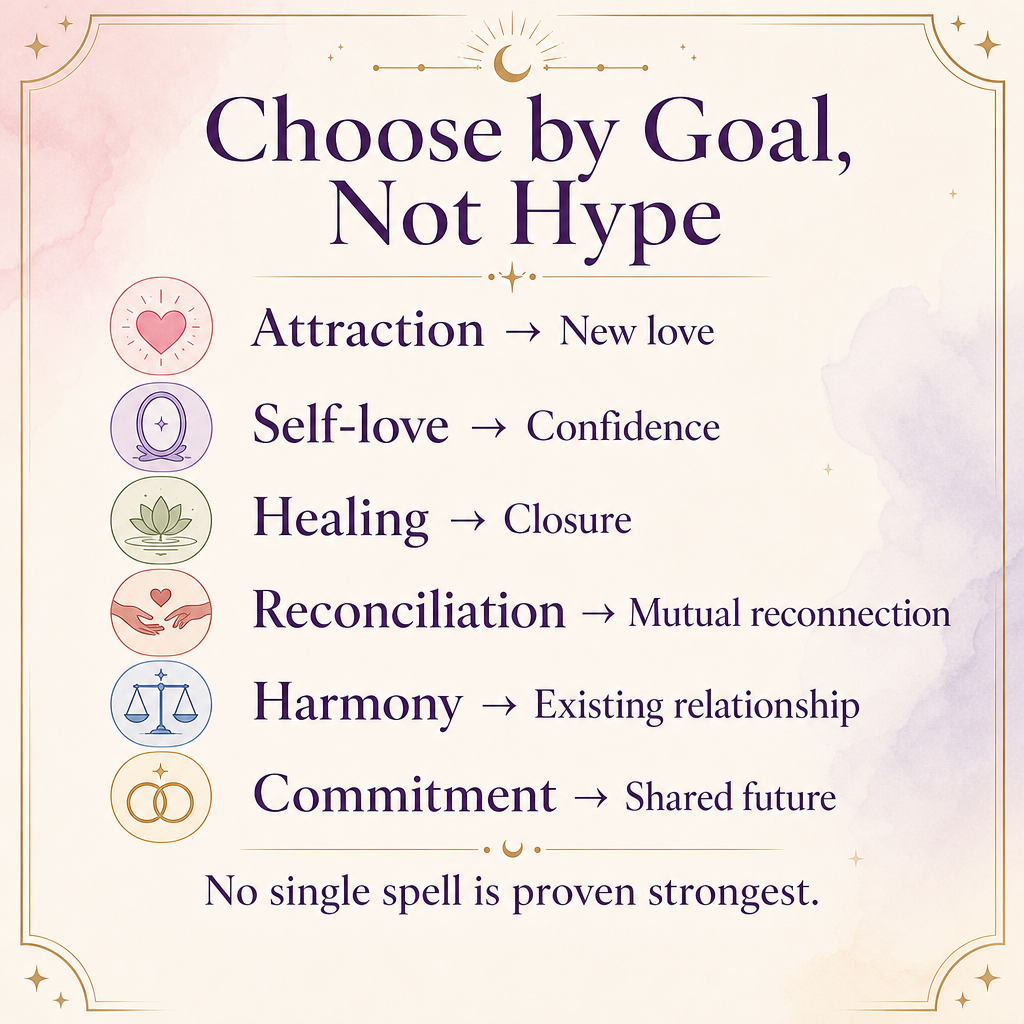
The Best Spell Depends on the Goal

New love
Attraction ritual
Confidence and self-worth
Self-love ritual
Heartbreak or closure
Healing ritual
Mutual reconnection
Reconciliation ritual
Existing relationship
Harmony ritual
Shared future
Commitment ritual

If these terms are unfamiliar, our love spell glossary explains the vocabulary used across common spiritual traditions.

Attraction Spells: Best for New Possibilities

Attraction rituals are commonly used when someone wants to become more open to meeting a compatible partner. A healthy version focuses on qualities rather than one unwilling person:

  • Mutual attraction.
  • Shared values.
  • Kindness and emotional availability.
  • Respectful communication.
  • Compatible long-term goals.

The practical side matters too: meeting people, accepting invitations, joining activities, and communicating openly creates real opportunities for connection.

Self-Love Spells: Often the Strongest Starting Point

Self-love rituals can be especially meaningful after rejection, heartbreak, or a period of low confidence. Their advantage is that the intention centers on your own behavior and emotional growth rather than another person’s decisions.

A self-love practice might include a journal entry, meditation, gratitude list, symbolic bath, affirmation, or quiet reflection. It does not need rare tools to be meaningful.

Healing Spells: When Moving Forward Matters Most

If the main issue is grief, resentment, or emotional exhaustion, an attraction ritual may be premature. Healing-focused practice can create space to ask what you learned, what boundaries need to change, and what you want to carry into your next relationship.

Reconciliation Spells: Only When Reconnection Is Mutual

Reconciliation work is most appropriate when both people remain open to rebuilding. It is not a way to override an ex-partner’s refusal or force contact. A healthier intention is “may honest communication and mutual healing be possible if this relationship is right for both of us.”

Harmony Spells: For Relationships That Already Exist

Harmony rituals fit couples who already have a relationship and want to strengthen patience, appreciation, or communication. Our article on strengthening relationships naturally explains how spiritual intention can be paired with everyday actions.

Commitment Rituals: For a Shared Future

Commitment work should reflect a decision both partners are already making. It may be used around an anniversary, engagement, wedding, or other milestone to symbolize loyalty, shared goals, and gratitude.

Which Love Spell Fits Your Goal?

Infographic matching love spell types to intentions
Choose a ritual by the goal it represents rather than by claims that one option is universally strongest.

Why Complexity Does Not Equal Power

Long ingredient lists, imported supplies, complicated chants, or expensive services can make a ritual feel impressive. They do not prove that it is more effective. Complexity can actually make beginners less focused because attention shifts from the intention to performing every step “perfectly.”

A simple ritual that you understand and can perform safely may be more personally meaningful than one chosen because someone called it the “strongest.”

Why Price Does Not Equal Power

High prices do not establish spiritual effectiveness. Be cautious when a practitioner claims that only a more expensive version can prevent failure, remove a sudden curse, or guarantee a result. Our love spell safety guide covers fear-based upselling and other warning signs.

Does Moon Timing Make a Spell Stronger?

Some traditions connect the new moon with beginnings and the full moon with fulfillment or celebration. Others do not use lunar timing at all. If moon phases are meaningful to you, they can provide structure and symbolism, but they do not guarantee a result. See when to cast a spell for more on timing traditions.

A Five-Question Choosing Method

  1. What is my actual goal? New love, healing, reconciliation, harmony, or commitment?
  2. Does the goal depend on controlling someone? If yes, rewrite it around mutual choice.
  3. Am I emotionally ready? If fear or desperation is driving the decision, pause.
  4. What practical action supports the intention? Communication, boundaries, meeting people, counseling, or self-care?
  5. Can I accept more than one healthy outcome? If not, the intention may be too rigid.

What Makes a Ritual Meaningful After It Ends?

The most useful question is not “Was this the strongest spell?” but “What did I do differently afterward?” If a self-love ritual leads you to set better boundaries, or a harmony ritual encourages a needed conversation, the practice may have real personal value without requiring supernatural certainty.

Frequently Asked Questions

1. What is the most powerful love spell?

There is no proven single strongest spell. The best fit depends on your intention and situation.

2. Are attraction spells stronger than self-love spells?

No. They have different purposes. Attraction focuses on new possibilities; self-love focuses on confidence and personal growth.

3. Is a reconciliation spell powerful?

It can be meaningful for believers when both people are open to reconnecting, but it cannot force reconciliation.

4. Are expensive spells more powerful?

No. Price does not prove effectiveness.

5. Do rare ingredients make a ritual stronger?

Not necessarily. Many traditions use simple, symbolic items.

6. Are complicated rituals better?

No. Complexity can make it harder to stay focused on the actual intention.

7. Is self-love a good first spell?

Yes. It centers the practice on your own confidence, healing, and choices.

8. Can I combine different love spells?

You can, but focusing on one clear goal at a time may make the practice easier to understand.

9. Does a full moon make a spell more powerful?

Some traditions value full-moon symbolism, but it does not guarantee a result.

10. Can the strongest spell make a specific person love me?

No ritual can guarantee another person’s feelings or override their decisions.

11. What spell is best after a breakup?

Healing or self-love may be more appropriate before attraction or reconciliation work.

12. What spell is best for an existing couple?

Harmony, gratitude, healing, or commitment rituals fit existing relationships better than attraction work.

13. How do I know if I chose the wrong spell?

Revisit your goal. If the ritual does not match what you actually need, choose a practice that does.

14. Should beginners start simple?

Yes. Simple journaling, meditation, gratitude, or candle-free intention practices are easier to use safely.

15. What matters most after the ritual?

Respectful action, communication, boundaries, self-awareness, and willingness to accept healthy outcomes matter more than complexity.

Final Thoughts

The search for the “most powerful” love spell often becomes much simpler once you stop ranking rituals and start defining the goal. A ritual for healing is not weaker than one for attraction; it is simply designed for a different need.

For believers, the most meaningful practice is usually the one that matches honest intentions, respects free will, and encourages practical choices that support healthier relationships.

Love Spell Safety Guide: Practice Love Magic Safely

0
Man preparing a candle safely in a ceramics studio

Love spell safety is broader than choosing a calm room or using the “right” ritual tools. The supplied draft correctly raises several different kinds of safety at once: physical safety around candles and herbs, emotional balance, free will, realistic expectations, and avoiding practitioners who use fear or pressure.

Best safety rule: spiritual practice should never require you to ignore fire safety, ingest or burn unknown substances, violate another person’s boundaries, spend money under pressure, or believe that a guaranteed romantic outcome has been proven.

This guide turns those ideas into a practical checklist for beginners and experienced believers.

1. Start with the Intention

Before using any ritual tool, ask what you are trying to accomplish. Safer intentions focus on your own choices or on mutual relationship goals:

  • Become more open to compatible love.
  • Build confidence after heartbreak.
  • Encourage honest communication in an existing relationship.
  • Reflect on whether reconciliation is healthy.
  • Practice gratitude or self-love.

Trying to override a specific person’s refusal, boundaries, or decisions is a very different goal. Our older article on whether it is safe to cast a love spell is a useful companion to this broader checklist.

2. Respect Free Will and Consent

No spiritual interpretation should be used as permission to pressure, monitor, repeatedly contact, or pursue someone who has said no. A dream, tarot card, repeating number, or intuitive feeling may be personally meaningful, but it is not consent.

For relationship-focused practice, safer language is “may mutual love grow where it is genuine” rather than “make this person choose me.”

3. Use Candles Like Open Flames—Because They Are

Candles are common in love rituals, but symbolism does not change basic fire risk. The National Fire Protection Association advises keeping candles at least 1 foot (30 cm) from anything that can burn, using sturdy holders, and extinguishing candles before leaving a room or going to sleep. See the NFPA candle safety guidance.

  • Use a stable, heat-resistant holder.
  • Keep candles away from curtains, books, bedding, paper, dried herbs, and decorations.
  • Keep flames away from children and pets.
  • Never leave a burning candle unattended.
  • Keep loose clothing and hair away from flame.
  • Use a flameless candle when open flame is unnecessary.

Our guide to using candles for magic discusses the symbolic side; physical fire safety still comes first.

4. Be Careful with Herbs, Smoke, and Oils

Plants used symbolically are still physical substances. “Natural” does not mean safe to burn, inhale, swallow, place on skin, or use around pets. If you do not know what a herb or oil is, do not ingest it or apply it to your body.

  • Do not burn unknown plants indoors.
  • Ventilate rooms when using incense or smoke.
  • Avoid ingredients that trigger allergies or irritation.
  • Keep essential oils away from eyes and use them according to product directions.
  • Do not treat ritual herbs as medical treatment.
  • Store herbs and oils away from children and pets.

For symbolic background, see our guide to magical herbs and their traditional uses.

5. Crystals Are Symbols, Not Medical Tools

Crystals may carry spiritual meaning for believers, but they should not replace medical care or be used in unsafe ways. Avoid putting unknown minerals in drinking water or using crystal elixirs unless you have reliable mineral-safety information. A crystal can simply sit nearby as a symbolic focus.

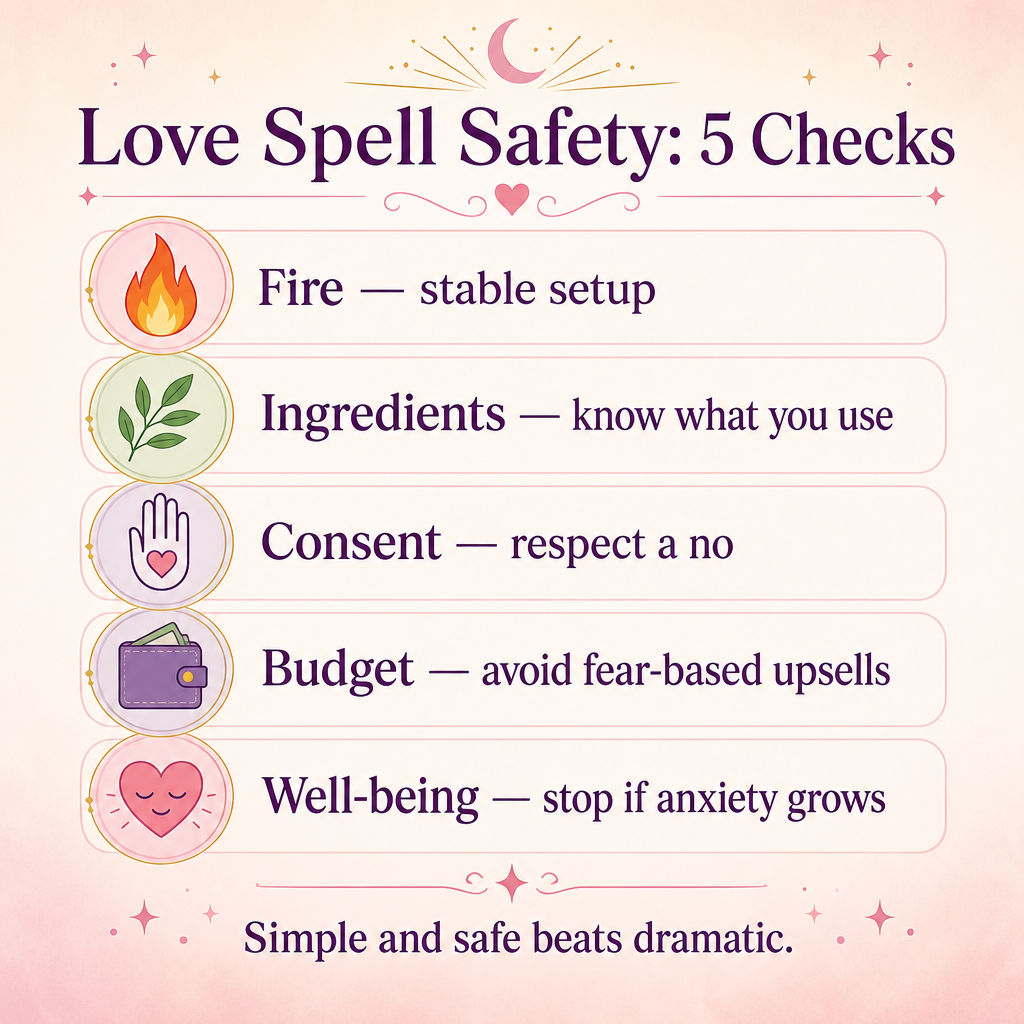
Love Spell Safety: Five Checks Before You Begin

Infographic with five practical love spell safety checks
Five practical checks help keep love-spell practice physically, emotionally, and financially safer.

6. Check Your Emotional State

Rituals performed during intense panic, jealousy, grief, or desperation can become part of a cycle of rumination. Before beginning, ask:

Am I calm enough to choose?
If not, delay the ritual.
Am I respecting reality?
Separate facts from hoped-for signs.
Am I sleeping and functioning normally?
Do not let ritual checking take over daily life.
Am I willing to accept more than one outcome?
Healthy practice leaves room for uncertainty.

Journaling, meditation, walking, or talking with someone you trust can be more useful than adding another ritual when emotions are overwhelming.

7. Set a Budget Before Paying a Practitioner

Spiritual services can become financially risky when fear is used to trigger repeated purchases. Be cautious if someone says:

  • A curse must be removed immediately.
  • Only they can prevent something terrible from happening.
  • You need a more expensive ritual every few days.
  • A guaranteed result requires one more payment.
  • You must keep paying or previous work will reverse.
Scam warning: pressure, threats, secrecy, guaranteed outcomes, and escalating emergency payments are warning signs—not proof of spiritual power.

The U.S. Federal Trade Commission provides general consumer guidance on scams and what to do if you paid someone you believe was fraudulent at FTC Consumer Advice.

8. Know What a Trustworthy Practitioner Sounds Like

A responsible practitioner should be able to explain what they offer, what it costs, and what they cannot guarantee. Positive signs include:

  • Transparent pricing.
  • No claims of guaranteed control over another person.
  • No threats about curses or consequences.
  • No pressure to keep buying upgrades.
  • Respect for consent and personal boundaries.
  • Willingness to say that a situation may require practical or professional help.

9. Choose the Simplest Safe Ritual That Fits

Complexity does not prove power. A quiet intention, journal entry, meditation, prayer, gratitude practice, or flameless candle may be just as meaningful as a larger ceremony. Our love spell glossary explains many common terms and tools without requiring that you use them all.

10. Know When Not to Use a Love Spell

Do not use spiritual practice as a substitute for urgent safety decisions. If a relationship includes threats, violence, stalking, coercive control, or serious financial abuse, prioritize safety and qualified support. If you have a medical or mental-health concern, seek appropriate professional care rather than relying on a ritual.

Frequently Asked Questions

1. Are love spells physically safe?

They can involve ordinary hazards such as open flame, smoke, oils, or herbs. Use standard physical safety precautions.

2. Is a flameless candle acceptable?

Yes. If the candle is symbolic, a battery-operated candle can remove the open-flame risk.

3. Can I leave a ritual candle burning overnight?

No. Open flames should not be left unattended or burning while you sleep.

4. Are all herbs safe to burn?

No. Only burn materials you can identify and use safely in a ventilated environment.

5. Can I drink crystal water?

Do not put unknown minerals in drinking water. Some minerals can release unsafe substances.

6. Is it safe to target a specific person?

A safer ethical approach focuses on mutual, compatible love rather than overriding another person’s choices.

7. Are dreams or signs consent?

No. Consent comes from the person, not from symbolic interpretation.

8. Should I repeat a spell every day?

Constant repetition can increase anxiety. Many believers prefer one clear intention followed by reflection and everyday life.

9. How much should I spend on a practitioner?

Set a budget you can afford to lose and avoid anyone who uses fear or escalating emergency payments.

10. Are guaranteed results a good sign?

No. No practitioner can guarantee another person’s feelings or decisions.

11. What if someone says I am cursed?

Do not let fear force an immediate payment. Seek a second perspective and protect your finances.

12. Can love spells replace counseling?

No. Spiritual practice may be personally meaningful, but it is not a substitute for qualified relationship or mental-health support.

13. What is the safest beginner practice?

Journaling, meditation, gratitude, prayer, or a flameless-candle intention ritual are low-risk starting points.

14. Do I need crystals or special tools?

No. Tools are optional symbols; intention and reflection do not require special objects.

15. When should I stop a ritual?

Stop if you feel unsafe, pressured, physically unwell, financially exploited, or increasingly obsessed with getting one specific outcome.

Final Thoughts

Safe love magic is less about collecting the right objects and more about using judgment. Protect yourself from fire and unsafe substances, respect another person’s free will, keep expectations realistic, and never let fear-based sales tactics control your spending.

A ritual can remain spiritually meaningful while being simple, grounded, and physically safe. The wisest practice is one that leaves you with more clarity, not more fear.

Love Spell Glossary: Essential Terms Every Believer Needs

0
Woman organizing symbolic love-spell items in a bright studio

Love-spell vocabulary comes from many different places: historical religious practices, folk magic, ceremonial magic, modern witchcraft, New Age spirituality, astrology, crystal culture, and internet communities. The supplied glossary brought these terms together, but it sometimes presented modern beliefs as if they were universal traditions.

This revised glossary keeps the believer-friendly purpose while clearly identifying spiritual concepts as beliefs and avoiding the idea that every term has the same history or authority.

How to use this glossary: treat definitions as orientation, not as proof that a spiritual claim is scientifically established. When a term belongs to a specific culture or tradition, learn from sources connected to that tradition.

Core Love-Spell and Spiritual Terms

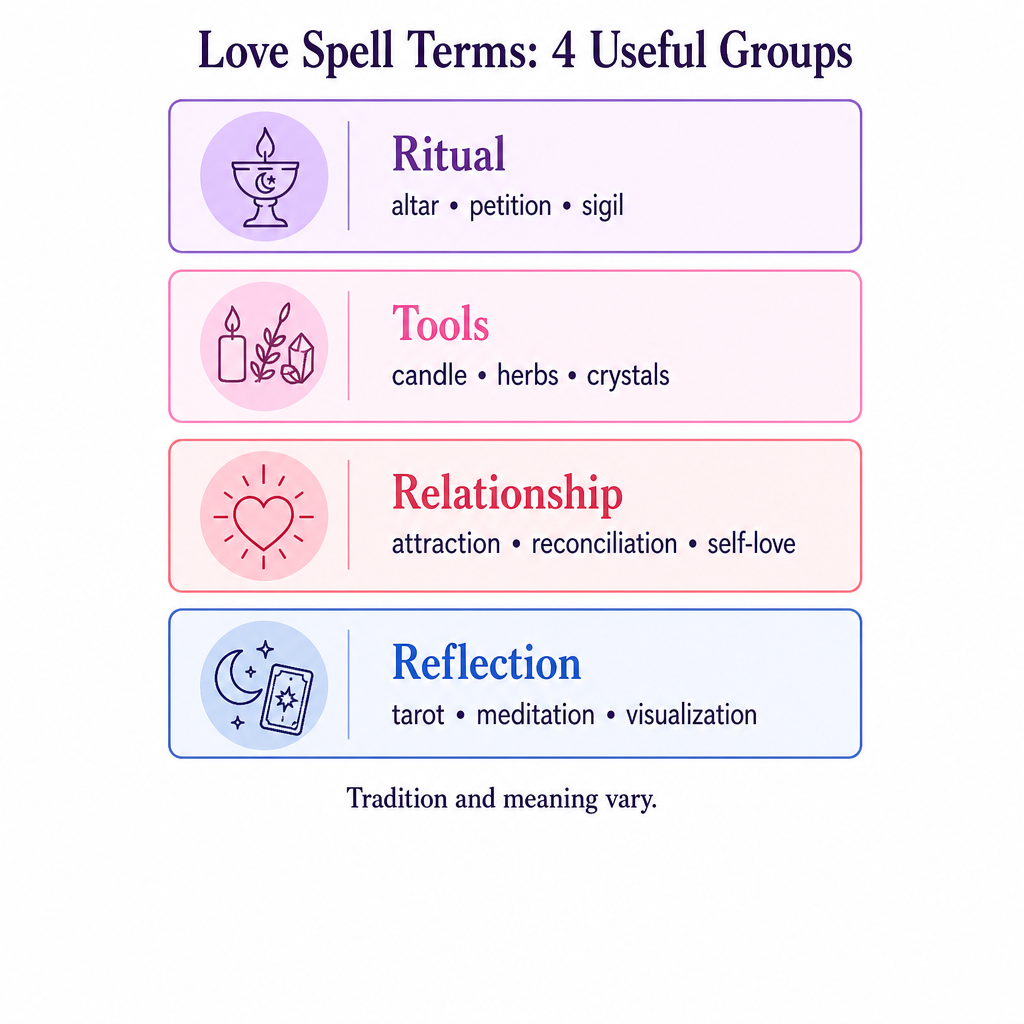
Love Spell Terms: 4 Useful Groups infographic

Affirmation

A repeated positive statement used by some practitioners to focus attention. It is better understood as a reflective tool than as a guarantee of an external result.

Altar

A dedicated surface or space used for ritual objects, prayer, reflection, or symbolic offerings. Altars exist in many religious and spiritual traditions, but their meanings differ.

Aura

A spiritual concept describing an energy field believed by some traditions to surround a person. It is a belief-based idea rather than a scientifically established physical field.

Binding spell

A term used differently across traditions. In relationship contexts, ethical practitioners may frame it around mutual commitment or symbolic connection; coercive interpretations raise consent concerns.

Blessing ritual

A ceremony or prayer intended to express hope, gratitude, protection, harmony, or goodwill.

Candle magic

A ritual practice using a candle as a symbol of intention. Color meanings vary by source and tradition.

Chakra

An energy-center concept associated with Indian religious and spiritual traditions and later modern wellness practices. The heart chakra is commonly linked symbolically with love and compassion.

Charm bag

A small pouch containing symbolic items such as herbs, written intentions, stones, or tokens, used in some folk and magical traditions.

Cord cutting

A modern symbolic release practice used to represent ending an attachment, pattern, or emotional tie.

Divination

A broad category of spiritual practices used to seek guidance or meaning, including tarot, pendulums, runes, and other systems.

Energy cleansing

A spiritual term for rituals intended to create a sense of symbolic clearing or preparation. Practices may include smoke, sound, prayer, water, or cleaning.

Full moon

A lunar phase with symbolic importance in many modern magical practices. Its ritual meaning is spiritual rather than proof of a causal effect on relationships.

Heart chakra

A modern English label for anahata, the fourth chakra in some Indian traditions, commonly associated with compassion and love.

Herbal magic

The symbolic use of plants in ritual. Historical and cultural meanings differ; herbs should not be assumed safe to ingest or burn simply because they appear in a ritual source.

Honey jar spell

A sweetening practice associated especially with African American folk-magic and hoodoo traditions. It is often described as a ritual intended to encourage warmer treatment or harmony.

Incense

A fragrant substance burned in religious or spiritual practice. Ventilation, allergies, pets, and fire safety should be considered.

Intention

The goal or purpose a practitioner brings to a ritual.

Knot magic

The use of knots, cords, or ribbons as symbols of intentions, promises, binding, or release in various folk and magical practices.

Love attraction spell

A ritual intended to symbolize openness to romance or compatible connection. A healthy framing avoids claims that it can force a particular person.

Love talisman

An object carried or kept as a symbolic reminder of a romantic, self-love, or relationship intention.

Manifestation

A modern term combining focused intention, visualization, belief, and often practical action toward a goal.

Meditation

A broad family of attention and awareness practices. It is used in both religious and secular settings and may be included before or after rituals.

Moon water

Water intentionally placed under moonlight in some modern spiritual practices and later used symbolically. It should be kept safe from contamination if it may contact skin.

Offering

A symbolic gift or act presented in a religious or spiritual context. Appropriate forms depend on the tradition.

Passion spell

A relationship-focused ritual associated with affection, romance, or sexual energy. Consent remains essential.

Pendulum

A weighted object suspended from a chain or cord and used in some divination practices. Its movements should not be treated as objective proof of another person’s thoughts.

Protection spell

A ritual intended to symbolize safety, boundaries, or protection from negativity. It does not replace practical safety measures.

Reconciliation spell

A ritual focused on healing, forgiveness, communication, or possible reunion. Reconnection still requires mutual willingness.

Rose quartz

A pink variety of quartz widely used in modern crystal spirituality as a symbol of love or compassion. Spiritual meanings are beliefs, separate from mineral facts.

Sacred space

A place prepared for prayer, meditation, ritual, or reflection.

Self-love spell

A ritual centered on self-respect, confidence, healing, or personal growth.

Sigil

A designed symbol that represents an intention, word, or idea in some magical systems.

Soulmate

A spiritual or cultural concept for a deeply significant relationship. Definitions differ widely.

Tarot reading

A card-based divination practice used for reflection or spiritual guidance. It cannot verify another person’s private thoughts or guarantee a future outcome.

Twin flame

A modern spiritual relationship concept describing an intense mirrored connection. It is not a scientific or clinical relationship category.

Visualization

The practice of deliberately imagining a desired situation or quality, often used in meditation, sports, therapy exercises, and spiritual practice.

Wax reading

The interpretation of shapes or patterns in cooled candle wax as a form of divination.

White candle

A candle commonly assigned symbolic meanings such as peace, clarity, blessing, or protection in modern magical practice.

Written petition

A handwritten statement of intention used symbolically in some rituals.

Zodiac compatibility

The comparison of astrological signs to interpret relationship dynamics. Astrology is a spiritual or cultural system, not a scientifically validated compatibility test.

Terms to Use With Extra Care

Some relationship-spirituality terms can become harmful when they are used to ignore another person’s choices. “Binding,” “soulmate,” “twin flame,” “destiny,” or “signs” should never be used as reasons to continue unwanted contact or to assume another person’s feelings.

If you are new to practical ritual structure, see How to Cast Love Spells. For candle symbolism, Can Candles Help With Love? provides more context.

Herbs, Crystals, and Ritual Tools

Tools can carry symbolic meaning without having to be described as physically powerful. A rose, a candle, a stone, or a handwritten petition may help a practitioner focus. They should not be presented as guaranteed mechanisms for changing another person.

For a broader herb reference, see Magical Herbs and Their Uses. Always separate symbolic use from ingestion, skin use, smoke exposure, and other physical-safety questions.

Traditional, Modern, and Informal Language

Type Examples How to interpret it
Longstanding spiritual/religious concepts altar, offering, meditation, chakra Meanings depend on the specific tradition and historical context.
Folk or magical practice terms honey jar, charm bag, petition, sigil Learn the cultural background rather than assuming one universal method.
Modern eclectic spirituality moon water, manifestation, cord cutting Often blends ideas from several sources and may have recent popular forms.
Modern relationship spirituality twin flame, synchronicity signs Use as personal spiritual language, not objective evidence about another person.

After a ritual, the article What Happens After a Love Spell Is Cast? explains how believers often interpret the period that follows.

Frequently Asked Questions

1. What is a love spell?

In this glossary, a love spell means a spiritual or folk ritual performed with an intention related to attraction, self-love, reconciliation, healing, harmony, or commitment. Beliefs and methods vary by tradition.

2. What is an intention?

An intention is the purpose you bring to a ritual or reflective practice. It can be as broad as becoming open to healthy love or as specific as improving communication in an existing relationship.

3. What is candle magic?

Candle magic is a ritual practice in which candles are used symbolically to represent an intention. Different traditions assign different meanings to colors and burning practices.

4. What is a reconciliation spell?

A reconciliation spell is a belief-based ritual focused on healing, forgiveness, communication, or the possibility of reconnecting. A healthy interpretation does not override either person’s choice.

5. What is a self-love spell?

A self-love spell is a ritual centered on confidence, self-respect, emotional healing, or personal growth.

6. What is manifestation?

Manifestation is a modern umbrella term for focusing attention, intention, visualization, and action on a desired goal. Spiritual interpretations differ widely.

7. What is a written petition?

A written petition is a note stating an intention or request that may be used symbolically during a ritual.

8. What is a sigil?

A sigil is a designed symbol used to represent an intention or concept in some magical traditions.

9. What is cord cutting?

Cord cutting is a symbolic release ritual used by some practitioners to represent letting go of an attachment, relationship, or emotional pattern.

10. What is a honey jar spell?

A honey jar is a sweetening ritual found in particular folk-magic traditions and is commonly described as a symbolic practice intended to encourage kinder or warmer interactions.

11. What is divination?

Divination is a spiritual practice used for reflection or guidance, such as tarot, pendulum work, or runes. It should not be treated as a verified way to read another person’s private thoughts.

12. What is a soulmate?

Soulmate is a spiritual or cultural idea describing a deeply meaningful connection. There is no single definition shared by all traditions.

13. What is a twin flame?

Twin flame is a modern spiritual relationship concept. It is not a clinical or scientific category and should not be used to justify unhealthy or unwanted pursuit.

14. What is spiritual cleansing?

Spiritual cleansing refers to symbolic practices intended to mark a fresh start or create a sense of ritual preparation, such as prayer, bathing, smoke, sound, or cleaning a space.

15. Are all glossary terms traditional?

No. Some terms are ancient or tied to specific traditions, while others are modern, eclectic, or informal. A careful glossary should identify that difference rather than treating every term as equally old or universal.

Final Thoughts on Love-Spell Vocabulary

A good glossary makes spiritual material easier to understand without flattening every practice into one system. Some words are historical, some are tradition-specific, some are modern, and some are simply informal community language.

Use the terms as a starting point, then learn the cultural history and practical context behind the ones that matter to your own spiritual path.

How Long Do Love Spells Take? Timing and Results Guide

0
Man reflecting on love-spell timing beside an analog clock and smartphone

After a love ritual, one of the most common questions is, “How long will this take?” The supplied draft correctly emphasized that there is no single timeline. That point is worth making even clearer: spiritual traditions may describe timing in symbolic ways, but no ritual can provide a dependable countdown for another person’s feelings or choices.

For believers, waiting can still be part of the practice. The useful goal is to combine spiritual reflection with real-world observation: Are you communicating more clearly? Are you less anxious? Is there mutual interest? Are you respecting boundaries? Those questions are more informative than counting days.

Key idea: Treat timing as a matter of spiritual interpretation, not a guarantee. Real relationships still depend on two people, real communication, and mutual choice.

Why There Is No Universal Love-Spell Timeline

People often want a number: three days, seven days, one lunar cycle, or a month. Different traditions may use numbers or moon phases symbolically, but they do not create a verified schedule for romantic outcomes. A person’s circumstances can change because of work, family, distance, healing, compatibility, or simple choice.

This is why a balanced approach separates two questions: “When might I notice something meaningful in my own practice?” and “When will another person do what I hope?” The first is about your reflection and behavior. The second cannot be promised by a ritual.

What Believers Often Notice First

The earliest changes described in spiritual communities are usually internal rather than dramatic. They may include:

  • Feeling calmer about the situation.
  • Having a clearer idea of the relationship you want.
  • Feeling more confident about communicating honestly.
  • Letting go of resentment or desperation.
  • Becoming more open to meeting compatible people.
  • Recognizing that a particular relationship may not be healthy to pursue.

These experiences can be meaningful whether you interpret them spiritually or simply as the result of focused reflection.

What About Moon Phases and Ritual Timing?

Many practitioners enjoy associating the new moon with beginnings, the waxing moon with growth, the full moon with culmination, and the waning moon with release. These are spiritual associations, not scientifically established relationship mechanisms.

If moon phases make your practice feel more intentional, they can serve as a calendar for reflection. For a broader discussion of when practitioners choose to perform rituals, see When to Cast a Spell.

Timing After the Ritual

The period after a ritual is often more useful when it is not spent constantly checking for proof. The article What Happens After a Love Spell Is Cast? explores that post-ritual stage in more detail.

Less useful approach More useful approach
Checking your phone every few minutes Watching for consistent, respectful communication over time
Interpreting every number or dream as proof Recording experiences without assuming they have one cause
Repeating rituals out of fear Giving yourself time and reviewing your real-life options
Waiting for a person to change Improving your own communication, boundaries, and confidence

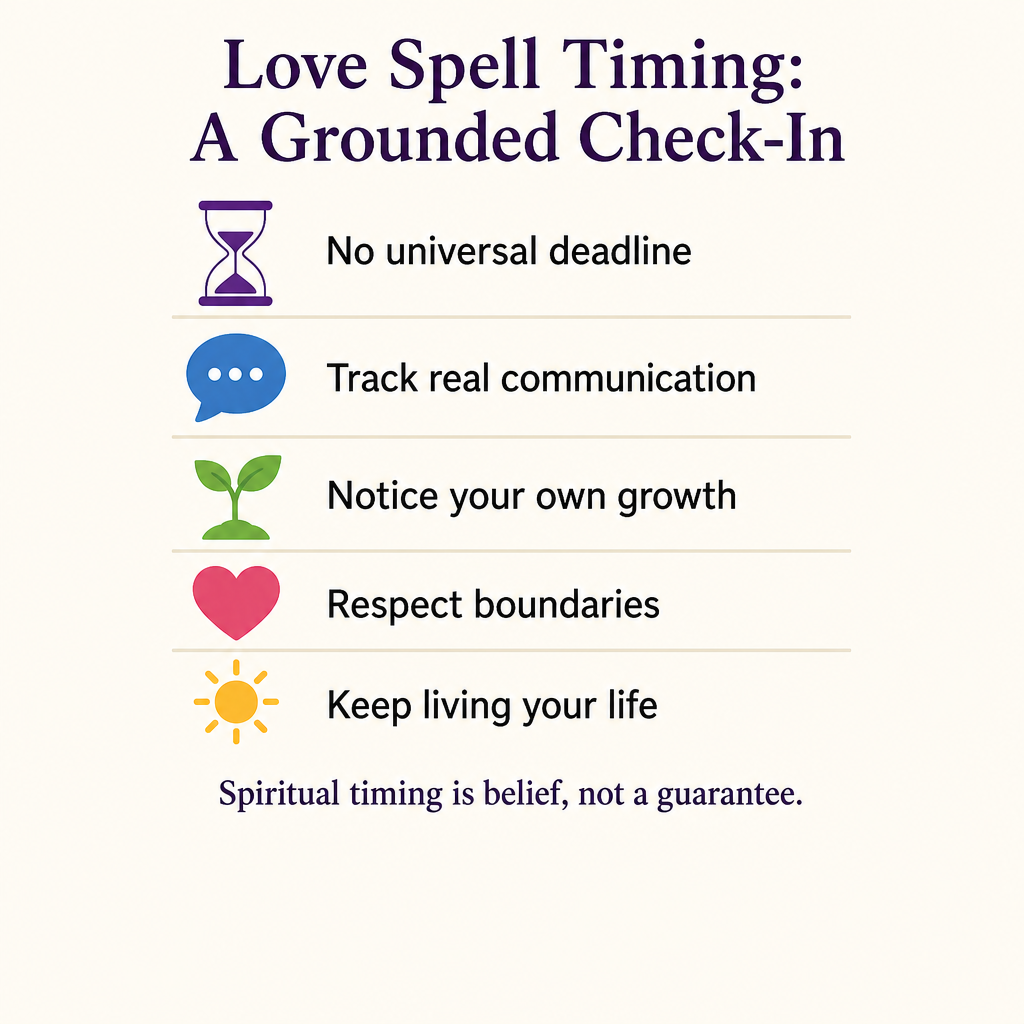
Love Spell Timing: A Grounded Check-In infographic

How Different Intentions Change What “Results” Mean

Attraction

A healthy attraction intention is less about making one specific person respond and more about becoming open to compatible opportunities. Results may look like greater confidence, more social activity, or clearer standards.

Self-Love

Self-love work is primarily internal. Progress may be easier to recognize because it can involve your own habits, self-respect, boundaries, and emotional recovery.

Reconciliation

Reconciliation depends on mutual willingness. A ritual cannot substitute for an apology, changed behavior, honest conversation, or consent. If you are considering reconnecting with an ex, the healthiest outcome may be reunion, closure, or simply greater clarity.

Relationship Harmony

For an existing relationship, focus on practical markers: better listening, fewer repeated conflicts, more appreciation, and shared effort. See Can Love Spells Strengthen Relationships Naturally? for a fuller guide.

Signs That Waiting Is Becoming Unhealthy

Spiritual practice should not trap you in a cycle of monitoring. Consider changing course if you are:

  • Ignoring a clear “no” or lack of response.
  • Putting work, friendships, sleep, or daily responsibilities on hold.
  • Spending money repeatedly because someone promises faster results.
  • Feeling pressured to buy stronger or more expensive rituals.
  • Interpreting every ordinary event as a message about one person.

For a practical reality-check approach, Using Common Sense for Love Spells is a useful companion.

A Simple Progress Journal

Instead of asking every day whether a ritual “worked,” try a weekly check-in. Record:

  1. Your original intention.
  2. Your mood and level of anxiety.
  3. Any real communication or relationship changes.
  4. Actions you took yourself.
  5. Whether boundaries were respected.
  6. What you learned about what you actually want.

This creates a more grounded record than relying on memory or a single coincidence.

Frequently Asked Questions

1. How long does a love spell usually take?

There is no reliable universal timeline. In spiritual traditions, some people interpret changes quickly while others notice nothing for weeks or months. Relationship outcomes also depend on ordinary factors such as mutual interest, communication, availability, and choice.

2. Can a love spell work overnight?

Some traditions contain stories about rapid results, but an overnight result should not be treated as a normal or guaranteed expectation. A sudden message or coincidence is not proof that a ritual caused it.

3. What counts as progress after a ritual?

A more useful measure is whether you are calmer, clearer about what you want, communicating better, respecting boundaries, and noticing real reciprocal changes in the relationship.

4. Do moon phases make a spell work faster?

Some practitioners attach symbolic meaning to moon phases, but there is no established evidence that a lunar phase determines whether a relationship outcome will occur or how fast it will happen.

5. Should I repeat the ritual if nothing happens?

Repeating a ritual immediately can feed anxiety. Many practitioners prefer to give one intention time, reflect on what is happening in real life, and only revisit the practice if it still feels meaningful.

6. Can anxiety make results harder to interpret?

Yes. Constant checking can make ordinary events feel unusually important. Keeping a simple journal and reviewing patterns over time can help separate a one-off coincidence from a meaningful change in your own behavior or relationship.

7. Is an unexpected text a sign the spell worked?

It may feel meaningful, but one message cannot establish cause. Pay attention to the quality and consistency of communication rather than treating a single contact as proof.

8. What if my desired person does not respond?

A lack of response should be respected. Spiritual practice should never be used as a reason to ignore another person’s boundaries or continue unwanted contact.

9. Do different love-spell types have different timelines?

Practitioners may describe them differently, but there is no verified timing chart. A self-love ritual, for example, is mostly about your own reflection, while reconciliation depends on two people’s choices.

10. Can personal growth be the main result?

Yes. Many believers consider increased confidence, emotional healing, clearer boundaries, and better decision-making meaningful outcomes even when a specific romantic outcome does not occur.

11. Should I stop living my normal life while waiting?

No. Continue friendships, hobbies, work, dating when appropriate, and ordinary relationship communication. A ritual should not become a reason to put your life on hold.

12. How long should I journal after a ritual?

There is no required period. A few weeks can be enough to notice whether your mood, behavior, communication, or expectations are changing without obsessively checking every day.

13. Can timing depend on another person’s feelings?

Any real relationship outcome necessarily depends on the other person’s interests, circumstances, and decisions. Mutual choice matters more than any claimed ritual timetable.

14. What if I feel worse after waiting for results?

Shift attention away from the ritual and toward grounding activities, supportive people, and practical decisions. If the process is increasing distress or compulsive checking, it is reasonable to stop.

15. What is the healthiest question to ask about timing?

Instead of asking when a specific person will act, ask whether your spiritual practice is helping you become clearer, kinder, more confident, and more open to a mutually chosen relationship.

Final Thoughts on Love-Spell Timing

There is no dependable number of days that applies to love spells. Believers may use timing, moon phases, or ritual calendars as meaningful spiritual frameworks, but relationship outcomes remain connected to real people and real choices.

The most constructive approach is patience without passivity: keep living your life, communicate respectfully, protect your boundaries, and notice whether the practice is helping you become clearer and healthier in the way you approach love.

Can Love Spells Strengthen Relationships Naturally?

0
Mature couple sharing a relationship ritual on an outdoor patio

Love-spell traditions are not only about attracting a new partner or reconnecting with an ex. Some rituals are intended for couples who are already together and want to focus on trust, appreciation, communication, or renewed closeness.

Relationship harmony rituals are spiritual or symbolic practices, not scientifically proven ways to repair a relationship. They work best as a meaningful structure for reflection and shared intention alongside honest communication, consent, and everyday effort.

What Relationship Harmony Spells Focus On

Rather than trying to change a partner’s personality or force affection, harmony-focused practices usually center on qualities both people want to strengthen.

  • Trust and reliability.
  • Open communication.
  • Patience during conflict.
  • Emotional safety.
  • Gratitude and affection.
  • Shared commitment.

This is similar to the intent behind a respectful binding ritual when the emphasis is on an existing mutual bond rather than control. Another related guide is White Magic and Fixing Relationships.

Why Shared Intention Matters

A relationship ritual becomes more constructive when both partners know what they are working toward. One person may want more affection while the other wants less conflict. Naming the shared goal can turn a vague wish for “stronger love” into something practical.

Examples of shared intentions include: “We want to listen without interrupting,” “We want to make more time for each other,” or “We want to rebuild trust through consistent actions.”

Simple Relationship Rituals Couples Can Share

Gratitude candle reflection

Light a candle safely and take turns naming one thing you appreciate about the other person. The candle is symbolic; the useful part is the intentional exchange of appreciation.

Intention letters

Each partner writes a short note describing what they hope the relationship feels like over the next few months. Compare the themes and choose one shared goal.

Shared walk

Take a phone-free walk and discuss one hope, one challenge, and one thing you are grateful for in the relationship.

Thirty-day gratitude journal

Each person writes one specific appreciation every day. Specific observations such as “You checked in when I was stressed” are more useful than repeating a general phrase.

Spiritual Practice Plus Everyday Behavior

A ritual cannot replace the actions that make relationships safer and more satisfying. If the intention is trust, keep promises. If the intention is communication, listen and speak honestly. If the intention is closeness, create regular time together.

  • Listen without preparing your rebuttal.
  • Repair misunderstandings instead of keeping score.
  • Show appreciation in ordinary moments.
  • Respect each other’s boundaries and independence.
  • Discuss shared plans instead of assuming agreement.
Infographic with five practical ways to strengthen a relationship

What a Relationship Spell Cannot Do

A harmony ritual cannot make an unwilling partner participate, erase serious incompatibility, or make harmful behavior acceptable. If one person repeatedly lies, threatens, controls, or ignores boundaries, the priority should be safety and clear decision-making rather than a ritual intended to preserve the relationship at any cost.

A Five-Step Harmony Practice

  1. Agree on one shared relationship intention.
  2. Choose a simple symbol such as a candle, flower, or written note.
  3. Each person says what the intention means in practical terms.
  4. Choose one action each partner will take during the next week.
  5. Review what changed and decide what needs continued attention.

Signs of Meaningful Progress

Instead of looking only for spiritual signs, notice patterns in the relationship itself. More respectful conversations, greater reliability, easier repair after disagreements, more laughter, increased appreciation, and stronger teamwork are practical signs that the relationship is moving in a healthier direction.

When a Ritual Is Especially Meaningful

Couples sometimes use symbolic rituals around anniversaries, moving in together, marriage, renewing vows, recovering from a stressful period, or starting a new life chapter. The date itself is less important than the shared intention and willingness to follow through.

Frequently Asked Questions

1. Can couples perform relationship love spells together?

Yes. Many believers find a shared ritual more meaningful because both partners can name the intention and participate willingly.

2. Are harmony spells different from attraction spells?

Yes. Harmony rituals focus on an existing relationship, while attraction rituals are generally associated with openness to new romantic opportunities.

3. Can a ritual replace communication?

No. Communication, trust, boundaries, and consistent behavior are still necessary for a healthy relationship.

4. When is a good time for a relationship ritual?

Anniversaries, milestones, stressful transitions, or any quiet time when both partners want to reconnect can be meaningful.

5. Do both partners have to share the same spiritual beliefs?

No, but both should be comfortable with the activity and agree on the practical relationship intention.

6. Can a love spell fix recurring arguments?

A ritual may create space for reflection, but recurring conflicts usually require different communication habits and attention to the underlying issue.

7. Are gratitude rituals considered love spells?

Some practitioners see them that way, while others view them simply as spiritual or relationship practices. Either way, the focus is appreciation.

8. Do we need candles or crystals?

No. Symbolic tools are optional. A conversation, journal, shared walk, or written intention can be enough.

9. Can a relationship ritual rebuild trust?

It can symbolize a commitment to rebuild trust, but trust itself returns through honesty, reliability, accountability, and time.

10. What if only one partner wants to continue the relationship?

A ritual cannot create mutual commitment. Both people must freely choose whether to continue.

11. Are anniversary rituals useful?

They can provide a meaningful time to appreciate the relationship, review shared goals, and renew commitments.

12. Can beginners try harmony rituals?

Yes. Simple gratitude, journaling, meditation, or intention-setting practices are accessible to beginners.

13. What are healthy signs of progress?

Look for better communication, more reliable behavior, respectful conflict repair, appreciation, teamwork, and mutual affection.

14. Can a ritual help during a stressful period?

It may create a calm moment to reconnect and clarify priorities, but practical stressors still need practical solutions.

15. What is the best intention for an existing relationship?

Choose a specific shared quality such as trust, communication, gratitude, patience, closeness, or teamwork rather than trying to control a partner.

Final Thoughts

Relationship love spells are most constructive when they serve as shared reminders to care for a bond that already exists. A ritual can create a meaningful pause for gratitude or intention, but the relationship grows through what both partners do afterward: communicate, keep promises, repair conflict, and continue choosing each other freely.

Can Love Spells Bring an Ex Back? A Spiritual Guide

0
Woman reflecting on reconciliation with journal and smartphone

After a breakup, it is common to replay unfinished conversations, shared memories, and the possibility of reconnecting. That is why many people become curious about reconciliation love spells. In many spiritual traditions, these rituals are framed as practices for healing and renewed communication rather than a way to force an ex to return.

Spiritual belief and real-world outcome are different things. Love spells are not scientifically established methods for changing another person’s feelings, and no ritual can guarantee reconciliation. A healthy reunion requires mutual choice.

What a Reconciliation Love Spell Is Meant to Do

Within love-spell traditions, reconciliation work is usually centered on conditions that may support a healthier conversation: forgiveness, reduced resentment, emotional clarity, compassion, and openness. The goal is not to manufacture feelings that are not there.

  • Encourage calm reflection.
  • Support forgiveness without excusing harmful behavior.
  • Clarify whether reconnecting is genuinely wanted.
  • Focus on respectful communication.
  • Leave room for either reconciliation or closure.

For a broader look at what people believe happens after spiritual work, see what happens after a love spell is cast. If your intentions have changed, the companion guide on removing or releasing a love spell may be more useful.

When Reconciliation May Be Worth Exploring

Some breakups happen because of miscommunication, temporary distance, work or family pressures, or other circumstances rather than a complete loss of care. In those situations, a ritual can be used as a private way to clarify what would need to change before a reunion would actually be healthy.

Ask what changed

Wanting someone back is not the same as being ready to rebuild. Ask what you learned, what caused the breakup, what you would do differently, and whether both people could realistically create a better pattern.

Look for mutual willingness

A message, dream, coincidence, or strong intuition is not a substitute for consent. The clearest sign that reconciliation is possible is respectful, mutual communication.

Respect space

If your ex asks for distance, honor it. Spiritual practice should never be used as a reason to pressure, repeatedly contact, monitor, or manipulate someone.

Reconciliation vs. Control

A useful ethical line is simple: focus on the relationship conditions you hope to welcome, not on controlling a named person’s thoughts. Intentions such as “May communication become honest and peaceful” or “May the healthiest outcome unfold for both of us” preserve more room for free will than “Make this person return to me.”

RelationshipSpell.com also has a practical overview of reconciliation spells and healing past relationships, which complements this question-focused guide.

When Healing Is the Better Intention

Not every relationship should be restored, especially where there has been repeated dishonesty, ongoing disrespect, emotional harm, incompatible life goals, or chronic unhappiness. In those cases, a self-love or release ritual can be more constructive than trying to reopen the relationship.

  • Choose closure when contact is unwelcome.
  • Choose boundaries when old patterns remain unchanged.
  • Choose support when the breakup is overwhelming.
  • Choose safety over spiritual interpretation if there was abuse, threats, stalking, or coercion.

A Simple Reconciliation Reflection Ritual

  1. Write one sentence describing the healthiest outcome you can accept.
  2. List what you miss and, separately, what was difficult in the relationship.
  3. Write three changes that would be necessary for a healthy reunion.
  4. Spend several quiet minutes breathing or meditating.
  5. Close with an intention that respects both people’s freedom to choose.

This is deliberately a reflection practice rather than a promise of supernatural control. It can help you move from desperation toward a clearer decision.

Signs to Evaluate Carefully

Believers may notice calmer feelings, greater clarity, improved communication, unexpected contact, forgiveness, or feeling emotionally lighter. Those experiences can be meaningful personally, but they should not be treated as proof that a spell caused another person’s behavior.

More useful questions are: Is communication respectful? Are old problems being addressed? Are both people choosing to reconnect? Are actions consistent over time?

Patience Without Passive Waiting

Healthy reconciliation is active. If you want another chance, work on communication, accountability, boundaries, and the issues that contributed to the breakup. Personal growth and respectful boundaries matter more than simply waiting for a result.

Infographic checklist for healthy reconciliation and free will

Frequently Asked Questions

1. Can a love spell guarantee my ex will come back?

No spiritual practice can guarantee another person’s decision. Reconciliation depends on mutual feelings, circumstances, communication, and the choices both people make.

2. What is a reconciliation love spell?

In many spiritual traditions, it is a symbolic ritual focused on healing, forgiveness, communication, and openness to a possible reunion rather than control.

3. Can a reconciliation spell override free will?

A respectful approach does not aim to override free will. Healthy reconciliation requires both people to choose the relationship willingly.

4. How long does a reconciliation spell take?

There is no reliable timetable. Believers often describe spiritual work as gradual, while real-world reconciliation can take time because trust and communication may need rebuilding.

5. What if my ex never contacts me?

That outcome may mean the relationship is not reopening. The ritual can still serve as a period of reflection, healing, and clarification about what you want next.

6. Should I contact my ex after a spell?

Only if contact is appropriate, welcome, and respectful. A ritual is not a reason to ignore a request for space or a clear boundary.

7. Can beginners perform reconciliation rituals?

Many beginners choose simple practices such as journaling, meditation, prayer, affirmations, or a candle ritual focused on clarity and healing.

8. Should I cast the same spell repeatedly?

Many traditions recommend one clear intention followed by patience and reflection instead of repeating rituals from anxiety or desperation.

9. What makes reconciliation more realistic?

Mutual interest, honest communication, accountability, changed behavior, compatible goals, and willingness to rebuild trust make reconciliation more realistic.

10. What if the breakup involved repeated disrespect?

A reunion may not be the healthiest goal. Self-love, healing, support, and strong boundaries may be more appropriate than reconciliation work.

11. Are unexpected dreams or coincidences proof the spell worked?

Believers may find them personally meaningful, but they are not objective proof that another person’s feelings or decisions have changed.

12. Can a spell fix broken trust?

A ritual may help someone focus on healing, but trust is rebuilt through consistent behavior, honesty, accountability, and time.

13. Is it better to focus on a specific ex or on the best outcome?

A broader intention such as healing, clarity, and the healthiest outcome can leave more room for mutual choice and personal growth.

14. Can reconciliation lead to a stronger relationship?

It can when both people address the reasons for the breakup, communicate differently, and make sustainable changes rather than simply resuming old patterns.

15. When should I stop pursuing reconciliation?

If the other person clearly says no, asks for no contact, or the relationship was harmful or unsafe, respect that boundary and redirect your energy toward healing.

Final Thoughts

A love spell cannot guarantee that an ex will return. In a balanced spiritual approach, reconciliation rituals are best used to focus hope, healing, clarity, and respectful communication while accepting that the other person has full freedom to choose. If a reunion happens, what makes it last will be the relationship you build afterward—not the ritual itself.