

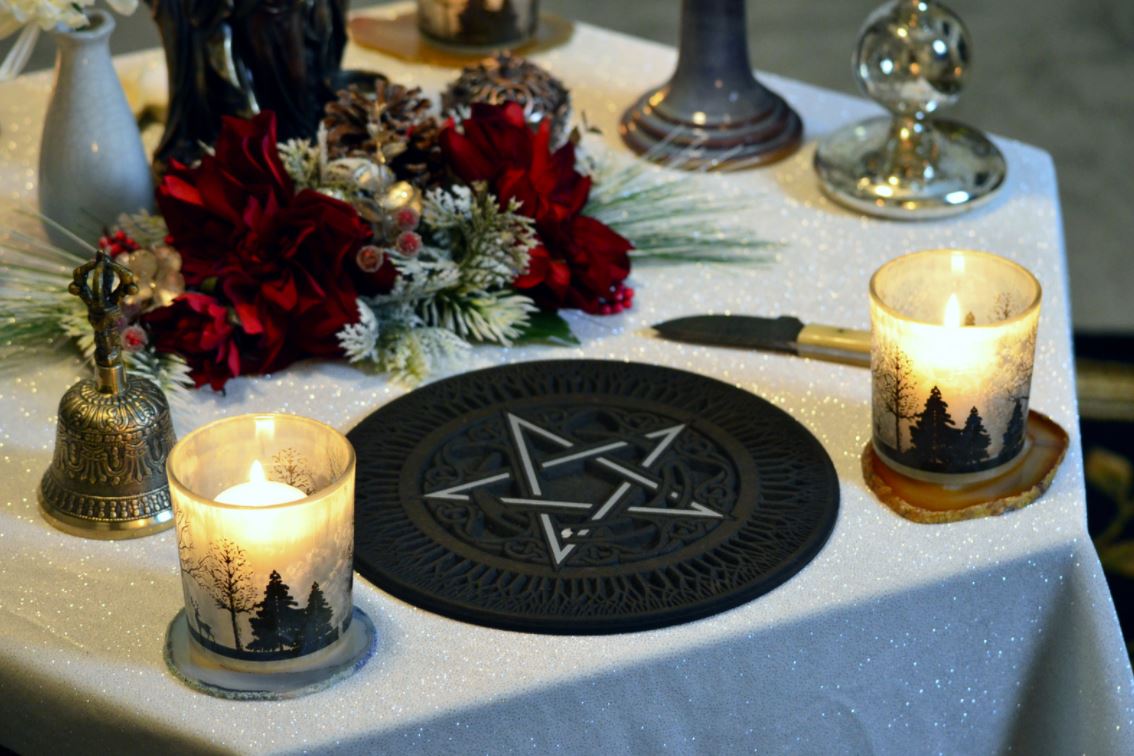
Beginning witchcraft can feel exciting and confusing at the same time. One guide tells you to buy tools, another tells you to follow the Moon, and a third presents a long list of spiritual labels. You do not have to settle every question before taking a thoughtful first step.
Start by noticing what draws you in. Perhaps it is the symbolism of a candle, a sense of connection outdoors, the language of tarot, or a wish to make everyday life feel more intentional. That interest can guide your learning without requiring you to promise a particular result or adopt someone else’s entire worldview.
What does witchcraft mean in this guide?
People use the word witchcraft in different religious, cultural and personal ways. Here, the focus is on beginning a personal practice of symbolic ritual, spiritual reflection and learning. This is not a claim that every tradition has the same beliefs or that a short introductory exercise grants access to every tradition’s rites.
Wicca is one modern Pagan religious path associated with witchcraft. It is not a label that every person interested in witchcraft uses. The Covenant of the Goddess’s Wicca FAQ describes its religious context and the variation among groups. Read such sources in their own context rather than treating one group’s practice as a rule for everyone.
For a broader look at identity and common stereotypes, see what it means to be a witch. The next steps here are about learning and beginning a practice.
Learn a few terms before collecting techniques
- Intention: The purpose you bring to a practice. Writing it clearly helps you understand what you are choosing to do.
- Ritual: A deliberate sequence of actions given meaning by a person or community. Its form depends on its context.
- Correspondence: An association between a symbol or material and an idea, such as a colour representing an intention. Associations can vary between sources.
- Divination: Practices for seeking or interpreting guidance through symbols, signs or tools. A reading is an interpretation, not access to another person’s private thoughts.
- Book of Shadows: A name many practitioners use for a record of their study and practice. Follow your tradition’s use of the term, or simply call yours a journal.
You may also encounter the word energy. Ask what the writer means by it. In a personal journal, record the actual feeling or experience: alert, peaceful, distracted, emotionally moved, or something else. You do not have to assign yourself a vibration score or claim to measure a spiritual frequency.
Choose one starting point that interests you
Rather than choosing a permanent type of witch, choose an activity you want to understand. The following are starting points for study, not a personality test or a ranking of spiritual ability.
Explore why a particular word, image or everyday object feels meaningful. Learn where its associations come from.
Observe a tree, the changing daylight or your local surroundings. Keep notes without needing to gather plants or objects.
Learn one symbol or card in context. Compare an initial impression with the source’s explanation.
If you feel drawn to gods, spirits or a particular religious tradition, begin by learning from that community’s own explanations. Find out whether practices are openly shared, taught through a lineage or subject to specific expectations. You can be curious without claiming a tradition as your own immediately.
A first-week learning plan
This plan is flexible. Each part can take more than a day, and you can pause at any point. Its purpose is to move from collecting ideas to understanding what you actually want to practise.
- Write down your interest. Complete: I am curious about this because… Name one question you would like to answer. You might want to understand why a symbol keeps catching your attention, or how ritual fits with your beliefs.
- Read one source carefully. Note the author, title and tradition or perspective. Separate what the source teaches from what you personally believe. Write down an unfamiliar term instead of rushing to copy a whole ritual.
- Observe without forcing a message. Spend a little time with a symbol, an outdoor view or a quiet moment. Record what you noticed first, then any meaning you associate with it. Not every event needs a spiritual explanation.
- Try the simple reflection below. Use words and paper rather than adding unfamiliar ingredients. Connect your intention to one action within your control.
- Review and choose your next question. What felt useful? What was confusing? Would you like to repeat the practice, study another source or take a break? There is no requirement to make a purchase or choose a new identity.
Try a simple written intention
Choose a place where you can sit comfortably. Put a notebook or piece of paper in front of you. Settle your attention in whatever ordinary way feels comfortable; you do not need to create a special sensation.
Write an intention centred on your own choices. For example: I want to communicate with more honesty and care. Below it, write one small action: I will think through what I need to say before our next conversation. Read both sentences, then decide when you will return to the note.
You can regard that moment as sacred, reflective or simply intentional, according to your beliefs. The words mark your commitment. They do not require another person to reply, forgive or feel a certain way.
If you want to develop a more structured piece of spellwork later, use the spell-writing guide alongside what you have learned about your chosen tradition. If lunar timing interests you, the eight-phase Moon guide explains the cycle and offers a free way to check the current phase.
A free journal page you can copy
My question: What am I trying to understand?
My source: Who taught this idea, and in what context?
My intention: What am I choosing to practise?
What I did: What actually happened during the activity?
What I noticed: What did I see, feel or think?
My interpretation: What meaning am I considering, and what else could explain it?
My next step: What will I study, repeat, change or leave alone?
This page does not produce a psychic score or certify a result. It gives you a way to reflect clearly over time. A blank answer is useful too: it can show where you need more information.
Keep the practice within your means and comfort
You do not need to start with herbs, blades, smoke, a collection of crystals or an open flame. The budget witchcraft guide and free spending planner can help you consider supplies without treating shopping as proof of commitment.
Do not copy an unfamiliar recipe for burning, drinking or applying something to your body just because it is described as magical. Learn about the material and its intended use first. If a practice feels frightening, overwhelming or uncomfortable, you can stop; that feeling does not oblige you to keep going or pay someone to remove a supposed problem.
Learn from people without handing over your judgment
A book, class or group can offer context that scattered social posts lack. Ask practical questions before joining: What tradition is being taught? What are the costs? Can I observe before participating? How are consent and privacy handled? What happens if I decline an activity?
Be cautious about anyone who demands secrecy about mistreatment, pressures you into personal or sexual contact, or insists that only expensive work can prevent a disaster. Respectful learning leaves room for questions, boundaries and a decision to leave.
For your first week, one clear question and one manageable practice are enough. Let your next step come from what you have learned, rather than from pressure to prove that you belong.
Beginning witchcraft: common questions
1. Do I need to be born with psychic abilities to begin?
You can explore personal ritual, symbolism, journaling and spiritual study without claiming special powers. Curiosity and a willingness to learn are enough for these introductory activities; a feeling of connection is not a test you must pass.
2. Is witchcraft the same as Wicca?
Not always. Wicca is a particular modern Pagan religious path that includes witchcraft, while people also use witchcraft for other religious or nonreligious practices. Ask how a source or community uses each word rather than assuming everyone shares one definition.
3. Do I have to choose a type of witch immediately?
No. Labels can help you find topics to study, but you do not need to choose a permanent identity before beginning. Learn about one practice and its context before combining several traditions.
4. What do I need for a first practice?
For the simple reflection in this guide, use paper, a pen and a quiet place. No candle, herb, crystal, knife or special clothing is required. Formal traditions may have different requirements for their own rites.
5. Do I need to wait for a full moon?
Not for the introductory written practice here. Some traditions give lunar timing a spiritual role, but you can start learning, keeping notes and reflecting at a time that fits your life.
6. Must I tell everyone I am interested in witchcraft?
No. You can decide what to share, with whom and when. Consider your privacy and circumstances. You do not owe public disclosure, and keeping personal spiritual notes private is a reasonable choice.
7. Should I work alone or find a teacher?
Either can be a starting point. If you seek a teacher or group, ask about their tradition, expectations, costs, consent and privacy. You should be able to ask questions, decline an activity and leave without pressure.
8. What should I record in a Book of Shadows?
Record the source you studied, what you intended, what you actually did, what you noticed and what you want to understand next. Keep observations separate from interpretations so you can revisit them fairly.
9. What if I do not sense energy or see signs?
You do not need to force a sensation or treat ordinary events as messages. Note what you experienced without grading yourself. You can focus on study or a simple reflective practice, change your approach or take a break.
10. What if a spell does not bring the outcome I wanted?
Do not assume you failed or need to pay for a stronger ritual. Revisit your intention, the real-world circumstances and the actions within your control. Another person remains free to make their own choices.