
Love-spell vocabulary comes from many different places: historical religious practices, folk magic, ceremonial magic, modern witchcraft, New Age spirituality, astrology, crystal culture, and internet communities. The supplied glossary brought these terms together, but it sometimes presented modern beliefs as if they were universal traditions.
This revised glossary keeps the believer-friendly purpose while clearly identifying spiritual concepts as beliefs and avoiding the idea that every term has the same history or authority.
Core Love-Spell and Spiritual Terms
Affirmation
A repeated positive statement used by some practitioners to focus attention. It is better understood as a reflective tool than as a guarantee of an external result.
Altar
A dedicated surface or space used for ritual objects, prayer, reflection, or symbolic offerings. Altars exist in many religious and spiritual traditions, but their meanings differ.
Aura
A spiritual concept describing an energy field believed by some traditions to surround a person. It is a belief-based idea rather than a scientifically established physical field.
Binding spell
A term used differently across traditions. In relationship contexts, ethical practitioners may frame it around mutual commitment or symbolic connection; coercive interpretations raise consent concerns.
Blessing ritual
A ceremony or prayer intended to express hope, gratitude, protection, harmony, or goodwill.
Candle magic
A ritual practice using a candle as a symbol of intention. Color meanings vary by source and tradition.
Chakra
An energy-center concept associated with Indian religious and spiritual traditions and later modern wellness practices. The heart chakra is commonly linked symbolically with love and compassion.
Charm bag
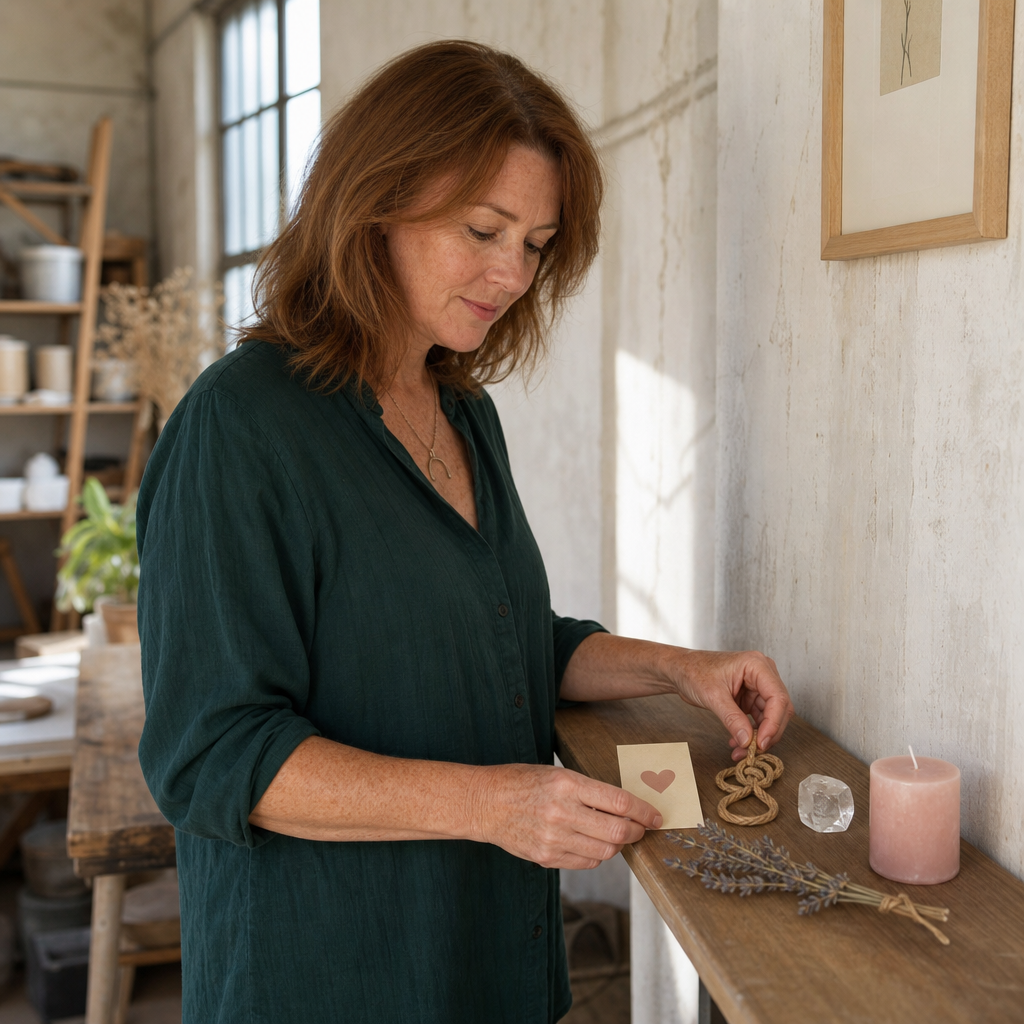
A small pouch containing symbolic items such as herbs, written intentions, stones, or tokens, used in some folk and magical traditions.
Cord cutting
A modern symbolic release practice used to represent ending an attachment, pattern, or emotional tie.
Divination
A broad category of spiritual practices used to seek guidance or meaning, including tarot, pendulums, runes, and other systems.
Energy cleansing
A spiritual term for rituals intended to create a sense of symbolic clearing or preparation. Practices may include smoke, sound, prayer, water, or cleaning.
Full moon
A lunar phase with symbolic importance in many modern magical practices. Its ritual meaning is spiritual rather than proof of a causal effect on relationships.
Heart chakra
A modern English label for anahata, the fourth chakra in some Indian traditions, commonly associated with compassion and love.
Herbal magic
The symbolic use of plants in ritual. Historical and cultural meanings differ; herbs should not be assumed safe to ingest or burn simply because they appear in a ritual source.
Honey jar spell
A sweetening practice associated especially with African American folk-magic and hoodoo traditions. It is often described as a ritual intended to encourage warmer treatment or harmony.
Incense
A fragrant substance burned in religious or spiritual practice. Ventilation, allergies, pets, and fire safety should be considered.
Intention
The goal or purpose a practitioner brings to a ritual.
Knot magic
The use of knots, cords, or ribbons as symbols of intentions, promises, binding, or release in various folk and magical practices.
Love attraction spell
A ritual intended to symbolize openness to romance or compatible connection. A healthy framing avoids claims that it can force a particular person.
Love talisman
An object carried or kept as a symbolic reminder of a romantic, self-love, or relationship intention.
Manifestation
A modern term combining focused intention, visualization, belief, and often practical action toward a goal.
Meditation
A broad family of attention and awareness practices. It is used in both religious and secular settings and may be included before or after rituals.
Moon water
Water intentionally placed under moonlight in some modern spiritual practices and later used symbolically. It should be kept safe from contamination if it may contact skin.
Offering
A symbolic gift or act presented in a religious or spiritual context. Appropriate forms depend on the tradition.
Passion spell
A relationship-focused ritual associated with affection, romance, or sexual energy. Consent remains essential.
Pendulum
A weighted object suspended from a chain or cord and used in some divination practices. Its movements should not be treated as objective proof of another person’s thoughts.
Protection spell
A ritual intended to symbolize safety, boundaries, or protection from negativity. It does not replace practical safety measures.
Reconciliation spell
A ritual focused on healing, forgiveness, communication, or possible reunion. Reconnection still requires mutual willingness.
Rose quartz
A pink variety of quartz widely used in modern crystal spirituality as a symbol of love or compassion. Spiritual meanings are beliefs, separate from mineral facts.
Sacred space
A place prepared for prayer, meditation, ritual, or reflection.
Self-love spell
A ritual centered on self-respect, confidence, healing, or personal growth.
Sigil
A designed symbol that represents an intention, word, or idea in some magical systems.
Soulmate
A spiritual or cultural concept for a deeply significant relationship. Definitions differ widely.
Tarot reading
A card-based divination practice used for reflection or spiritual guidance. It cannot verify another person’s private thoughts or guarantee a future outcome.
Twin flame
A modern spiritual relationship concept describing an intense mirrored connection. It is not a scientific or clinical relationship category.
Visualization
The practice of deliberately imagining a desired situation or quality, often used in meditation, sports, therapy exercises, and spiritual practice.
Wax reading
The interpretation of shapes or patterns in cooled candle wax as a form of divination.
White candle
A candle commonly assigned symbolic meanings such as peace, clarity, blessing, or protection in modern magical practice.
Written petition
A handwritten statement of intention used symbolically in some rituals.
Zodiac compatibility
The comparison of astrological signs to interpret relationship dynamics. Astrology is a spiritual or cultural system, not a scientifically validated compatibility test.
Terms to Use With Extra Care
Some relationship-spirituality terms can become harmful when they are used to ignore another person’s choices. “Binding,” “soulmate,” “twin flame,” “destiny,” or “signs” should never be used as reasons to continue unwanted contact or to assume another person’s feelings.
If you are new to practical ritual structure, see How to Cast Love Spells. For candle symbolism, Can Candles Help With Love? provides more context.
Herbs, Crystals, and Ritual Tools
Tools can carry symbolic meaning without having to be described as physically powerful. A rose, a candle, a stone, or a handwritten petition may help a practitioner focus. They should not be presented as guaranteed mechanisms for changing another person.
For a broader herb reference, see Magical Herbs and Their Uses. Always separate symbolic use from ingestion, skin use, smoke exposure, and other physical-safety questions.
Traditional, Modern, and Informal Language
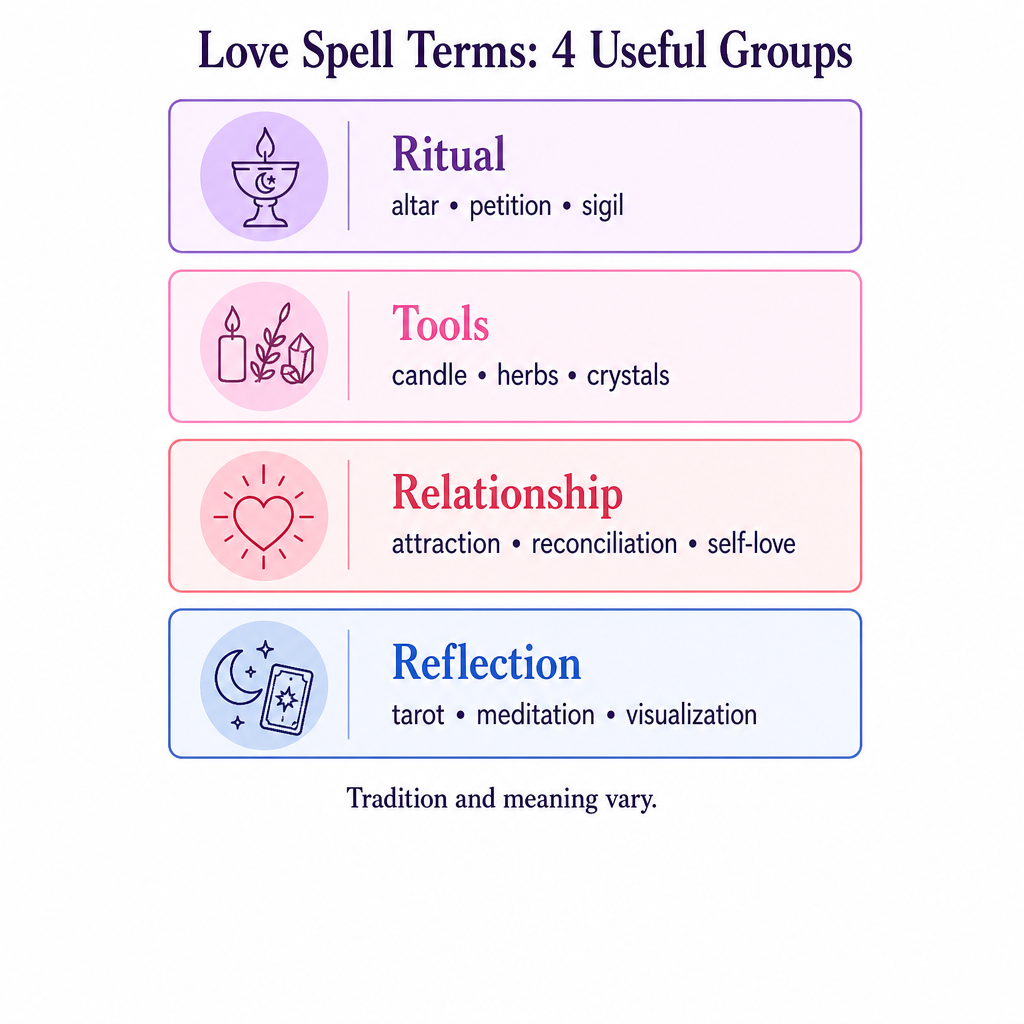
| Type | Examples | How to interpret it |
|---|---|---|
| Longstanding spiritual/religious concepts | altar, offering, meditation, chakra | Meanings depend on the specific tradition and historical context. |
| Folk or magical practice terms | honey jar, charm bag, petition, sigil | Learn the cultural background rather than assuming one universal method. |
| Modern eclectic spirituality | moon water, manifestation, cord cutting | Often blends ideas from several sources and may have recent popular forms. |
| Modern relationship spirituality | twin flame, synchronicity signs | Use as personal spiritual language, not objective evidence about another person. |
After a ritual, the article What Happens After a Love Spell Is Cast? explains how believers often interpret the period that follows.
Frequently Asked Questions
1. What is a love spell?
In this glossary, a love spell means a spiritual or folk ritual performed with an intention related to attraction, self-love, reconciliation, healing, harmony, or commitment. Beliefs and methods vary by tradition.
2. What is an intention?
An intention is the purpose you bring to a ritual or reflective practice. It can be as broad as becoming open to healthy love or as specific as improving communication in an existing relationship.
3. What is candle magic?
Candle magic is a ritual practice in which candles are used symbolically to represent an intention. Different traditions assign different meanings to colors and burning practices.
4. What is a reconciliation spell?
A reconciliation spell is a belief-based ritual focused on healing, forgiveness, communication, or the possibility of reconnecting. A healthy interpretation does not override either person’s choice.
5. What is a self-love spell?
A self-love spell is a ritual centered on confidence, self-respect, emotional healing, or personal growth.
6. What is manifestation?
Manifestation is a modern umbrella term for focusing attention, intention, visualization, and action on a desired goal. Spiritual interpretations differ widely.
7. What is a written petition?
A written petition is a note stating an intention or request that may be used symbolically during a ritual.
8. What is a sigil?
A sigil is a designed symbol used to represent an intention or concept in some magical traditions.
9. What is cord cutting?
Cord cutting is a symbolic release ritual used by some practitioners to represent letting go of an attachment, relationship, or emotional pattern.
10. What is a honey jar spell?
A honey jar is a sweetening ritual found in particular folk-magic traditions and is commonly described as a symbolic practice intended to encourage kinder or warmer interactions.
11. What is divination?
Divination is a spiritual practice used for reflection or guidance, such as tarot, pendulum work, or runes. It should not be treated as a verified way to read another person’s private thoughts.
12. What is a soulmate?
Soulmate is a spiritual or cultural idea describing a deeply meaningful connection. There is no single definition shared by all traditions.
13. What is a twin flame?
Twin flame is a modern spiritual relationship concept. It is not a clinical or scientific category and should not be used to justify unhealthy or unwanted pursuit.
14. What is spiritual cleansing?
Spiritual cleansing refers to symbolic practices intended to mark a fresh start or create a sense of ritual preparation, such as prayer, bathing, smoke, sound, or cleaning a space.
15. Are all glossary terms traditional?
No. Some terms are ancient or tied to specific traditions, while others are modern, eclectic, or informal. A careful glossary should identify that difference rather than treating every term as equally old or universal.
Final Thoughts on Love-Spell Vocabulary
A good glossary makes spiritual material easier to understand without flattening every practice into one system. Some words are historical, some are tradition-specific, some are modern, and some are simply informal community language.
Use the terms as a starting point, then learn the cultural history and practical context behind the ones that matter to your own spiritual path.