


Love spell ethics starts with a simple limit: a meaningful ritual is not permission to control another person. You can use spiritual practice to explore hope, confidence and grief while leaving someone else free to choose a relationship—or decline one.
This guide treats love spells as spiritual or symbolic practices, not a proven way to change another person’s feelings. No ritual guarantees attraction, reconciliation or commitment. The practical question is whether your intention and your actions respect consent, privacy and real-world boundaries.
Consent is the starting point
Consent involves a freely given agreement, not silence, pressure or an assumption based on past affection. RAINN’s consent guidance explains the importance of clear communication and the freedom to change one’s mind. Its guidance concerns sexual consent; this article applies the broader ethical principle of respecting choice to spiritual practice.
You do not need permission to have a private feeling or write in your own journal. But private hope does not authorize using someone else’s belongings, sharing their personal information with a reader, or demanding a response. A person who once wanted a relationship can choose not to continue it.
Compare two intentions: “Help me communicate honestly if we both want contact” leaves room for choice. “Make this person obsessed and unable to leave” treats choice as an obstacle. Even without evidence that a spell can produce either result, the second intention can encourage unhealthy behavior in the person performing it.
Three areas of responsibility
Your choices
Confidence, honesty, patience, reflection and how you respond to disappointment are appropriate personal intentions.
Shared participation
A couple can choose a ritual together. Agree on its purpose, materials and limits. Either person can stop.
Another person’s decisions
Their attraction, privacy, relationships and decision to leave remain theirs. Do not try to bypass these limits.
Boundaries outweigh signs and predictions
A repeated number, vivid dream or hopeful reading can feel personally significant. It cannot tell you that someone has consented to contact. If a person has blocked you or requested space, do not use another number, a friend’s account or an unexpected visit to get around that boundary.
Love is respect’s guide to setting boundaries and emphasizes communicating what makes each person feel respected. In practice, ask rather than assume—and accept an answer you do not prefer.
Keep two separate records if symbolism is important to you: what an experience means to you, and what the other person has actually communicated. The first belongs in reflection. The second governs whether you should approach them. When consent is unclear, do not escalate romantic or physical contact.
The CARE check for love spell ethics
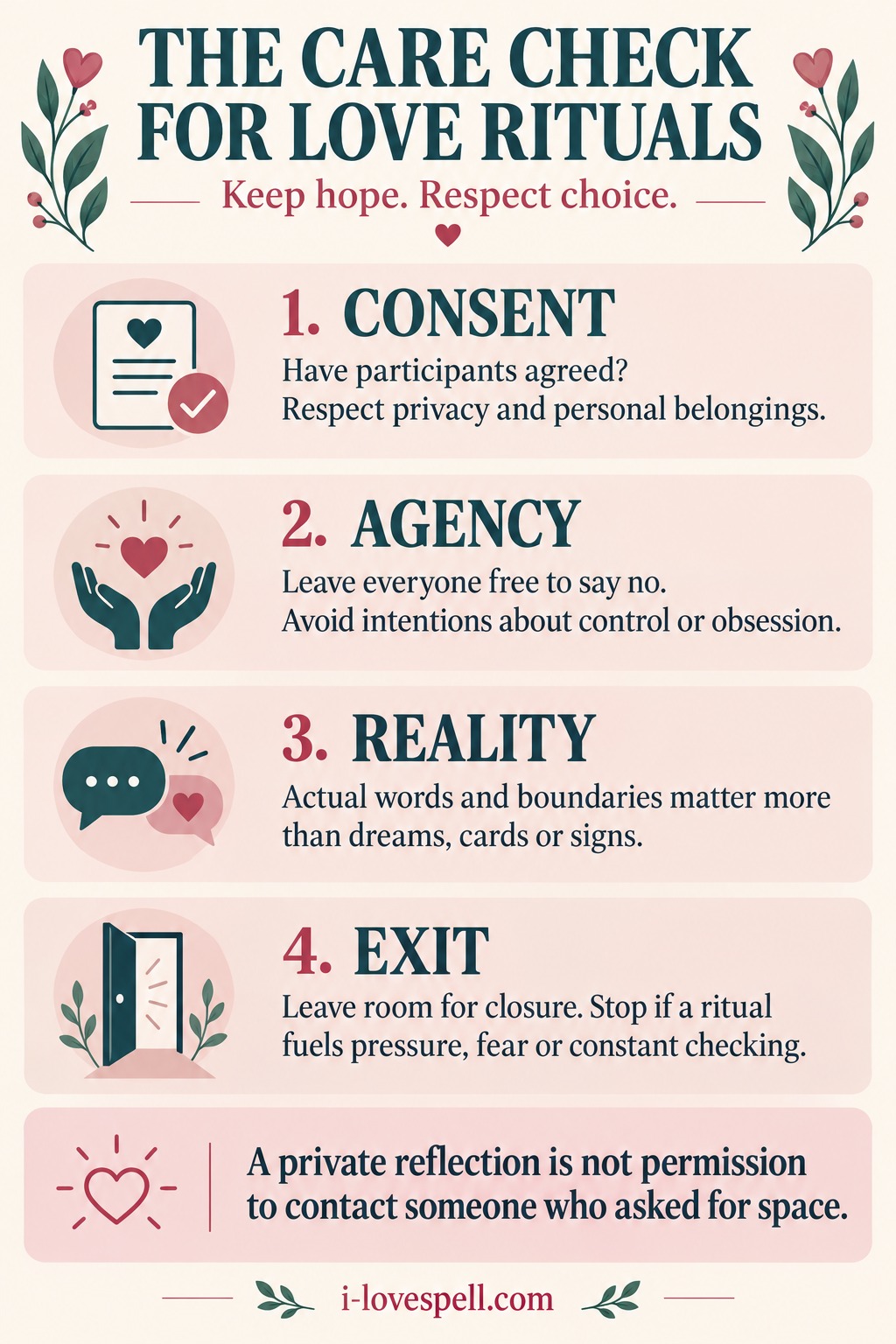
Use this editorial checklist before a ritual. It is a reflection aid, not a scientific assessment.
- Consent: Has anyone actively participating agreed, and have you respected privacy?
- Agency: Does the intention leave every person free to say no?
- Reality: Are you taking actual words and behavior more seriously than imagined signs?
- Exit: Can you accept closure, stop the ritual and move on without punishment or pressure?
If any answer is no, revise the intention or pause. An expensive ritual does not deserve more chances merely because you have already paid for it.
Three ethical alternatives to controlling intentions
When you want an ex to return
Try: “May I understand what happened and communicate respectfully if we both welcome it. If reunion is not mutual, may I find closure.” Do not send a message if a no-contact boundary already exists. If contact is welcome, one clear conversation is more informative than repeatedly seeking predictions.
If you caused harm, reflection should lead to accountability. Our guide to apologizing in a relationship explains practical repair without treating forgiveness as something you are owed.
When you are interested in someone new
Try: “May I show up honestly and recognize mutual interest.” A respectful invitation can be appropriate when circumstances allow it. An evasive answer or refusal is not a challenge to intensify the ritual or pursue the person harder.
When a couple wants to reconnect
Each partner can write one quality they want to bring to the relationship and one boundary they want respected. Share only what both feel comfortable discussing. Choose one practical action, such as putting phones aside during dinner or checking before discussing private matters with others.
A shared ritual is optional. Someone can care about the relationship without sharing your spiritual beliefs.
Build a simple, non-coercive ritual
- Name the need: Are you seeking companionship, reassurance, an apology, confidence or closure?
- Make it your responsibility: Replace commands about another person with a choice you can make.
- Use your own materials: A notebook or neutral symbol is enough. Do not take hair, clothing, messages or photographs from private spaces.
- Leave room for refusal: Include “if mutual and healthy” in your intention.
- Choose a practical action: Journal, have an invited conversation, seek support or step back.
- Set a review point: Notice whether the practice helps you function and accept reality. Stop if it fuels constant checking.
No special purchase is necessary. Avoid substances intended to affect someone without their knowledge, and never add herbs, oils or other ingredients to their food or drink. If you use candles or other materials, follow our separate love spell safety guide.
When to pause or seek support
Pause if the practice increases panic, anger, revenge fantasies, compulsive checking or spending you cannot comfortably afford. Be cautious of anyone claiming that rejection proves a curse or that another payment is needed to prevent harm.
Spiritual advice should not replace help with stalking, threats, coercion or abuse. Prioritize safety and contact a trusted support service when it is safe to do so. If there is immediate danger, use local emergency services. You are not responsible for maintaining a relationship because a reader calls it destined.
Key Takeaways
- A private ritual can support reflection without granting authority over someone else.
- Mutual choice matters more than a desired outcome, prediction or symbolic sign.
- Ethical intentions lead to accountable behavior, not surveillance or repeated pressure.
- Closure is a valid outcome; no relationship is owed to anyone.
Frequently Asked Questions
1. What makes a love spell ethical?
An ethical intention respects consent, privacy and another person's freedom to decline. It focuses on your behavior or genuinely shared participation rather than control.
2. Can a love spell guarantee that someone loves me?
No ritual can guarantee attraction or commitment. This guide treats spells as spiritual or symbolic practices, not a proven method of controlling feelings.
3. Is it wrong to hope an ex returns?
Private hope is not the same as coercion. Keep your actions respectful, accept a refusal and do not bypass a no-contact request.
4. Does a dream about someone mean I should contact them?
A dream can have personal meaning without conveying the other person's wishes. Base contact on their actual boundaries and whether communication is welcome.
5. Can I use someone's belongings in a ritual?
Ask permission before using their belongings or private information. Your own journal or a neutral symbol avoids that privacy problem.
6. Do both partners have to believe in a shared ritual?
No one should be pressured to participate or adopt a belief. If you choose a shared practice, agree on its purpose and allow either person to stop.
7. What if a psychic says we are destined to be together?
A prediction does not create consent or an obligation to stay. Judge the relationship by mutual interest, behavior, safety and freely made decisions.
8. Is silence consent to romantic contact?
Do not interpret silence as agreement or an invitation to escalate. Respect clear refusals and give someone room not to respond.
9. How can I replace an obsession spell intention?
Focus on your own confidence, clarity and ability to accept an answer. Invite mutual connection without asking for dependence or obedience.
10. Can self-love rituals fit this approach?
Yes. Journaling about values, practicing self-respect and choosing a healthy next step stay within your own responsibilities. Supernatural effects are not established.
11. What does the CARE check mean?
It stands for Consent, Agency, Reality and Exit. It is this article's reflection checklist, not a validated test or guarantee of a healthy relationship.
12. Should I pay for a ritual to remove a relationship curse?
Do not treat a frightening claim as proof that you must pay. Pause, avoid urgent purchases and discuss the situation with someone independent whom you trust.
13. Can I perform a ritual after someone blocks me?
A private reflection focused on acceptance does not require contacting them. Do not use the ritual as justification to get around the block.
14. Do ethical rituals require candles or crystals?
No. A written intention and a practical action are enough. If you use physical materials, consider fire, ingestion and other ordinary safety risks.
15. When should I stop a love ritual?
Stop if it encourages boundary violations, compulsive checking, fear or unaffordable spending. Seek appropriate support when distress or relationship safety needs attention.