


People often search for the “most powerful love spell” as though there must be one secret ritual that outranks every other option. The supplied draft takes a better approach: the most meaningful ritual depends on the intention, emotional readiness, and relationship situation—not on rare ingredients, complexity, or dramatic promises.
That means attraction, self-love, healing, reconciliation, harmony, and commitment rituals should not be treated as competing versions of the same spell. They solve different spiritual questions. For a full reference comparison, see Types of Love Spells: Purposes, Meanings and Differences.
What Does “Powerful” Mean?
Before choosing a ritual, define the word. “Powerful” could mean:
- Emotionally meaningful.
- Simple enough to perform with focus.
- Well matched to the actual relationship goal.
- Helpful for reflection or confidence.
- Easy to support with practical action.
- Respectful of another person’s free will.
If “powerful” means guaranteed control over another person’s emotions, no ritual can responsibly promise that.
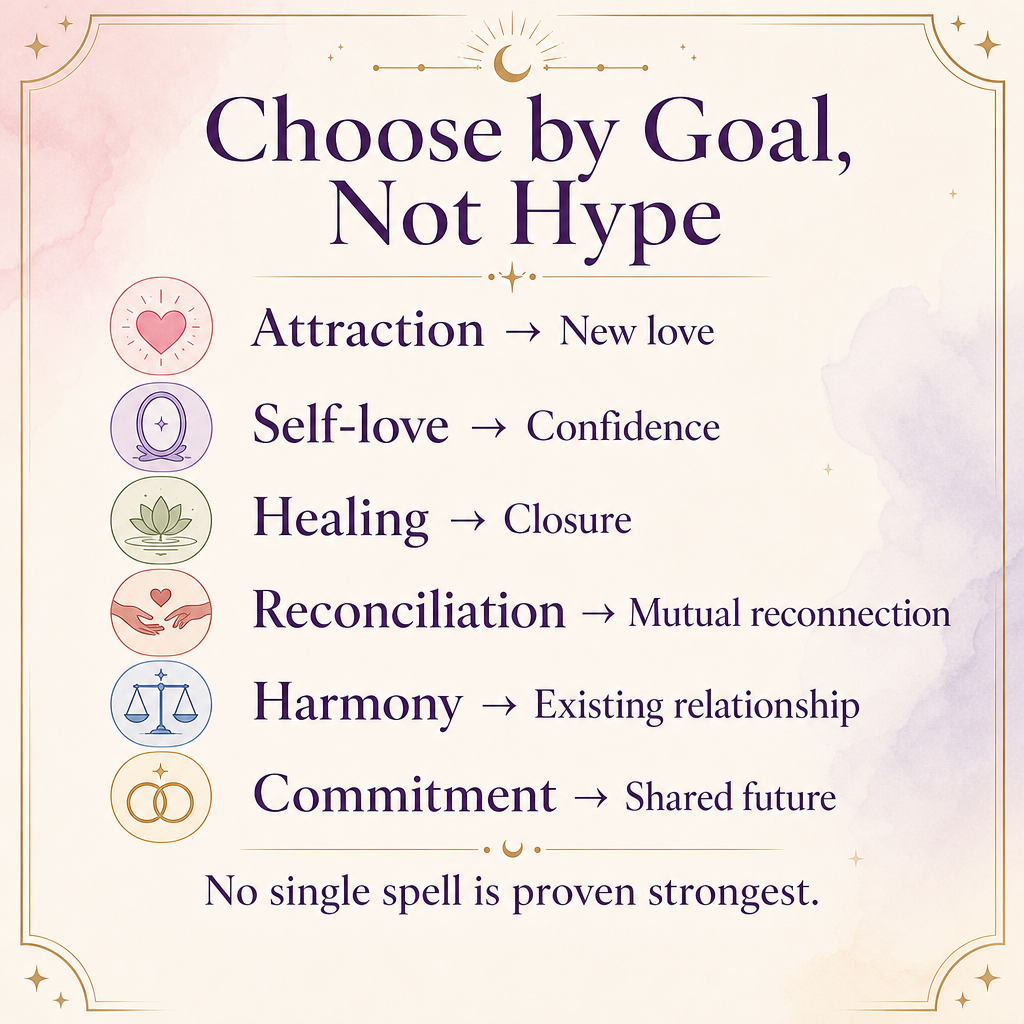
The Best Spell Depends on the Goal
Attraction ritual
Self-love ritual
Healing ritual
Reconciliation ritual
Harmony ritual
Commitment ritual
If these terms are unfamiliar, our love spell glossary explains the vocabulary used across common spiritual traditions.
Attraction Spells: Best for New Possibilities
Attraction rituals are commonly used when someone wants to become more open to meeting a compatible partner. A healthy version focuses on qualities rather than one unwilling person:
- Mutual attraction.
- Shared values.
- Kindness and emotional availability.
- Respectful communication.
- Compatible long-term goals.
The practical side matters too: meeting people, accepting invitations, joining activities, and communicating openly creates real opportunities for connection.
Self-Love Spells: Often the Strongest Starting Point
Self-love rituals can be especially meaningful after rejection, heartbreak, or a period of low confidence. Their advantage is that the intention centers on your own behavior and emotional growth rather than another person’s decisions.
A self-love practice might include a journal entry, meditation, gratitude list, symbolic bath, affirmation, or quiet reflection. It does not need rare tools to be meaningful.
Healing Spells: When Moving Forward Matters Most
If the main issue is grief, resentment, or emotional exhaustion, an attraction ritual may be premature. Healing-focused practice can create space to ask what you learned, what boundaries need to change, and what you want to carry into your next relationship.
Reconciliation Spells: Only When Reconnection Is Mutual
Reconciliation work is most appropriate when both people remain open to rebuilding. It is not a way to override an ex-partner’s refusal or force contact. A healthier intention is “may honest communication and mutual healing be possible if this relationship is right for both of us.”
Harmony Spells: For Relationships That Already Exist
Harmony rituals fit couples who already have a relationship and want to strengthen patience, appreciation, or communication. Our article on strengthening relationships naturally explains how spiritual intention can be paired with everyday actions.
Commitment Rituals: For a Shared Future
Commitment work should reflect a decision both partners are already making. It may be used around an anniversary, engagement, wedding, or other milestone to symbolize loyalty, shared goals, and gratitude.
Which Love Spell Fits Your Goal?
Why Complexity Does Not Equal Power
Long ingredient lists, imported supplies, complicated chants, or expensive services can make a ritual feel impressive. They do not prove that it is more effective. Complexity can actually make beginners less focused because attention shifts from the intention to performing every step “perfectly.”
A simple ritual that you understand and can perform safely may be more personally meaningful than one chosen because someone called it the “strongest.”
Why Price Does Not Equal Power
High prices do not establish spiritual effectiveness. Be cautious when a practitioner claims that only a more expensive version can prevent failure, remove a sudden curse, or guarantee a result. Our love spell safety guide covers fear-based upselling and other warning signs.
Does Moon Timing Make a Spell Stronger?
Some traditions connect the new moon with beginnings and the full moon with fulfillment or celebration. Others do not use lunar timing at all. If moon phases are meaningful to you, they can provide structure and symbolism, but they do not guarantee a result. See when to cast a spell for more on timing traditions.
A Five-Question Choosing Method
- What is my actual goal? New love, healing, reconciliation, harmony, or commitment?
- Does the goal depend on controlling someone? If yes, rewrite it around mutual choice.
- Am I emotionally ready? If fear or desperation is driving the decision, pause.
- What practical action supports the intention? Communication, boundaries, meeting people, counseling, or self-care?
- Can I accept more than one healthy outcome? If not, the intention may be too rigid.
What Makes a Ritual Meaningful After It Ends?
The most useful question is not “Was this the strongest spell?” but “What did I do differently afterward?” If a self-love ritual leads you to set better boundaries, or a harmony ritual encourages a needed conversation, the practice may have real personal value without requiring supernatural certainty.
Frequently Asked Questions
1. What is the most powerful love spell?
There is no proven single strongest spell. The best fit depends on your intention and situation.
2. Are attraction spells stronger than self-love spells?
No. They have different purposes. Attraction focuses on new possibilities; self-love focuses on confidence and personal growth.
3. Is a reconciliation spell powerful?
It can be meaningful for believers when both people are open to reconnecting, but it cannot force reconciliation.
4. Are expensive spells more powerful?
No. Price does not prove effectiveness.
5. Do rare ingredients make a ritual stronger?
Not necessarily. Many traditions use simple, symbolic items.
6. Are complicated rituals better?
No. Complexity can make it harder to stay focused on the actual intention.
7. Is self-love a good first spell?
Yes. It centers the practice on your own confidence, healing, and choices.
8. Can I combine different love spells?
You can, but focusing on one clear goal at a time may make the practice easier to understand.
9. Does a full moon make a spell more powerful?
Some traditions value full-moon symbolism, but it does not guarantee a result.
10. Can the strongest spell make a specific person love me?
No ritual can guarantee another person’s feelings or override their decisions.
11. What spell is best after a breakup?
Healing or self-love may be more appropriate before attraction or reconciliation work.
12. What spell is best for an existing couple?
Harmony, gratitude, healing, or commitment rituals fit existing relationships better than attraction work.
13. How do I know if I chose the wrong spell?
Revisit your goal. If the ritual does not match what you actually need, choose a practice that does.
14. Should beginners start simple?
Yes. Simple journaling, meditation, gratitude, or candle-free intention practices are easier to use safely.
15. What matters most after the ritual?
Respectful action, communication, boundaries, self-awareness, and willingness to accept healthy outcomes matter more than complexity.
Final Thoughts
The search for the “most powerful” love spell often becomes much simpler once you stop ranking rituals and start defining the goal. A ritual for healing is not weaker than one for attraction; it is simply designed for a different need.
For believers, the most meaningful practice is usually the one that matches honest intentions, respects free will, and encourages practical choices that support healthier relationships.