

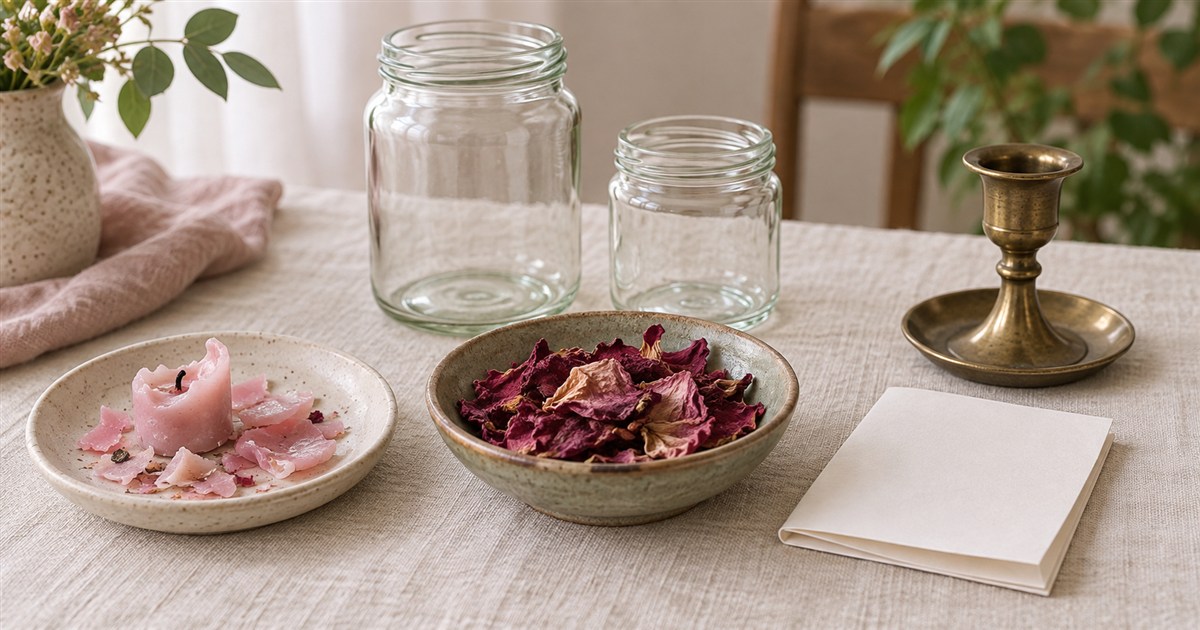
Dispose of love spell materials according to their physical contents: paper, wax, plants, containers or unknown mixtures. The ritual’s meaning does not determine which waste route is safe or accepted locally.
Start with an inventory and your local waste guide. You can mark the ending with a private note or spoken intention while keeping materials out of waterways, public land and wildlife habitats.
Sort the materials before choosing a disposal route
| Material | First check | Next step |
|---|---|---|
| Written paper | Private details, coatings or contamination | Destroy identifying information; check local paper rules |
| Candle remains | Completely extinguished and cool | Check local guidance for wax and the vessel |
| Herbs or flowers | Uncontaminated and accepted locally? | Use organics only if the programme accepts them |
| Oil or unknown liquid | Ingredients and original label | Ask local waste services; do not mix or pour away |
| Reusable object | Damage, residue and material care | Keep or donate only when safe and appropriate |
Scroll sideways to see the full table.
Decide the Closing
A love ritual might have represented hope, self-compassion, attraction, reconciliation, or a desire for certainty. Naming the purpose can help you choose what you want to let go of without making claims about consequences.
You might be ending the practice because the circumstances change, because another person sets a boundary, or just because the objects no longer feel useful to you. None of these reasons mean that you have to prove that the ritual failed or was successful.
Set a short intention, such as “I’m finished with this intention, and I’m choosing how to care for these materials the right way.” This is a statement that’s part of a personal practice and not a suggestion that has to be done correctly to prevent harm.
Always pay attention to other people’s freedom. Disposing of a love spell doesn’t create or cancel their consent. If someone doesn’t want contact, the respectful next step is to honor the boundary, no matter how the ritual ended.
Making a Physical Inventory List
Look at each of the items and identify what you know about them. Separate the following from one another:
- paper
- clean containers
- candle remains
- plant materials
- liquids
- stones
- metal
- unknown mixtures
You might find that different parts need different disposal routes. Keep the product labels in the packaging if they’re available. A bottle labeled only as “attraction oil” tells you less about the ingredients and even less about the disposal requirements. If you bought a prepared mixture, ask who made it for the ingredients and safety information on how to handle it.
Don’t open unfamiliar containers to smell them closely, and don’t taste any ingredient to identify it. If a container is damaged, leaking, or has unknown chemical mixtures, don’t handle it until you find out what you should do with it.
For ordinary items, work on a stable surface away from where you prepare food and away from children and pets. It’s important to have a storage task and not test whether you can handle everything without assistance.
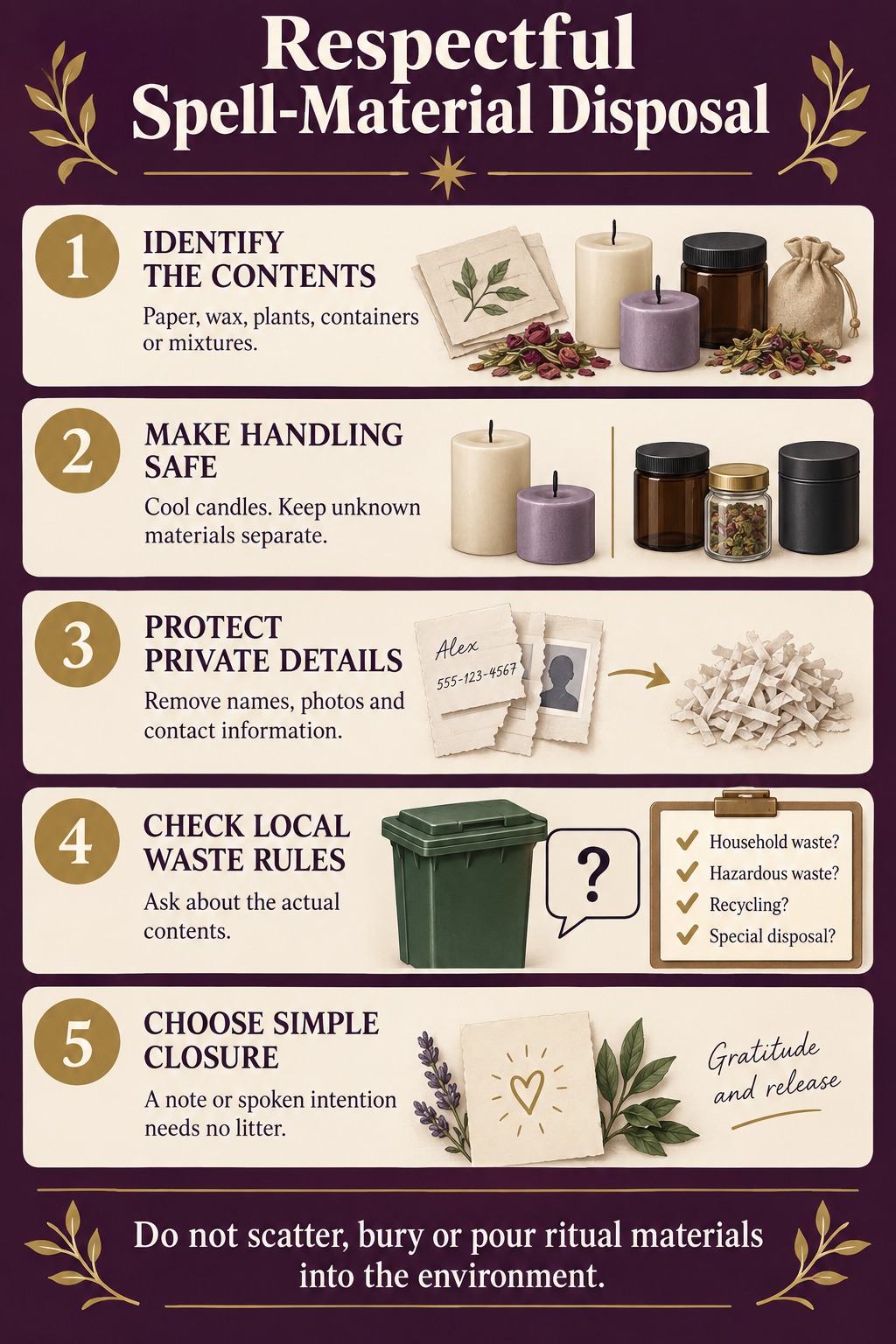
Respectful Spell-Material Disposal: visual guide
Read the infographic as text
- 1. IDENTIFY THE CONTENTS: Paper, wax, plants, containers or mixtures.
- 2. MAKE HANDLING SAFE: Cool candles. Keep unknown materials separate.
- 3. PROTECT PRIVATE DETAILS: Remove names, photos and contact information.
- 4. CHECK LOCAL WASTE RULES: Ask about the actual contents.
- 5. CHOOSE SIMPLE CLOSURE: A note or spoken intention needs no litter.
Find Out Local Waste Rules
Waste collection systems differ by location. An item accepted in one house’s recycling or organic program might not be accepted in another. Use your municipality’s current waste guide or contact its waste services if the materials are unclear.
The US Environmental Protection Agency's household hazardous-waste guidance explains why some household products require special handling and why pouring them into drains, onto land, or into storm sewers can cause harm. This general principle is useful even when your local collection rules differ from those in the United States.
Talk about the actual contents when you’re asking for help. You might say that you have a glass jar that has an unknown oil mixture and candle wax in it, which gives a waste worker useful information instead of just saying you have a love spell jar. You can keep your personal story private and still explain the problem.
If the contents can’t be identified, just say so. Don’t try to invent an ingredient or list or mix the materials with something else to make it easier to dispose of.
Handle Written Petitions and Personal Information Carefully
Written petitions or other papers used during a ritual might include things like names, pictures, contact information, personal wishes, or information about another person. If something contains private information, be careful about how you get rid of it instead of leaving it somewhere that other people could find or read it.
If it is regular paper, you can remove or destroy any personal information before throwing it away or recycling it. Shredding might be an option, but not every recycling program accepts shredded paper, so check the rules where you live if you plan to recycle it.
Some types of paper also cannot be recycled or composted the same way as regular paper. This can include paper covered in things like glitter, wax, plastic coating, or laminate. If you are not sure, check what your local waste or recycling service accepts before putting it in the recycling bin.
You can also keep the meaning of a ritual without keeping every piece of paper that was used. If you want something to remember the experience, you could write a new note about what stood out to you or what you learned without including someone else’s private information. Getting rid of the original paper does not take away from what the ritual meant to you.
Candle Remains
Before you handle a candle that’s been used or the container, make sure it’s completely out and cool. Don’t pour hot wax into a bin, sink, toilet, or outdoor drain, and avoid relighting a candle just because someone says it has to burn till the end of the spiritual work.
Wax, wicks, dyes, fragrances, decorations, and containers can make disposal hard. Ask for local guidance about both the finished item and its components. A glass candle container doesn’t automatically mean you can put it with food and drinks, especially if the residue or heat-resistant material changes the requirements.
If you’re thinking about reusing them, follow the manufacturer’s guidance. Don’t assume that a decorative candle vessel is suitable for food, hot drinks, or a homemade candle just because it looks like it works and is intact.
A safe closing ritual can happen without a flame. You might put the cold candle aside, read a short intention, and then get rid of it in the appropriate way. The symbolic ending doesn’t depend on more smoke or heat.
Herbs, Flowers, Salt and Food
Plant material might be eligible for local organics collection when it’s uncontaminated and accepted by a program. This doesn’t mean that every ritual mixture should go to the compost. Things like oils, wax, glitter, string, plastics, and unknown additives can change the answer.
Separate the materials only when it’s safe and practical. Don’t create dust or spread an unknown mixture across your work surface to get a small amount of compostable material. Ask about disposal of mixed items when separation isn’t certain.
Don’t scatter herbs, salt, food, or seeds outdoors. A material that says it’s natural doesn’t always mean it’s suitable for a certain habitat. Food can attract animals, and materials can affect an area in ways a household ritual doesn’t need to create.
If you want an earth-centered way to dispose of your stuff, spend quiet time outside and leave the physical materials out of it. You can appreciate the place that you’re in without adding to the soil or asking the wildlife to handle your leftovers.
Be Especially Careful with Liquids and Unknown Mixtures
If you have a jar left over from a ritual, think about what it is actually inside before deciding how to get rid of it. It could contain things like water, oils, perfume, alcohol, ink, cleaning products, or ingredients you are not completely sure about. How you dispose of it should depend on what is inside instead of what the jar was spiritually used for.
Do not mix leftover liquids together or add household chemicals in an attempt to neutralize them. You should also avoid heating an unknown mixture to try to get rid of it. If you do not know exactly what something contains, mixing or heating it could create a safety problem.
If it is safe to do so, keep the liquid in a closed and labeled container until you know how it should be handled. Check the original product label for disposal instructions or contact your local waste collection service if you are not sure what to do with it.
If you purchased something like a ritual oil and do not know what is in it, you can also ask the seller for an ingredient list or more information about the product. Do not assume that something is safe to pour outside or down the drain just because you only have a small amount. If you cannot find out what is in it, it is better to be cautious instead of making up a special spiritual way to dispose of it.
Decide if Stones and Reusable Objects Can Stay
Not everything you use during a ritual has to be thrown away when the ritual is finished. Things like crystals, bowls, cloths, jars, or metal objects might still be perfectly useful. You can keep them, use them for something else, or give them away if you no longer want them.
Before cleaning or reusing something, think about what it is made from and what it came into contact with. Different crystals and stones can react differently to water, salt, heat, or cleaning products, so make sure the cleaning method you use is safe for that particular material. The same goes for bowls, jars, and other decorative items, especially if you are thinking about using them later for food or drinks.
If you decide to give an item to someone else, let them know about anything that could physically matter, such as damage, coatings, or oils that were used on it. You do not have to expect the other person to share the same spiritual meaning you gave the object. They can decide what the item means to them and if they want to use it.
If an item belongs to someone else, using it in a ritual does not make it yours. It should still be returned when appropriate. If that person has asked you not to contact them, respect that boundary and find another appropriate way to return the item instead of using it as a reason to contact them again.
Leaving Materials in Public Places
Beaches, rivers, forests, crossroads, parks, and cemeteries are sometimes places where you’re supposed to leave ritual objects. These places have legal, cultural, community, and ecological contexts that shouldn’t be ignored.
The National Park Service's Leave No Trace principles emphasise responsible waste handling, respect for wildlife, and leaving places as you find them. A personal ceremony does not make litter, glass, wax, or food offerings harmless.
Don’t bury a jar, throw stones or metal into the water, or leave candles where someone else has to throw them away. Don’t bother graves, cultural sites, or private land. Permission and site-specific rules matter even if the ritual suggests a certain location.
You can pick a location for reflection without leaving objects there. Carry everything home to keep the personal moment while respecting other people and the place.
Easy Closure
Pick one thing to look at before you sort, and if handling it, make sure it’s safe. Name what the ritual said and what you want to carry forward. Maybe you want to keep hope while letting go of the demand for a specific outcome.
Then take action that supports your choice. You might clear a shelf, get rid of a reminder from your home, or make space for an activity that you’ve put off. Keep that action in your own life instead of directing it at someone else.
Don’t Create Fear
You might worry that disposing of an object incorrectly will bring bad luck or undo something important. A scary claim from a seller or reader can make an easy household task feel bigger than it is.
There’s no evidence that an ordinary disposal mistake creates a curse or requires payment for repair. Focus on the material risk and use good advice for them. If a tradition matters to you, ask a trusted practitioner about a symbolic alternative that’s safe and affordable.
Avoid anyone who tells you that they can remove the danger and demand urgent money. You’re allowed to take time to pause the conversation, get another point of view, and decline their services further.
If fear about rituals disrupts your sleep, work, or your daily routines, talk with a qualified mental health professional. You can talk about your spiritual beliefs and how they matter to you while asking for help with distress and repeated checking.
Finishing the Stages
You don’t have to sort every object into an emotionally hard afternoon. Look at anything that requires safety attention and arrange ordinary materials into tasks. Wait for a scheduled collection or for disposal advice that’s practical and not for evidence that the ritual controls you.
Final Thoughts: Planning Your Rituals
Before you use a new material, think about how you will store, clean, reuse, or get rid of it. A small amount of material is easier to deal with than a mixture of ingredients that you forget about as time goes on.
When you can, use reusable objects and keep simple ingredient notes for anything you mix. Don’t add glitter, plastic, decorations, or unnecessary things just because it makes the ritual look more exciting.
Use practices that don’t need physical materials at all, but instead use reflection, spoken intentions, music, or a private written note that stays on your own device. The meaning doesn’t depend on how many objects are involved.
Respectful disposal means caring for your own experiences and for other people in the environment. Always identify the contents, follow local guidance, protect private information, and let any symbolic ending stay a choice instead of a source of fear.
For the broader principles behind a respectful ritual, read love spell ethics, consent and boundaries.
For the next step, explore love spell safety guide.
Frequently asked questions
1. Is there one correct spiritual disposal method?
Traditions differ. Choose a physically safe route accepted locally, then add an optional symbolic gesture that fits your beliefs.
2. Do I have to burn a petition?
No. You can destroy identifying information without using fire. A symbolic ending does not require burning.
3. Can I recycle ritual paper?
Check for wax, glitter, plastic coatings or other contamination and follow local rules. Shredded paper is not accepted by every programme.
4. What if the paper names someone else?
Protect their privacy before disposal. You can keep a new reflection note that does not include their personal information.
5. Can candle wax go down a drain?
Do not pour wax into sinks, toilets or outdoor drains. Let it cool and check the local disposal route for the finished material.
6. Can I recycle a candle jar with food jars?
Not automatically. Residue and the type of glass can affect acceptance. Check your local programme’s specific guidance.
7. Can I reuse a candle vessel for food?
Do not assume it is food-safe. Follow manufacturer information about the material and intended use.
8. Can herbs go in compost?
Only when the material is uncontaminated and accepted by the relevant programme. Wax, oils, glitter or unknown additives can change the answer.
9. Should I scatter salt outdoors?
Choose a disposal route instead of scattering it. Natural materials can still affect soil, water or wildlife.
10. Can I bury a spell jar?
Do not leave glass or mixed waste in the ground. Keep the symbolic closure separate from physical disposal.
11. What should I do with unknown ritual oil?
Keep it separate and consult the label, seller or local waste service. Do not mix, heat or pour it away while guessing what it contains.
12. How do I ask a waste worker without explaining the ritual?
Describe the contents, such as a jar containing wax and an unknown oil. The physical inventory matters; your personal story can stay private.
13. Must I throw away every crystal or cloth?
No. Reuse can be appropriate if the object is safe, undamaged and cleaned according to its material and previous exposure.
14. Does disposal change another person’s consent?
No. Their boundaries remain their own. Do not use returning an object or ending a ritual as a reason for unwanted contact.
15. What is a simple closing gesture?
Write what you want to carry forward, say a private intention or clear a shelf. The gesture can be meaningful without flames, litter or a paid service.