

After a love ritual, one of the most common questions is, “How long will this take?” The supplied draft correctly emphasized that there is no single timeline. That point is worth making even clearer: spiritual traditions may describe timing in symbolic ways, but no ritual can provide a dependable countdown for another person’s feelings or choices.
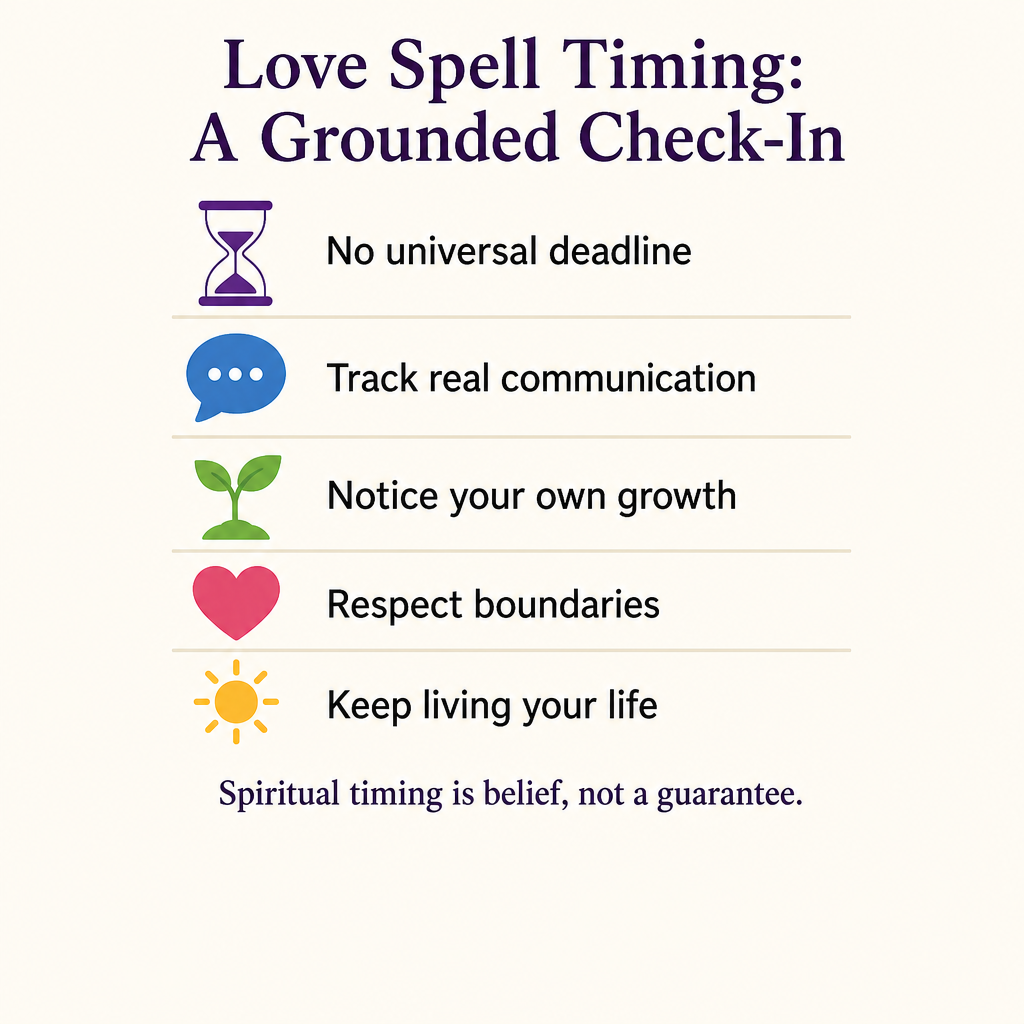
For believers, waiting can still be part of the practice. The useful goal is to combine spiritual reflection with real-world observation: Are you communicating more clearly? Are you less anxious? Is there mutual interest? Are you respecting boundaries? Those questions are more informative than counting days.
Why There Is No Universal Love-Spell Timeline
People often want a number: three days, seven days, one lunar cycle, or a month. Different traditions may use numbers or moon phases symbolically, but they do not create a verified schedule for romantic outcomes. A person’s circumstances can change because of work, family, distance, healing, compatibility, or simple choice.
This is why a balanced approach separates two questions: “When might I notice something meaningful in my own practice?” and “When will another person do what I hope?” The first is about your reflection and behavior. The second cannot be promised by a ritual.
What Believers Often Notice First
The earliest changes described in spiritual communities are usually internal rather than dramatic. They may include:
- Feeling calmer about the situation.
- Having a clearer idea of the relationship you want.
- Feeling more confident about communicating honestly.
- Letting go of resentment or desperation.
- Becoming more open to meeting compatible people.
- Recognizing that a particular relationship may not be healthy to pursue.
These experiences can be meaningful whether you interpret them spiritually or simply as the result of focused reflection.
What About Moon Phases and Ritual Timing?
Many practitioners enjoy associating the new moon with beginnings, the waxing moon with growth, the full moon with culmination, and the waning moon with release. These are spiritual associations, not scientifically established relationship mechanisms.
If moon phases make your practice feel more intentional, they can serve as a calendar for reflection. For a broader discussion of when practitioners choose to perform rituals, see When to Cast a Spell.
Timing After the Ritual
The period after a ritual is often more useful when it is not spent constantly checking for proof. The article What Happens After a Love Spell Is Cast? explores that post-ritual stage in more detail.
| Less useful approach | More useful approach |
|---|---|
| Checking your phone every few minutes | Watching for consistent, respectful communication over time |
| Interpreting every number or dream as proof | Recording experiences without assuming they have one cause |
| Repeating rituals out of fear | Giving yourself time and reviewing your real-life options |
| Waiting for a person to change | Improving your own communication, boundaries, and confidence |
How Different Intentions Change What “Results” Mean
Attraction
A healthy attraction intention is less about making one specific person respond and more about becoming open to compatible opportunities. Results may look like greater confidence, more social activity, or clearer standards.
Self-Love
Self-love work is primarily internal. Progress may be easier to recognize because it can involve your own habits, self-respect, boundaries, and emotional recovery.
Reconciliation
Reconciliation depends on mutual willingness. A ritual cannot substitute for an apology, changed behavior, honest conversation, or consent. If you are considering reconnecting with an ex, the healthiest outcome may be reunion, closure, or simply greater clarity.
Relationship Harmony
For an existing relationship, focus on practical markers: better listening, fewer repeated conflicts, more appreciation, and shared effort. See Can Love Spells Strengthen Relationships Naturally? for a fuller guide.
Signs That Waiting Is Becoming Unhealthy
Spiritual practice should not trap you in a cycle of monitoring. Consider changing course if you are:
- Ignoring a clear “no” or lack of response.
- Putting work, friendships, sleep, or daily responsibilities on hold.
- Spending money repeatedly because someone promises faster results.
- Feeling pressured to buy stronger or more expensive rituals.
- Interpreting every ordinary event as a message about one person.
For a practical reality-check approach, Using Common Sense for Love Spells is a useful companion.
A Simple Progress Journal
Instead of asking every day whether a ritual “worked,” try a weekly check-in. Record:
- Your original intention.
- Your mood and level of anxiety.
- Any real communication or relationship changes.
- Actions you took yourself.
- Whether boundaries were respected.
- What you learned about what you actually want.
This creates a more grounded record than relying on memory or a single coincidence.
Frequently Asked Questions
1. How long does a love spell usually take?
There is no reliable universal timeline. In spiritual traditions, some people interpret changes quickly while others notice nothing for weeks or months. Relationship outcomes also depend on ordinary factors such as mutual interest, communication, availability, and choice.
2. Can a love spell work overnight?
Some traditions contain stories about rapid results, but an overnight result should not be treated as a normal or guaranteed expectation. A sudden message or coincidence is not proof that a ritual caused it.
3. What counts as progress after a ritual?
A more useful measure is whether you are calmer, clearer about what you want, communicating better, respecting boundaries, and noticing real reciprocal changes in the relationship.
4. Do moon phases make a spell work faster?
Some practitioners attach symbolic meaning to moon phases, but there is no established evidence that a lunar phase determines whether a relationship outcome will occur or how fast it will happen.
5. Should I repeat the ritual if nothing happens?
Repeating a ritual immediately can feed anxiety. Many practitioners prefer to give one intention time, reflect on what is happening in real life, and only revisit the practice if it still feels meaningful.
6. Can anxiety make results harder to interpret?
Yes. Constant checking can make ordinary events feel unusually important. Keeping a simple journal and reviewing patterns over time can help separate a one-off coincidence from a meaningful change in your own behavior or relationship.
7. Is an unexpected text a sign the spell worked?
It may feel meaningful, but one message cannot establish cause. Pay attention to the quality and consistency of communication rather than treating a single contact as proof.
8. What if my desired person does not respond?
A lack of response should be respected. Spiritual practice should never be used as a reason to ignore another person’s boundaries or continue unwanted contact.
9. Do different love-spell types have different timelines?
Practitioners may describe them differently, but there is no verified timing chart. A self-love ritual, for example, is mostly about your own reflection, while reconciliation depends on two people’s choices.
10. Can personal growth be the main result?
Yes. Many believers consider increased confidence, emotional healing, clearer boundaries, and better decision-making meaningful outcomes even when a specific romantic outcome does not occur.
11. Should I stop living my normal life while waiting?
No. Continue friendships, hobbies, work, dating when appropriate, and ordinary relationship communication. A ritual should not become a reason to put your life on hold.
12. How long should I journal after a ritual?
There is no required period. A few weeks can be enough to notice whether your mood, behavior, communication, or expectations are changing without obsessively checking every day.
13. Can timing depend on another person’s feelings?
Any real relationship outcome necessarily depends on the other person’s interests, circumstances, and decisions. Mutual choice matters more than any claimed ritual timetable.
14. What if I feel worse after waiting for results?
Shift attention away from the ritual and toward grounding activities, supportive people, and practical decisions. If the process is increasing distress or compulsive checking, it is reasonable to stop.
15. What is the healthiest question to ask about timing?
Instead of asking when a specific person will act, ask whether your spiritual practice is helping you become clearer, kinder, more confident, and more open to a mutually chosen relationship.
Final Thoughts on Love-Spell Timing
There is no dependable number of days that applies to love spells. Believers may use timing, moon phases, or ritual calendars as meaningful spiritual frameworks, but relationship outcomes remain connected to real people and real choices.
The most constructive approach is patience without passivity: keep living your life, communicate respectfully, protect your boundaries, and notice whether the practice is helping you become clearer and healthier in the way you approach love.
A sophisticated and humane approach to an often fraught subject. By delineating symbolic ritual timing from interpersonal causality, the article helps practitioners cultivate reflective patience rather than anxious expectation. The concrete suggestions — a progress journal, weekly check-ins, and prioritized boundaries — provide a scaffold for integrating spiritual practice into ethical, grounded relationship work. 🙏
The compassionate insistence that rituals are tools for internal clarity rather than contractual guarantees is beautifully put. I like how the article highlights self-love outcomes and respectful reconciliation as healthier measures of success. This encourages living fully, tending to boundaries, and honoring mutual consent in relationships. Very nurturing perspective. 🌷
A very sensible guide that strips away magical thinking without dismissing spiritual meaning. The practical markers for progress — calmer mood, better communication, clearer wants — are things anyone can observe. I also value the warning against repeating rituals out of fear and the reminder to respect a clear no. Thoughtful and humane advice.
What I appreciate most here is the encouragement to combine spiritual reflection with everyday realities. The guidance to watch for respectful, consistent communication and to protect your own life and responsibilities is refreshing. It makes ritual work feel like one helpful tool among many, not the whole story.
I found the distinctions in this article very illuminating: timing as symbolic versus timing as guaranteed outcome. The suggestions to use moon phases as intention markers and to maintain a practical journal are excellent. They preserve ritual meaning while avoiding unhealthy waiting or coercive interpretations of another person’s behavior.
This was so reassuring to read. The focus on self-care, boundaries, and not stopping life for a ritual felt realistic and kind. I like the weekly check-in idea because it helps me track feelings without obsessing and keeps me grounded in my day-to-day priorities. 😊
Short and sweet: this article helped me stop obsessing over exact days and instead look at how I behave and feel. The tips about boundaries and journaling weekly are excellent. It’s empowering to focus on things I can change and to respect other people’s choices with patience. 👍
Thoughtful and measured guidance like this helps demystify expectations around rituals. The separation between changes you might notice in yourself and any actions another person might take is crucial. I particularly value the checklist items about calmness, clearer desires, and improved boundaries as realistic markers of progress. Well framed and compassionate. ✨
Nice breakdown of expectations versus outcomes. The advice to journal weekly and track your mood, actions, and any real communication is something I can actually follow. That approach turns vague hope into a practical practice that supports growth and clarity while maintaining respect for other people.
I appreciate these simple reminders. It helps to hear that rituals can change how I feel and act without promising someone else will change. Focusing on my own actions, communication, and respect for boundaries feels doable and calming, and it reduces the urge to repeat things out of worry.
This piece explains an important distinction between spiritual practice and guaranteed outcomes, and it does so with clarity. I appreciate the emphasis on internal change, communication, and consent as practical measures of progress rather than chasing arbitrary timelines. Keeping a journal and protecting boundaries are excellent, grounded suggestions. 🌙
I really enjoyed the balanced view offered here. The suggestion to treat moon phases as symbolic tools for intention-setting rather than deterministic schedules resonated with me. It helps me keep rituals meaningful while also staying respectful of other people’s autonomy and real-life constraints. Very helpful and practical advice.
Thanks for the clear advice here. I like the idea of focusing on how I feel and whether I communicate better instead of waiting for a specific day to pass. That feels much healthier and kinder to myself, and it gives me something useful to check each week. 😊
This article offered a clear, balanced roadmap for anyone doing love work. I appreciated the emphasis on self-growth markers and the practical warning signs for unhealthy waiting. The guidance to continue living your life, maintain friendships, and protect your wellbeing while practicing rituals felt both realistic and compassionate.
This was a helpful read. The focus on clear communication and mutual choice makes sense, and the idea of using moon phases symbolically is nice without being pushy. I’ll try the weekly journal suggestion to see if it helps me notice real patterns instead of one-off coincidences.
I liked the simple language and practical steps here. It feels good to have permission to live my life and not obsess over every little sign. The tips about journaling and checking for real change instead of miracles are straightforward and helpful for staying sane. 😊
A lucid and ethical framing of ritual practice: rituals can catalyze internal shifts, but they cannot substitute for consent, communication, and mutual choice. The advice to keep living, document changes, and watch for consistent, respectful behavior offers a balanced method for evaluating progress while avoiding coercion or anxious repetition. Well written and prudent.
This read made me feel better about not knowing exact timelines. I liked the focus on small, steady changes like being calmer, clearer, and kinder to myself. It’s encouraging to think of rituals as part of a bigger life where I keep my boundaries and keep living, not waiting. 🌼