

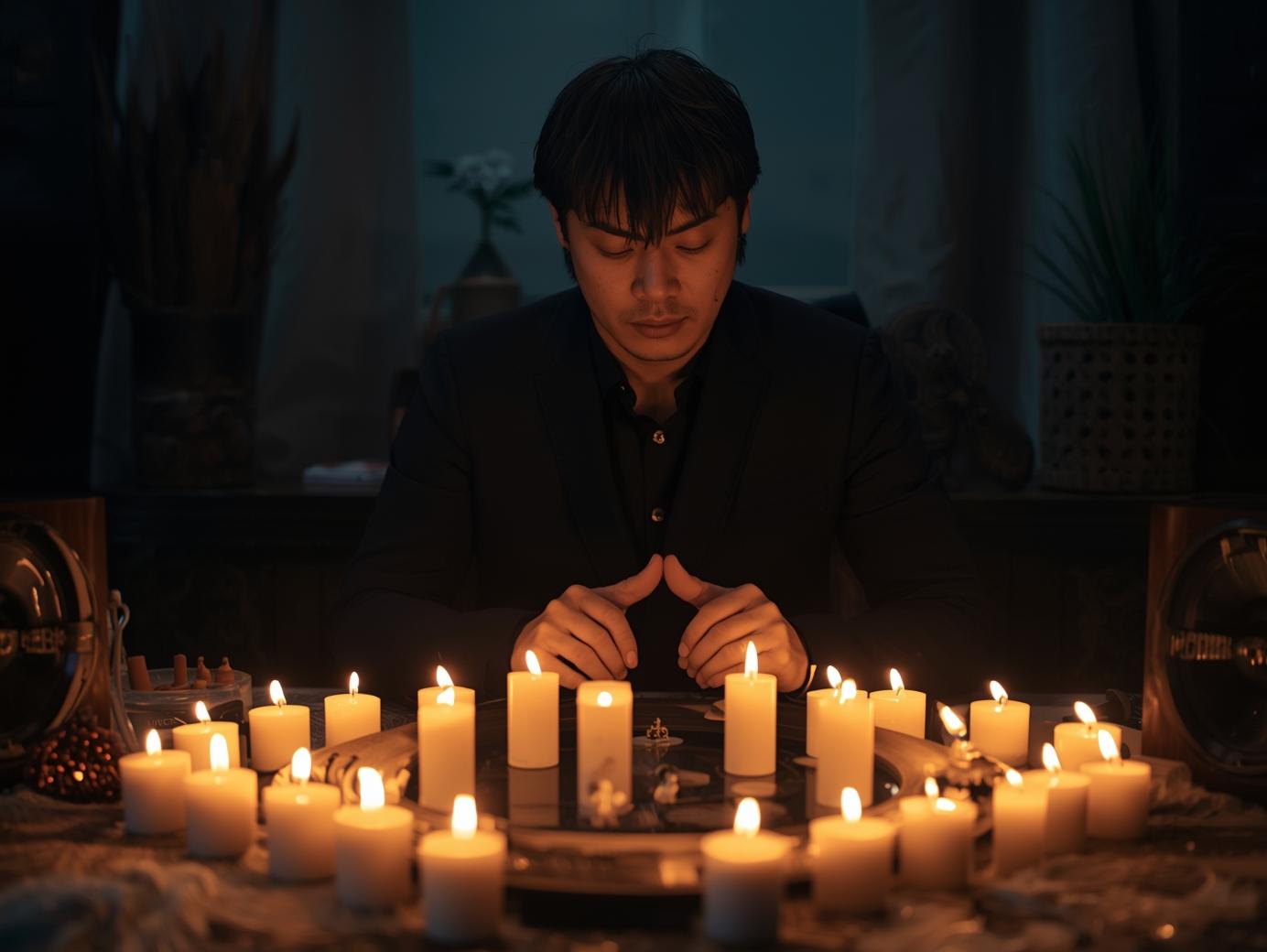
A favourite song, a clear table and one honest question can make the beginning of a psychic reading feel more personal. If ritual matters to you, those small choices can mark the moment when you set everyday distractions aside and turn towards something you want to understand.
You do not need an elaborate ceremony. Build a routine around what helps you feel present, then give just as much attention to the questions, time and boundaries you bring into the conversation. Candles and crystals can be meaningful symbols; your choices about the session still belong to you.
Start with three decisions
1. Your topic
Choose the relationship, transition or personal question you most want to explore. Put it into one plain sentence.
2. Your limits
Decide how much time and money you want to use, and which details you prefer to keep private.
3. Your setting
Choose a comfortable place where you can hear, take notes and end the session when you need to.
For example, “I want to understand what I need from a relationship” gives you a different starting point from “Tell me exactly what another person will do.” The first leaves room for your own values, observations and decisions.
A simple pre-reading routine
- Make a small space. Clear enough room for your notes and drink, charge your device if you need it and reduce interruptions. You do not have to clean the whole room.
- Choose an intention. Try “I want to listen carefully and ask clear questions” or “I want to explore this change without rushing.” An intention describes how you want to take part; it is not a promised outcome.
- Add one optional symbol. Use a candle, a crystal, a meaningful object or a moment of quiet. If none feels right, leave this step out.
- Check the practical details. Confirm the format, quoted price, session length and how to stop. Keep your first question where you can see it.
- Begin in your own words. You might say, “My main topic is this relationship. I have fifteen minutes, and I would like to understand how you work before we begin.”
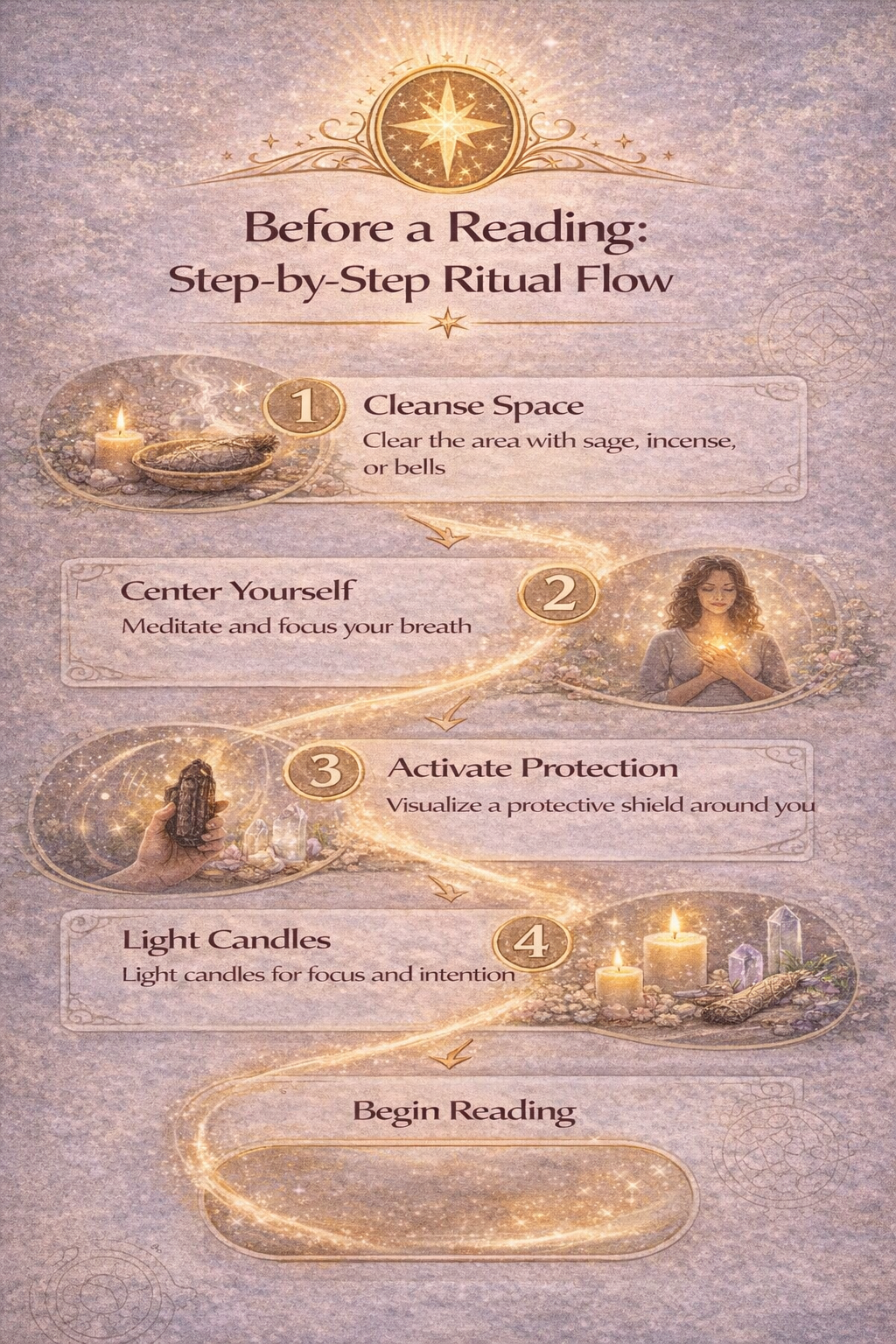
The ritual flow below offers familiar spiritual options. Treat it as a menu you can adapt: a tidy table or quiet bell can replace smoke, a flameless light can replace a candle, and a visualised boundary can remind you of the limits you have chosen.
Candles: choose atmosphere without making them a requirement
If a candle is part of your practice, choose its colour for the association it brings to you. White might suggest a fresh start, pink a gentle approach and purple reflection. Our candle colour guide and free suggestion tool explores those choices without turning them into predictions.
Place any lit candle in a suitable holder on a stable surface, away from things that can burn. Keep it attended and put it out before leaving. The National Candle Association’s candle guidance also explains why you should let wax cool before moving the candle. A flameless candle is a useful choice when your attention will be on a phone, screen or notebook.
There is no need to watch the flame for signs while listening to the reader. If you want a separate candle practice, the beginner candle guide offers a preparation check and a simple approach.
Music: make listening easy
A familiar instrumental track may help mark the start of your routine. Silence may suit you better. Choose by comfort, rather than by claims that a particular frequency will activate a gift or make a prediction more reliable.
For a phone or video reading, turn music down before the conversation. Test whether you can hear clearly and whether the other person can hear you. If music competes with the discussion, switch it off. For a written reading, you can use a quiet playlist while preparing questions and return to silence when reading the reply.
Protection symbols and personal boundaries
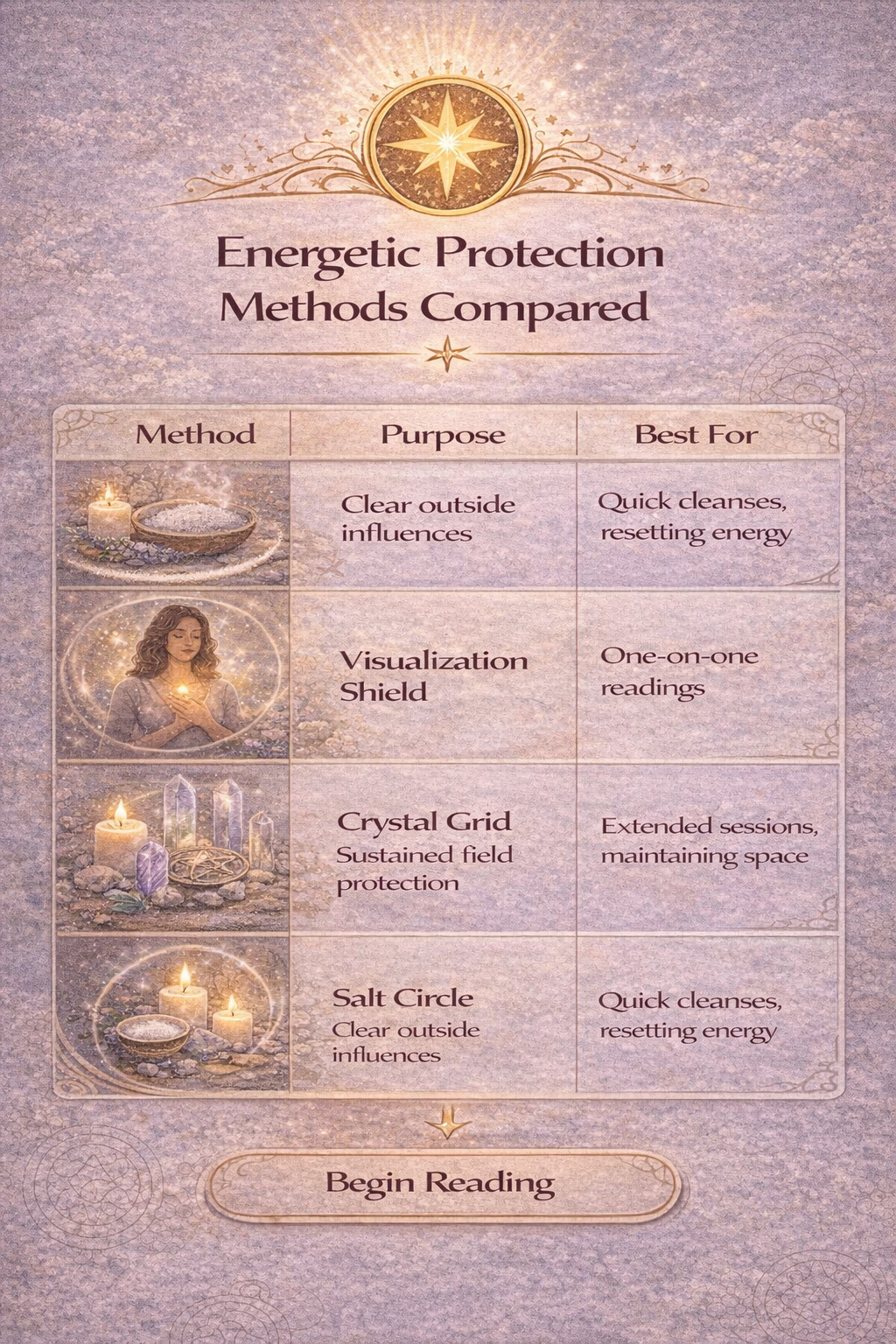
Visualising a circle of light, holding a crystal or placing a familiar object nearby can be part of a spiritual routine. You can use the image below to compare symbolic practices that appeal to you. Choose for personal meaning, without assuming that an object can guarantee protection or control what happens.
If you picture a boundary around your space, pair it with a sentence you can use: “I would rather not discuss that,” “Please explain what you mean,” or “I am ready to stop now.” You can keep your spiritual practice and exercise those choices at the same time.
Be cautious if someone says a frightening result can only be avoided by paying immediately for another ritual. Pause before sending more money or personal information. The FTC’s guidance on avoiding scams explains pressure tactics and encourages talking with someone you trust before acting.
Prepare questions you can work with
Write two or three questions and put the most useful first. Open questions invite explanation. You can then ask a specific follow-up when an answer is unclear.
- Love: “What patterns should I reflect on in the way I approach relationships?” Follow up with “What would that look like in an ordinary conversation?”
- A transition: “What do I want to understand before choosing my next direction?” Follow up with “Which part is a symbolic impression, and which part is a suggestion I can assess?”
- Your own intuition: “How can I make more space to notice my feelings?” Follow up with “What could I record and revisit for myself?”
For more relationship prompts, see questions to ask about love. You can ask about a reader’s process and decide how much background to offer. You do not have to agree with an interpretation that does not fit your experience.
Free per-minute session cost estimator
Use the price actually quoted to you. This calculator multiplies your planned minutes by that rate and adds a known one-time fee. It does not supply a provider’s price, convert currencies or estimate taxes. For a flat-price package, check the package terms instead.
Close the session with room to think
Keep an eye on the time you agreed. You can say, “I have time for one last question,” or “Thank you, I want to stop here.” Check the service’s billing terms before booking so you understand how an early ending is handled.
Afterwards, make three short notes: what was said, what you felt and what you want to explore next. Keep an interpretation separate from events that happen later. A useful next step might be preparing a conversation, checking information or giving yourself a day to think. You do not need to make a major decision while the session is still fresh.
Questions about preparing for a psychic reading
1. What should I do before a psychic reading?
Choose one main topic, write two or three questions and confirm the session format, length and price. Then make your space comfortable. A short personal ritual is optional; you can have a reading without candles, music or special objects.
2. Do I need a candle for a reading?
No. A candle can be a personal symbol of attention or intention, but it is not a requirement. A flameless candle, a meaningful object or a quiet moment can serve as a focus without an open flame.
3. Which candle colour works best?
Choose a colour that reminds you of the quality you want to bring to the conversation. White might suggest clarity, pink warmth and purple reflection. These are symbolic choices, not a way to make a reading more accurate.
4. What music should I play?
Choose something you find comfortable, or choose silence. For a call or video session, keep music low enough to hear both people clearly. If lyrics distract you, an instrumental track may be easier to leave in the background.
5. Must I use sage or incense?
No. You can tidy the table, open the curtains, sound a quiet bell or simply pause. Smoke is not necessary for a meaningful beginning. Choose a setup that works for the people, pets and shared space around you.
6. What does energetic protection mean here?
Some people use a visualised boundary, a crystal or another spiritual symbol to mark personal space. In this guide, pair that symbol with clear choices: what you want to discuss, what you prefer to keep private and when you will end the session. A symbol does not guarantee protection from harm.
7. How many questions should I prepare?
Start with one main topic and two or three questions. You may not get through every question in the time you choose. Put the most useful one first and leave room to ask what an unclear statement means.
8. Should I tell the reader everything beforehand?
You can ask how the reader normally begins and decide how much context you want to offer. You do not have to disclose private details to make the session worthwhile. Never share passwords, verification codes or payment-account access.
9. How do I estimate a per-minute session cost?
Multiply the quoted price per minute by the number of minutes you plan to use, then add any known one-time fee. Use one currency throughout. The calculator in this guide shows that estimate; confirm taxes, minimum charges and any other fees with the service before paying.
10. What if the session has a flat price?
Use the quoted flat price and confirm what it includes. The calculator here is for per-minute quotes, so it should not replace the terms of a flat-price package. Ask about the length, any extra charges and what happens if you end early.
11. Can I record the reading?
Ask the reader and service about permission and their recording policy before starting. If a recording is not agreed, ask whether taking notes is welcome. You can also write down your own impressions after the session.
12. What can I say if I do not understand something?
Try: Could you explain what you mean by that? You can also ask whether a statement is an impression, a symbolic interpretation or a practical suggestion. You do not have to agree with something simply because it was said confidently.
13. Can I stop a reading early?
Yes, you can say that you want to stop the conversation. Before booking, check how the service bills time and handles an early ending. If you feel pressured to pay for an urgent additional ritual, pause and discuss the situation with someone you trust.
14. What if I feel no special energy during the routine?
You can still continue, shorten the routine or leave it out. You do not need to produce a particular feeling or perform the steps perfectly. The useful question is whether your setup helps you arrive with clear questions and comfortable boundaries.
15. What should I do after the reading?
Write down what was actually said, what it brought up for you and what you still want to think about. Keep those notes separate from later events. Choose an ordinary next step you can assess for yourself, and give yourself time before making a major decision.