

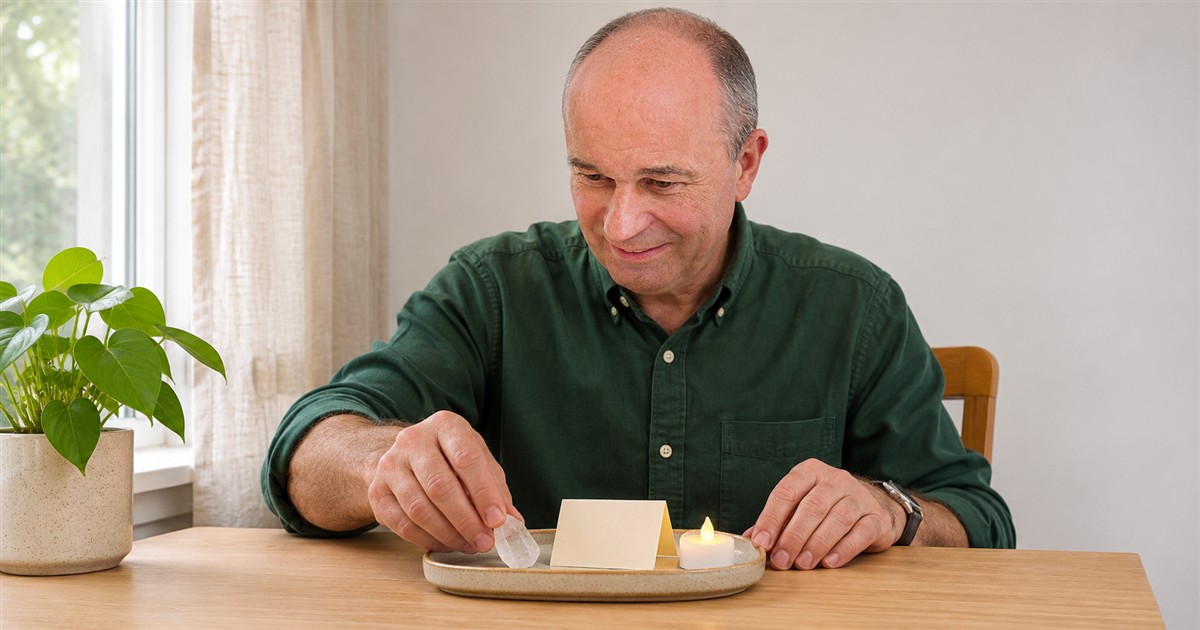
Your first spell can begin with an ordinary question: what needs my attention now? You may understand spellcasting as directing intention, working with spiritual forces or making a sacred promise to yourself. A small clarity ritual gives that belief a practical form without requiring a cupboard full of supplies.
Begin with a situation in your own life, such as preparing for a conversation or choosing which task to tackle first. Keep another person’s private thoughts out of the request. “Help me ask clearly” gives you something to work with; “make them agree” tries to supply their answer.
The four parts of a first spell
1. Intention
Name one purpose in a sentence you understand. A clear intention can be hopeful without claiming the outcome is already certain.
2. Symbol
Choose an object that expresses the purpose: a plain card for a fresh perspective, a stone for steadiness or a battery light for illumination.
3. Ritual action
Give the intention a beginning, a spoken or silent expression and an ending. You do not need special wording or perfect visualization.
4. Everyday follow-through
Decide what you will actually do after the ritual. Seeking information, making a welcome invitation or resting can all be appropriate actions.
Prepare a simple place
Clear a small surface and choose a time when you can finish without rushing. Put paper, a pen and one optional symbol within reach. A quiet corner is enough; elaborate altars, expensive crystals and a paid initiation are unnecessary for this personal exercise.
If you prefer a circle, mark it with a small drawing rather than obstacles on the floor. Learn the meaning of any deity name or religious symbol before borrowing it. Your own words are suitable when you are not following a particular tradition. See how to prepare for a spell for a separate preparation guide.
A first clarity spell, from opening to closing
- Choose the question. Write “What do I need to understand before I take my next step?” Add the actual situation below it.
- Set the symbol in place. Place a plain card or familiar stone beside the question. Use a battery light if you want a candle-like focus.
- Arrive in the moment. Sit comfortably and breathe normally. Notice the room and the support beneath your feet. Eyes can stay open.
- Speak your intention. Try: “May I see what is mine to choose, ask what I need to know and act with care.” Adapt the words to your beliefs.
- Write three observations. Separate what you know, what you assume and what information is missing. Leave uncertainty visible rather than treating every first thought as a message.
- Close and follow through. Put the symbol away and choose one manageable action. Thank the space or any spiritual presence you consciously invited, if that fits your practice.
Timing, tools and expectations
Some practitioners choose waxing moonlight for growth or a new moon for a fresh start. These are spiritual correspondences you may choose to use. You can also begin when you have the time and privacy to concentrate. The moon-phase guide explains those choices without making a date compulsory.
Keep loose herbs, oils and paper away from actual flames. A flameless light avoids that part of the setup; the U.S. Fire Administration’s candle guidance explains why unattended candles are a fire risk. You can complete every step here with no flame or fragrance.
Afterward, record what you did and what happened separately from your interpretation. A feeling of clarity can matter without proving what another person thinks. If the ritual leaves you repeatedly checking for signs or buying more supplies, pause and return to the practical question.
Free clarity-spell planner
Your entries are not submitted or saved by this tool. Download only on a device where you want to keep the file.
Questions about this practice
1. What is spellcasting?
For practitioners, spellcasting is a focused spiritual practice using intention, words, symbols and actions. Traditions differ in how they explain its power.
2. Which spell should I try first?
Choose a small purpose involving your own choices. The clarity ritual here asks what you need to understand before acting.
3. Do I need to be Wiccan?
No. Wicca is one religious context for magic, while other practitioners follow different traditions or a personal path.
4. Can I use my own words?
Yes. Use words you understand and mean. You do not have to imitate an unfamiliar language or religious ceremony.
5. What supplies are essential?
Paper and a pen are enough for this exercise. A card, stone or battery light is optional.
6. Do I have to visualize?
No. You can speak, write, notice a physical object or work silently without forming a mental picture.
7. Can I cast without candles?
Yes. The practice does not require a flame. A battery light or ordinary lamp can provide a visual focus.
8. Must I wait for a full moon?
No. If lunar timing matters in your tradition, use it thoughtfully. You can also choose an ordinary quiet moment.
9. What if I stumble over the wording?
Pause and repeat or rephrase it if you wish. A verbal mistake is not evidence that you invited danger.
10. Can I ask about someone else?
Keep the request about your conduct and available information. A spell cannot establish another person’s undisclosed feelings or consent.
11. How long should I spend?
Choose a brief period that suits you. Finishing clearly matters more than meeting an exact number of minutes.
12. Can I write on my phone instead?
Yes, if that suits your privacy needs. Use a device and app where you are comfortable keeping personal notes.
13. How do I close the spell?
State that your practice is complete, offer thanks if appropriate, put materials away and move to your chosen action.
14. What counts as a useful review?
Record the action you took, information you learned and how you felt. Keep those observations separate from spiritual interpretation.
15. Should I repeat it until I receive a sign?
Avoid making repetition a test you must pass. Return to the question when circumstances change or you have useful new information.