

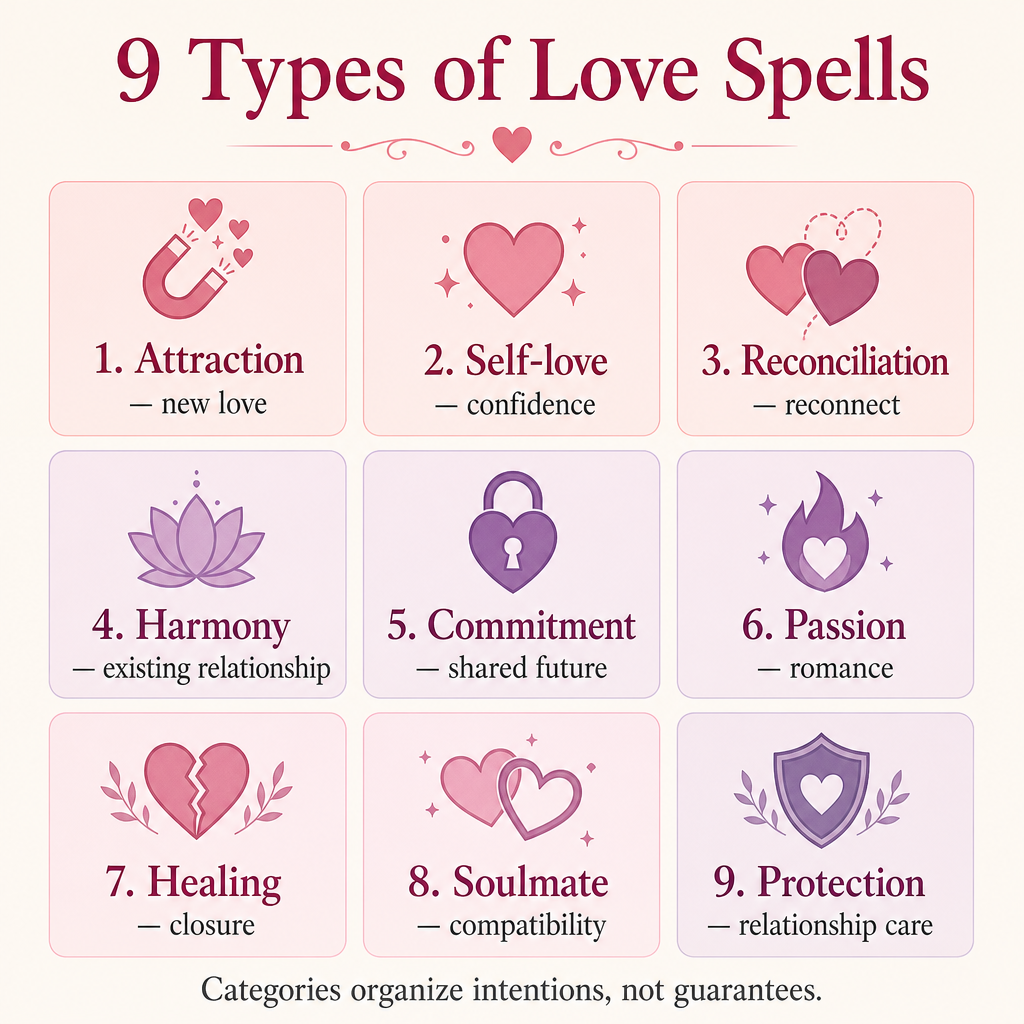
The phrase “love spell” covers many different spiritual practices. The uploaded draft lists attraction, self-love, reconciliation, commitment, romance, healing, soulmate, and relationship-protection rituals. Those categories are useful when they are treated as spiritual purposes rather than as promises of specific outcomes.
This guide is a reference page: it explains what each type is meant to symbolize, how the categories differ, and what real-life relationship goal sits underneath each one. Different traditions may use different names, and there is no universal scientific classification of love spells.
Love Spell Types at a Glance
| Type | Spiritual purpose | Grounded relationship focus |
|---|---|---|
| Attraction | Openness to new love | Meeting compatible people |
| Self-love | Confidence and healing | Self-respect and boundaries |
| Reconciliation | Healing a past connection | Mutual willingness to reconnect |
| Harmony | Peace in an existing bond | Communication and teamwork |
| Commitment | Celebrating stability | Shared goals and reliability |
| Passion | Renewing romance | Affection and quality time |
| Healing | Release after hurt | Closure and emotional recovery |
| Soulmate | Openness to deep compatibility | Values, maturity, and patience |
| Protection | Symbolic care for a relationship | Boundaries, trust, and problem-solving |
1. Attraction Love Spells
Attraction rituals are usually associated with welcoming new romantic opportunities. A grounded version focuses less on “making” a particular person respond and more on clarifying the kind of relationship you want to recognize when it appears.
Useful reflection questions include: What values matter most? What kind of communication feels safe? What patterns do you want to avoid repeating?
2. Self-Love Spells
Self-love rituals focus on confidence, self-respect, emotional healing, and becoming more comfortable with your own needs. They are often described as a foundation for other love-focused practices because healthier boundaries and self-awareness can improve relationship choices.
Self-love does not mean becoming perfectly healed before dating. It means treating your own well-being as part of the relationship equation.
3. Reconciliation Love Spells
Reconciliation rituals are intended to symbolize forgiveness, healing, and the possibility of renewed communication after a breakup or conflict. They are most grounded when both people are still willing to talk and when reconnecting would actually be healthy.
If the relationship involved repeated disrespect, coercion, or a clear request for no contact, a reconciliation ritual should not be used to reinterpret that boundary.
For a full reconciliation guide, see Can Love Spells Bring an Ex Back?.
4. Relationship Harmony Spells
Harmony rituals are for an existing relationship. They usually symbolize patience, listening, forgiveness, and renewed appreciation. The practical counterpart is simple: discuss the actual source of tension, listen without interrupting, and make changes both people can observe.
For couples, Can Love Spells Strengthen Relationships Naturally? explores this category in more depth.
5. Commitment Love Spells
Commitment rituals are usually connected with loyalty, stability, long-term partnership, anniversaries, engagements, or other milestones. They are best understood as ceremonies that celebrate commitment that already exists, not as ways to create commitment against someone’s wishes.
6. Romance and Passion Spells
Passion rituals focus on affection, romance, excitement, and emotional closeness. Long relationships naturally change over time, so some couples use symbolic rituals as a prompt to make time for each other again.
The practical actions behind this category include planning time together, expressing appreciation, discussing intimacy honestly, and noticing whether both people feel respected.
7. Healing Love Spells
Healing rituals are centered on heartbreak, resentment, disappointment, grief, or the end of a relationship. Their purpose is not to erase what happened but to create a structured moment for release and reflection.
A healing ritual may be more appropriate than an attraction or reconciliation ritual when you are still overwhelmed by the previous relationship.
8. Soulmate Love Spells
Soulmate rituals are usually framed around openness to a deep, compatible relationship. It is safer to treat “soulmate” as a spiritual idea about connection and shared growth rather than a guarantee that one predetermined person must appear.
If you are deciding between soulmate, attraction, or another category, What Is the Most Powerful Love Spell? explains why matching the ritual to the goal is more useful than chasing the strongest label.
9. Relationship Protection Spells
Protection rituals symbolize caring for the peace and stability of an existing relationship. They may focus on boundaries, trust, loyalty, or reducing outside stress. They should not be used to blame every conflict on “negative energy” when the issue is communication, dishonesty, jealousy, or incompatible goals.
10. Gratitude and Renewal Rituals
Some practices do not fit neatly into one traditional category. Gratitude rituals, anniversary intentions, renewal ceremonies, or shared reflection may support harmony, commitment, or self-love depending on the goal.
This is a useful reminder that categories are flexible. The intention gives the ritual its meaning.
How to Choose Among the Different Types
- Name the real-life problem or goal.
- Decide whether the focus is you, a new relationship, a past relationship, or an existing partnership.
- Ask whether another person’s consent or boundary is involved.
- Choose the simplest category that matches the goal.
- Add a practical action that supports the same intention.
For vocabulary used across these categories, see the Love Spell Glossary.
Tools Do Not Define the Category
Candles, herbs, crystals, prayer, journaling, moon symbolism, and meditation can appear in many types of rituals. The same pink candle could be used in a self-love practice, a gratitude ritual, or an attraction ceremony depending on the intention.
The tools are better understood as symbols or prompts rather than proof that one ritual is stronger than another.
Timing Does Not Change the Basic Purpose
Some traditions connect new beginnings with the new moon, growth with the waxing moon, celebration with the full moon, and release with the waning moon. These associations can give a ritual rhythm, but they do not guarantee a relationship result.
If timing is your main question, see How Long Do Love Spells Take?.
Safety and Boundaries Apply to Every Type
No category should be used as a reason to ignore consent, fire safety, emotional well-being, or financial pressure from a practitioner. A ritual should not require fear, secrecy from someone whose consent matters, or repeated spending to “fix” an escalating spiritual threat.
The Love Spell Safety Guide covers these issues in more detail.
Frequently Asked Questions
1. What are the main types of love spells?
Common categories include attraction, self-love, healing, reconciliation, harmony, commitment, passion, soulmate, and relationship-protection rituals. Different traditions may use different names.
2. Are attraction spells the same as spells for a specific person?
Not necessarily. A grounded attraction practice can focus on becoming open to compatible relationships rather than targeting one person.
3. What is a self-love spell?
A self-love ritual is usually centered on confidence, emotional healing, self-respect, and becoming more open to healthy relationships.
4. What is a reconciliation spell?
Reconciliation rituals are generally associated with healing, forgiveness, and the possibility of renewed communication when both people are genuinely open to reconnecting.
5. What is a harmony spell?
Harmony rituals focus on an existing relationship and commonly symbolize patience, communication, understanding, and emotional closeness.
6. What is a commitment spell?
Commitment rituals are associated with loyalty, stability, shared goals, and celebrating an existing relationship rather than creating commitment where it does not exist.
7. What is a passion or romance spell?
These rituals are commonly used by couples who want to focus on affection, romance, appreciation, and time together.
8. What is a healing love spell?
Healing rituals focus on processing heartbreak, resentment, disappointment, or emotional pain so a person can move forward more clearly.
9. What is a soulmate spell?
Soulmate rituals are usually framed around openness to a deep, compatible relationship rather than identifying or guaranteeing one destined person.
10. What is a relationship protection spell?
Protection rituals symbolize protecting an existing relationship’s peace, trust, and boundaries. They should not replace communication or practical problem-solving.
11. Which type of love spell is strongest?
There is no reliable basis for calling one category universally strongest. The useful question is which ritual best matches the goal you are reflecting on.
12. Do I need special tools for each type?
No. Tools vary by tradition and are usually symbolic. Many practices can be simplified to reflection, journaling, meditation, prayer, or a single meaningful object.
13. Can one ritual fit more than one category?
Yes. A gratitude ritual could support self-love, harmony, or commitment depending on the intention. Categories are guides, not fixed scientific classifications.
14. How do I choose the right type of spell?
Start with the real-life goal, your emotional readiness, the other person’s boundaries, and what healthy action would support the same intention.
15. Can a love spell type guarantee an outcome?
No. A spiritual category can organize a practice, but it cannot guarantee another person’s feelings, consent, or future choices.
Final Thoughts: Use Categories as a Map, Not a Promise
Understanding the types of love spells can make spiritual practice less confusing. Attraction, self-love, reconciliation, harmony, commitment, passion, healing, soulmate, and protection rituals each point toward a different intention.
The category itself does not guarantee an outcome. What matters most for a grounded practice is whether the intention is clear, the ritual respects everyone involved, and your real-life actions support the kind of relationship you say you want.
What a sweet and sensible guide! It makes love rituals feel hopeful without being pushy. I like that it tells people to check consent and to do real-life work like talking and setting boundaries. That makes the whole idea kinder and more doable 😊
Clear, compassionate, and pragmatic: I admire how the guide treats rituals as symbolic frameworks that articulate relationship intentions while insisting on consent and emotional safety. The emphasis on matching ritual type to real-life goals and readiness helps prevent harm and encourages accountability in spiritual practice.
Thoughtful and well organized — I appreciate the way each ritual is tied to a grounded relationship goal. Treating tools as symbolic and emphasizing practical steps like communication and boundaries makes spiritual practice feel respectful and sustainable. Great resource for beginners and experienced folks alike.
A lucid and ethically minded taxonomy of love rituals, this draft succeeds in reframing ‘‘love spells’’ as categories of intentional work rather than deterministic formulas. By centering consent, psychological readiness, and complementary practical actions, it both demystifies the practices and preserves their ritual potency for reflective practitioners. Thoughtful cross-references and safety notes strengthen its value as a reference text for anyone integrating spiritual work with relational maturity. ✨
This guide helped me understand why rituals can be supportive without promising outcomes. It feels kind and realistic to focus on healing, boundaries, and communication first. I also liked the simple tip that tools are symbols and not magic guarantees — very reassuring 😊
I really value the way you linked intentions to real behaviors; that approach makes rituals feel like a helpful prompt rather than a shortcut. The safety and consent reminders are crucial, and I appreciate the practical examples that show how a ceremony can pair with honest conversations and steady effort.
This write-up is friendly and useful. I like how it says spells are about intentions and real-life actions, not forcing someone to love you. The safety reminders and the focus on consent make the whole topic feel less scary and more honest 😊
This is a very helpful reference. I especially liked the practical decision steps for choosing a ritual: name the goal, check boundaries, pick the simplest matching category, and add a supportive action. Those guidelines make ritual practice feel intentional, respectful, and useful in everyday relationships.
I really like this guide! It helps me see different love spell types in a clear way. It feels safe and sensible to focus on consent, boundaries, and healthy actions rather than promises. Thanks for practical tips 🙂
I appreciate the nuance here: categorizing rituals by intention and corresponding relationship work reframes magic as ethical practice rather than coercion. The sections on healing and reconciliation are compassionate, and the insistence on consent and realistic expectations helps cultivate responsibility alongside spiritual aspiration.
Nice overview that keeps things grounded. I appreciate the clear categories and the reminder to pair rituals with honest action. Focusing on consent, boundaries, and communication feels like the right way to approach any love-centered practice, and the safety tips are very practical.
This guide offers a very balanced framework, mapping spiritual intentions onto concrete relational aims while resisting magical thinking that overrides consent. The distinctions among attraction, reconciliation, and protection are especially helpful for people wanting to pair ritual with responsible behavior and clear boundaries 🌿