

After a breakup, it is common to replay unfinished conversations, shared memories, and the possibility of reconnecting. That is why many people become curious about reconciliation love spells. In many spiritual traditions, these rituals are framed as practices for healing and renewed communication rather than a way to force an ex to return.
Spiritual belief and real-world outcome are different things. Love spells are not scientifically established methods for changing another person’s feelings, and no ritual can guarantee reconciliation. A healthy reunion requires mutual choice.
What a Reconciliation Love Spell Is Meant to Do
Within love-spell traditions, reconciliation work is usually centered on conditions that may support a healthier conversation: forgiveness, reduced resentment, emotional clarity, compassion, and openness. The goal is not to manufacture feelings that are not there.
- Encourage calm reflection.
- Support forgiveness without excusing harmful behavior.
- Clarify whether reconnecting is genuinely wanted.
- Focus on respectful communication.
- Leave room for either reconciliation or closure.
For a broader look at what people believe happens after spiritual work, see what happens after a love spell is cast. If your intentions have changed, the companion guide on removing or releasing a love spell may be more useful.
When Reconciliation May Be Worth Exploring
Some breakups happen because of miscommunication, temporary distance, work or family pressures, or other circumstances rather than a complete loss of care. In those situations, a ritual can be used as a private way to clarify what would need to change before a reunion would actually be healthy.
Ask what changed
Wanting someone back is not the same as being ready to rebuild. Ask what you learned, what caused the breakup, what you would do differently, and whether both people could realistically create a better pattern.
Look for mutual willingness
A message, dream, coincidence, or strong intuition is not a substitute for consent. The clearest sign that reconciliation is possible is respectful, mutual communication.
Respect space
If your ex asks for distance, honor it. Spiritual practice should never be used as a reason to pressure, repeatedly contact, monitor, or manipulate someone.
Reconciliation vs. Control
A useful ethical line is simple: focus on the relationship conditions you hope to welcome, not on controlling a named person’s thoughts. Intentions such as “May communication become honest and peaceful” or “May the healthiest outcome unfold for both of us” preserve more room for free will than “Make this person return to me.”
RelationshipSpell.com also has a practical overview of reconciliation spells and healing past relationships, which complements this question-focused guide.
When Healing Is the Better Intention
Not every relationship should be restored, especially where there has been repeated dishonesty, ongoing disrespect, emotional harm, incompatible life goals, or chronic unhappiness. In those cases, a self-love or release ritual can be more constructive than trying to reopen the relationship.
- Choose closure when contact is unwelcome.
- Choose boundaries when old patterns remain unchanged.
- Choose support when the breakup is overwhelming.
- Choose safety over spiritual interpretation if there was abuse, threats, stalking, or coercion.
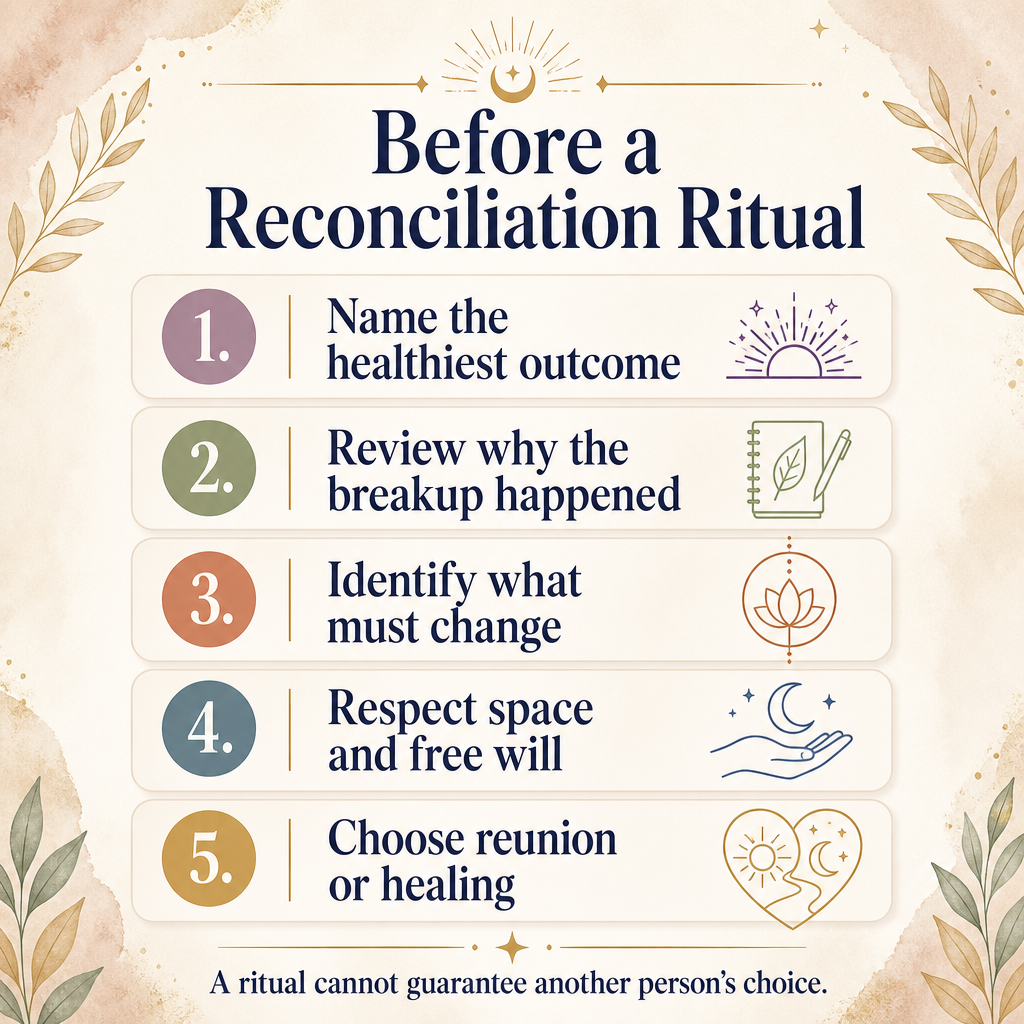
A Simple Reconciliation Reflection Ritual
- Write one sentence describing the healthiest outcome you can accept.
- List what you miss and, separately, what was difficult in the relationship.
- Write three changes that would be necessary for a healthy reunion.
- Spend several quiet minutes breathing or meditating.
- Close with an intention that respects both people’s freedom to choose.
This is deliberately a reflection practice rather than a promise of supernatural control. It can help you move from desperation toward a clearer decision.
Signs to Evaluate Carefully
Believers may notice calmer feelings, greater clarity, improved communication, unexpected contact, forgiveness, or feeling emotionally lighter. Those experiences can be meaningful personally, but they should not be treated as proof that a spell caused another person’s behavior.
More useful questions are: Is communication respectful? Are old problems being addressed? Are both people choosing to reconnect? Are actions consistent over time?
Patience Without Passive Waiting
Healthy reconciliation is active. If you want another chance, work on communication, accountability, boundaries, and the issues that contributed to the breakup. Personal growth and respectful boundaries matter more than simply waiting for a result.
Frequently Asked Questions
1. Can a love spell guarantee my ex will come back?
No spiritual practice can guarantee another person’s decision. Reconciliation depends on mutual feelings, circumstances, communication, and the choices both people make.
2. What is a reconciliation love spell?
In many spiritual traditions, it is a symbolic ritual focused on healing, forgiveness, communication, and openness to a possible reunion rather than control.
3. Can a reconciliation spell override free will?
A respectful approach does not aim to override free will. Healthy reconciliation requires both people to choose the relationship willingly.
4. How long does a reconciliation spell take?
There is no reliable timetable. Believers often describe spiritual work as gradual, while real-world reconciliation can take time because trust and communication may need rebuilding.
5. What if my ex never contacts me?
That outcome may mean the relationship is not reopening. The ritual can still serve as a period of reflection, healing, and clarification about what you want next.
6. Should I contact my ex after a spell?
Only if contact is appropriate, welcome, and respectful. A ritual is not a reason to ignore a request for space or a clear boundary.
7. Can beginners perform reconciliation rituals?
Many beginners choose simple practices such as journaling, meditation, prayer, affirmations, or a candle ritual focused on clarity and healing.
8. Should I cast the same spell repeatedly?
Many traditions recommend one clear intention followed by patience and reflection instead of repeating rituals from anxiety or desperation.
9. What makes reconciliation more realistic?
Mutual interest, honest communication, accountability, changed behavior, compatible goals, and willingness to rebuild trust make reconciliation more realistic.
10. What if the breakup involved repeated disrespect?
A reunion may not be the healthiest goal. Self-love, healing, support, and strong boundaries may be more appropriate than reconciliation work.
11. Are unexpected dreams or coincidences proof the spell worked?
Believers may find them personally meaningful, but they are not objective proof that another person’s feelings or decisions have changed.
12. Can a spell fix broken trust?
A ritual may help someone focus on healing, but trust is rebuilt through consistent behavior, honesty, accountability, and time.
13. Is it better to focus on a specific ex or on the best outcome?
A broader intention such as healing, clarity, and the healthiest outcome can leave more room for mutual choice and personal growth.
14. Can reconciliation lead to a stronger relationship?
It can when both people address the reasons for the breakup, communicate differently, and make sustainable changes rather than simply resuming old patterns.
15. When should I stop pursuing reconciliation?
If the other person clearly says no, asks for no contact, or the relationship was harmful or unsafe, respect that boundary and redirect your energy toward healing.
Final Thoughts
A love spell cannot guarantee that an ex will return. In a balanced spiritual approach, reconciliation rituals are best used to focus hope, healing, clarity, and respectful communication while accepting that the other person has full freedom to choose. If a reunion happens, what makes it last will be the relationship you build afterward—not the ritual itself.
Thanks for this practical, compassionate explanation of reconciliation spells. I appreciate the reminder that rituals are about healing and clearer communication, not forcing someone back. The reflection ritual seems doable and respectful. I’ll focus on growth, boundaries, and patience instead of hoping for instant results, and that feels calming. 😊
The reflection practice described here is a gentle, ethical approach to dealing with post-breakup feelings. I value its emphasis on consent, mutual willingness, and choosing healing over control. For anyone uncertain about next steps, this guide offers grounding exercises and clear questions to consider before trying to reconnect. Well written and humane. 🌿
This explanation makes the whole idea feel less scary and more about self-care. I like that the ritual is meant for reflection and healing, not forcing someone back. The step-by-step reflection looks doable and kind, and the reminders about respecting boundaries are really important. Appreciated this clear advice and the focus on safety. 😊
This piece balances spiritual practice with psychological insight in a thoughtful way. The distinction between intention-setting for personal clarity and attempts to override another’s autonomy is vital. I especially liked the focus on accountability and behavioral change as the real foundation for reconciliation, not ritual alone. It’s a refreshing, responsible take that respects both inner work and ethical boundaries.
I appreciate how you point out when reconciliation might not be healthy and when to choose closure. That honest guidance matters a lot after a breakup. The ritual feels practical and safe, especially for people who need structure to process feelings and set boundaries. Grateful for this clear, compassionate advice. 🙏
Good read! I didn’t know spells could be about healing instead of making someone come back. That makes me less anxious. I’ll try writing down what I miss and what was hard, like the ritual says. Seems like a calm step to figure things out and take better care of myself. 🙂
This is nice. Helps me think about saying sorry and learning from what went wrong. I like the part about respecting space and not trying to make someone come back. I’ll try the breathing and list-making steps to feel calmer and more sure, and that seems like a good way to heal. 😊
The emphasis on rebuilding trust through consistent behavior rather than quick fixes is spot on. Any attempt at reconciliation requires accountability, changed patterns, and transparent communication. I like that the article discourages repeated rituals driven by anxiety, recommending instead deliberate personal work. That approach increases the likelihood of a durable, healthier relationship if reconnection occurs. Well put. 🧭
This guide feels practical and humane. The line about choosing safety over spiritual interpretation when there has been abuse is particularly important. Many people need clear permission to prioritize their wellbeing, and this article gives it. Simple rituals for reflection can support that process, but healing always needs real-world support and boundaries too. ❤️
Solid, compassionate guidance. I like that the piece encourages honest examination of whether reconciliation is truly desired and feasible, not just an emotional reflex. The practical reflection ritual is something I can recommend to friends: it’s gentle, actionable, and respectful of both people’s freedom to choose. Thanks for this balanced perspective. 🌟
Thanks for explaining this in a simple way. I feel better knowing rituals can help me sort my feelings, not control someone else. The advice to respect boundaries and look for mutual willingness is really helpful. I’ll do the reflection steps and try to be patient and kind to myself as I move forward. 🙂
I agree with focusing on healing and clarity rather than magical fixes. The reflection ritual’s separation of what’s missed from what was difficult is a particularly useful exercise for objective self-assessment. It helps with deciding whether to pursue reconnection or to seek closure and personal growth, which is ultimately empowering and respectful to both parties. 🌱
This article provides a rare synthesis of ritual practice and ethical mindfulness, framing reconciliation spells as instruments for introspection rather than coercion. The guidance to orient intentions toward healthy conditions—clear communication, accountability, mutual willingness—resonates deeply. I especially value the cautionary notes about abusive dynamics and the priority of safety. Such careful framing helps preserve dignity for everyone involved while supporting genuine healing and potential reconnection.
Helpful and reassuring read. I like how the article encourages focusing on the healthiest outcome, even if that means closure rather than reunion. The reflection prompts are concise and actionable, offering a structured way to move forward without clinging to uncertainty. I appreciate the balanced, respectful tone throughout and will share this with friends who need it. 🌼
The nuanced distinction between intention-setting for internal clarity and attempts to manipulate another person is essential and well articulated here. Emphasizing mutual consent, consistent behavior change, and safety creates a responsible framework for anyone considering reconciliation work. This article models a compassionate, autonomy-respecting spirituality that aligns well with ethical relationship repair. Insightful and practical. 🙌